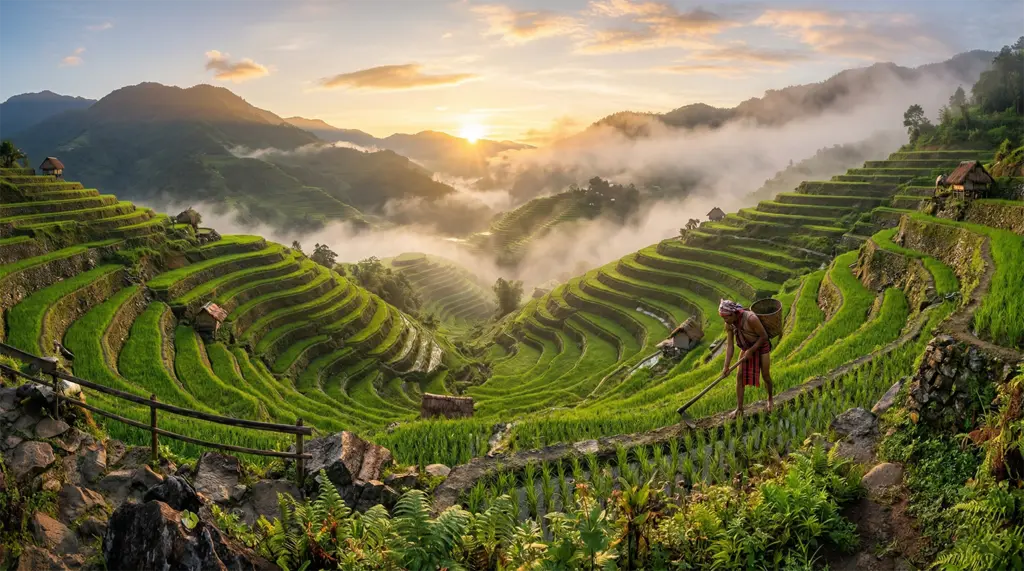
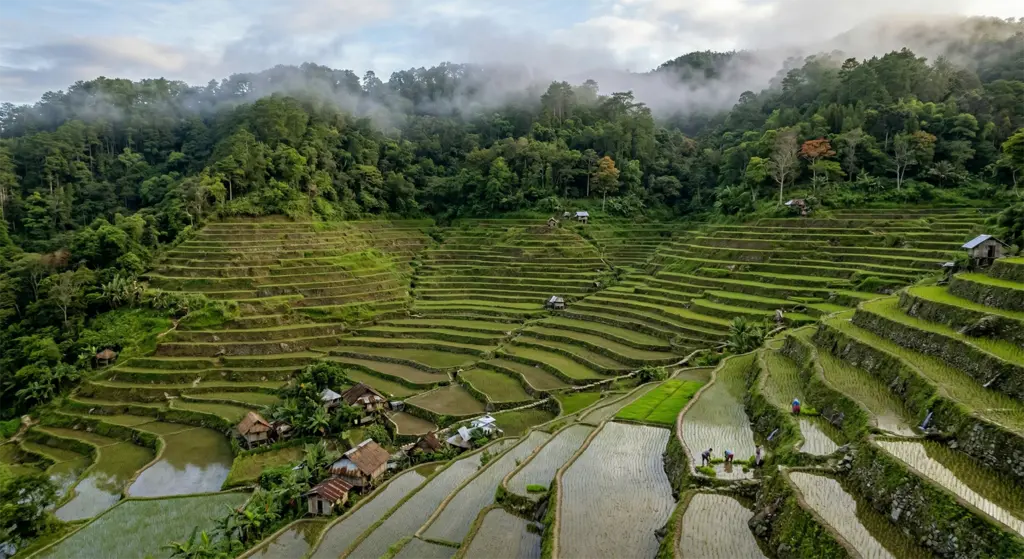
The terraces weren’t built by an empire. No colonial authority commissioned them. No central government funded them. The Ifugao people of the Cordillera built them one terrace at a time, across generations. No concrete or heavy machinery. No blueprint that anyone would recognize today. They built on slopes so steep that modern earthworks equipment would turn the job down. What they left behind has lasted 2,000 years.
The Ifugao Rice Terraces are a UNESCO World Heritage Site and one of the most photographed landscapes in the Philippines. Most visitors who see them think they are looking at a feat of ancient ambition. What they are looking at is more specific than that. It is a fully functional, continuously maintained agricultural system. It has been feeding people and managing a complex mountain watershed for two millennia. That distinction matters when you understand the threat the system is now under.
How the Ifugao Rice Terraces Were Built — and How They Still Work
The terraces cover an estimated 10,360 hectares across five clusters in Ifugao province, each recognized separately by UNESCO: Batad, Bangaan, Hungduan, Mayoyao, and Nagacadan. They sit at different altitudes and carry different microclimates. Each cluster has its own water management pattern and its own community of Ifugao farmers maintaining it. They are not a single monument. There are five distinct communities tied together by the same agricultural logic.
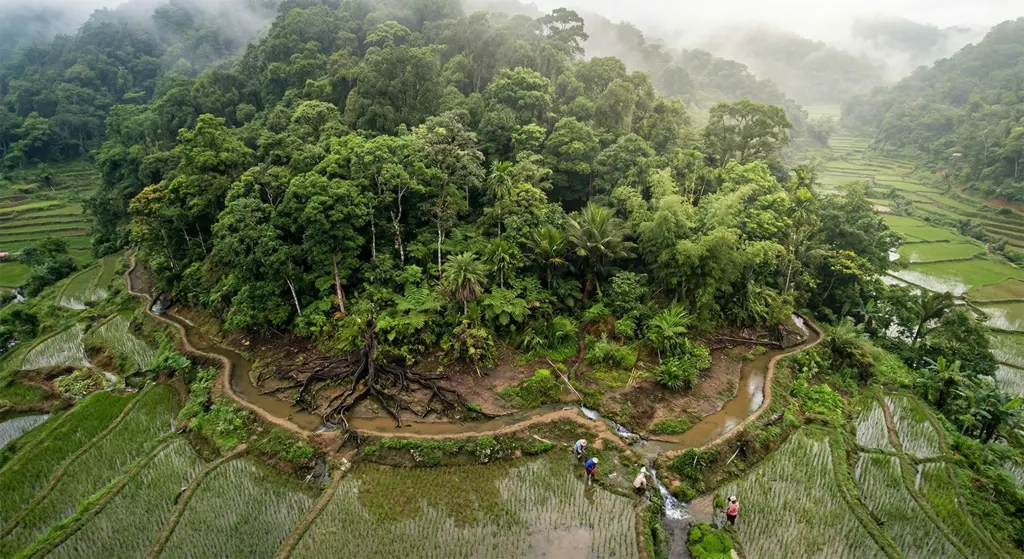
That logic is gravity. Water enters each cluster from the muyong, privately owned forest plots maintained by individual Ifugao families on the slopes above their paddies. The muyong absorbs rainfall and filters it through the forest floor. It releases that water slowly into channels that carry it from terrace to terrace, without pumps, pipes, or external infrastructure. The system regulates itself, provided the muyong stays intact.
This is the part of the Ifugao system that doesn’t appear in the photographs. The viewpoint at Banaue and the trekking trail at Batad show the terraces. They don’t show the privately tended forest above the paddies that makes the irrigation possible. The muyong is as essential to the terraced fields as the stonework below it. The Ifugao understood 2,000 years ago that a rice paddy and its water source are a single system. Sustainable agriculture researchers are still working to replicate that understanding at scale.
Rice, Ritual, and the Bulul — The Cultural System Behind the Landscape
For the Ifugao, rice is not a commodity. The entire social and spiritual calendar of Ifugao life is organized around its cultivation. The rice cycle covers preparation, planting, growing, and harvesting. Each phase is accompanied by rituals called baki, which invoke the ancestors and the forces believed to govern the land’s productivity. The agricultural and spiritual systems are the same system.
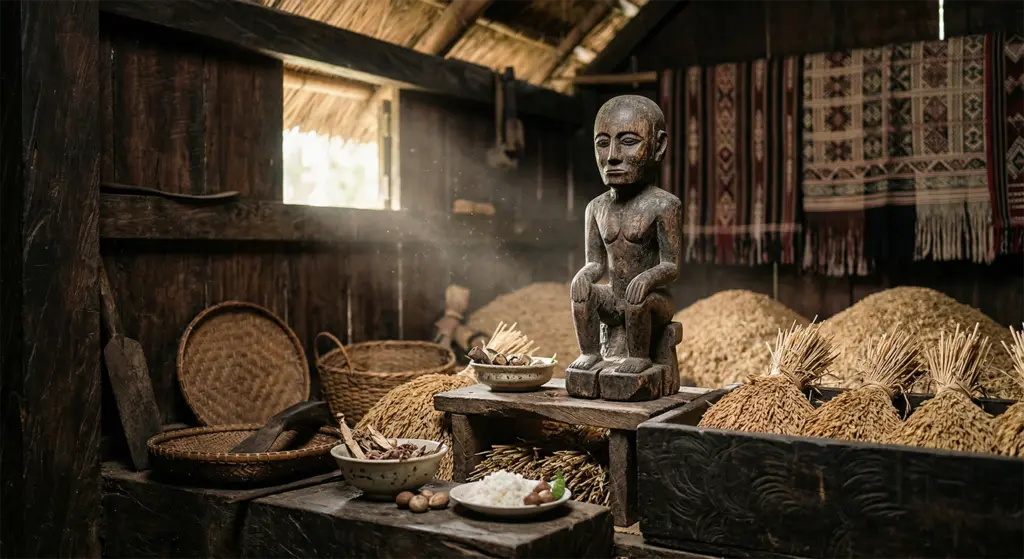
The bulul makes this visible. These are carved wooden figures, often depicting human forms, placed in the granary to guard the rice harvest. A bulul is not decorative. Families that maintain traditional practices treat it as a living presence requiring ritual attention. Selling one for the tourist market is considered a serious transgression against the family’s spiritual integrity. That matters for visitors: Ifugao wood carvings are available as genuine crafts in the market, but a bulul sitting in a family’s granary is not for sale and is not to be photographed without explicit permission.
The hudhud chants are another expression of the same relationship. UNESCO recognized them as part of the Intangible Cultural Heritage of Humanity. These are multi-hour oral epics performed during rice harvests and funerals, encoding the history, genealogy, and moral understanding of Ifugao communities. They are not performed because tourists are present. They are performed because the rice requires them. For more on the broader context of indigenous Philippine crafts and cultural systems, see the companion article on Filipino traditional crafts and textiles — the Ifugao weaving tradition and bulul carving are part of the same living inheritance.
The Threat the Photographs Don’t Show
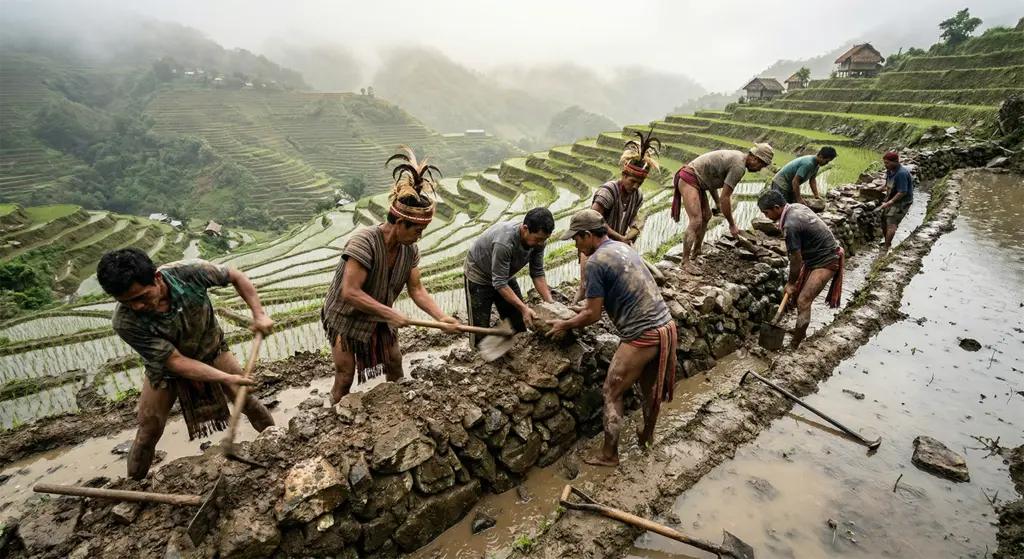
The Ifugao Rice Terraces were placed on UNESCO’s World Heritage in Danger list in 2001. The reasons were specific. Younger Ifugao were leaving for cities and lowland employment. Without enough people to maintain the bunds and channels, sections began to collapse. Deforestation of the Muyong forests was cutting off irrigation to the lower terraces. And the golden apple snail had established itself in the paddies, destroying rice seedlings before they could root. This invasive species was introduced to the Philippines in the 1980s as a potential food source.
UNESCO removed the terraces from the danger list in 2012, citing genuine conservation progress. Community organizations, government programs, and international partnerships worked on reforestation, terrace restoration, and invasive species management. That progress was real. But removal from the danger list did not mean the danger ended.
The structural challenge has not changed: the terraces require continuous, labor-intensive maintenance by people who live on the land. The highland farming population is aging. Conservation researchers have documented renewed terrace abandonment in some clusters since the mid-2010s. The muyong forests continue to face pressure to be cleared in certain areas. The golden apple snail remains active in sections where control programs have lapsed. The tourist photographs from the Banaue viewpoint show the maintained sections in the foreground. They rarely capture the abandoned sections at the edges. Both are real.
What Responsible Visitors Actually Do Here
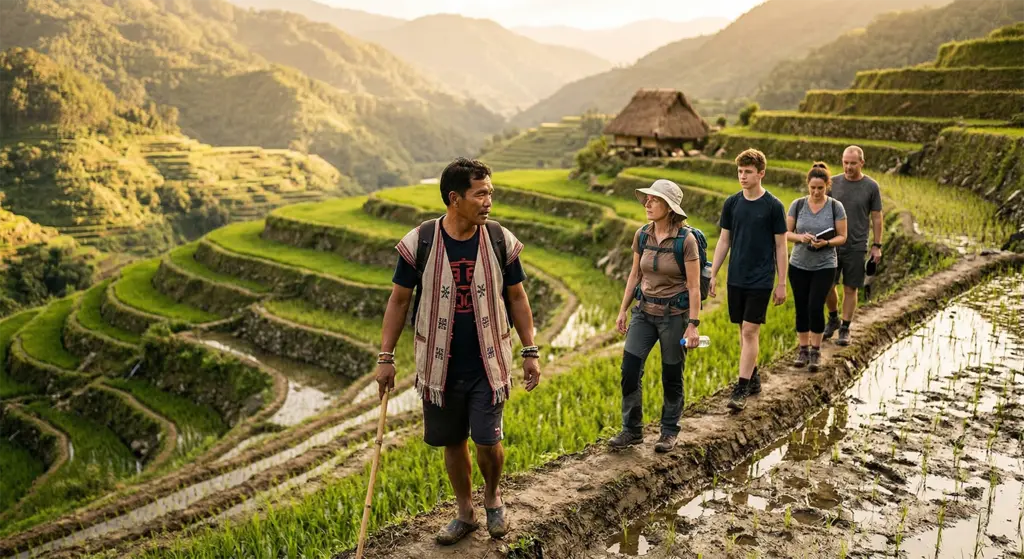
The terraces are working farmland, not a national park. The paddies visible from the viewpoints and accessible on trekking trails are actively farmed by Ifugao families who have maintained their sections across generations. Behavior that treats the terraces as scenery creates real costs. Walking bands without local guidance, approaching ritual activities with cameras, and flying drones during agricultural work all cause damage that farming families absorb without compensation.
The practical alternative is straightforward. Book through community-based tourism programs rather than outside operators who route groups through and leave. Hire a local guide from the cluster being visited. Batad has an established guide network accessible at the trailhead. For Hungduan, Mayoyao, and Nagacadan, the Ifugao provincial tourism office in Lagawe connects visitors with community-based guides. The guide fee is not large, and it stays in the community. Pay the terrace maintenance fee at the trailhead; it funds restoration work and is not optional.
Two seasons make the strongest case for visiting. Planting season in April and May fills the paddies with water. The harvest season in October and November turns the terraces gold, and it is when hudhud performances are most likely to occur. Both seasons also carry heavier rainfall, so come prepared for that. The Banaue-to-Manila overnight bus from Cubao takes 8 to 10 hours; book several days in advance during Holy Week and the harvest months. For the broader Luzon travel context, including how Banaue fits into a
longer northern Luzon itinerary, the Luzon Island travel guide has the regional planning details.
Why the Ifugao Rice Terraces Matter Beyond the Philippines
The Ifugao Rice Terraces are not a monument to ancient ingenuity. They are a functioning argument against the assumptions of modern industrial agriculture. Two thousand years of continuous rice cultivation on the same land, without chemical inputs, without external irrigation infrastructure, and without depleting the soil. Food security researchers and agricultural scientists study the system not as a curiosity but as a model for how productive agriculture can work across climate variability.
The resilience comes from integration. The muyong forest above, the terraces below, the heirloom rice varieties adapted to this microclimate over generations. The baki rituals and hudhud chants encode agricultural knowledge in cultural memory. The distributed muyong ownership structure places responsibility on individual families rather than centralized management. Remove any element, and the system degrades. That integration is what industrial agriculture has consistently failed to replicate.
High-yield monoculture produces more rice per hectare in the short term. It also depletes soil, depends on chemical inputs that accumulate year over year, and concentrates production risk. Entire regions are left exposed when conditions shift. The Ifugao optimized resilience. Modern agriculture is optimized for yield. A 2,000-year track record favors one of those choices. The Banaue Rice Terraces visitor guide covers the logistics of visiting the terraces. This article covers why the visit is worth more than a photograph.
The Visitors Challenge
The Ifugao farmers maintaining these terraces are not keepers of a museum piece. They are the authors of a system that agricultural scientists with advanced degrees are still trying to understand. They are doing it on land that doesn’t forgive mistakes, with a shrinking labor pool, and with the muyong forests under pressure from all sides. A visit to the terraces is a visit to a demonstration that is still running. The question for any visitor is whether they leave it stronger or weaker than they found it.
Frequently Asked Questions About the Ifugao Rice Terraces
Q1. Are the Ifugao Rice Terraces and the Banaue Rice Terraces the same thing?
Yes and no, and the distinction matters before you go. The Banaue Rice Terraces became the internationally recognized name largely because the viewpoint above Banaue town — accessible by road — is where most tourists take the photograph that appeared on the old 1,000-peso bill. Banaue refers to a municipality. Ifugao refers to the entire province, and the UNESCO World Heritage designation covers five separate terrace clusters spread across that province: Batad, Bangaan, Hungduan, Mayoyao, and Nagacadan.
Each cluster has a different character. Batad is the most visited because it is relatively accessible and has a dramatic amphitheater shape that photographs well. Bangaan is smaller and receives fewer visitors. Hungduan and Mayoyao require more effort to reach, and the reward is less tourist infrastructure and more of the traditional agricultural life that has functioned as it has for generations. Nagacadan, near Kiangan in the south of the province, is the cluster most visitors skip entirely.
If the only photograph you’ve seen is from the Banaue viewpoint, you’ve seen the tourist-facing surface of a much larger system. Hungduan and Mayoyao will show you more of how the terraces actually function as a living agricultural community. The trade-off is access: slower roads, fewer facilities, and less English signage. That is a fair description of what responsible travel in this region looks like, and most visitors who make the extra effort consider it the better choice.
Q2. When is the best time to visit the Ifugao Rice Terraces?
Two seasons produce the most dramatic landscape: planting season, which runs roughly from April through May, and harvest season, which runs from October through November. Planting season fills the paddies with water, creating the layered reflections that have made the terraces famous. Harvest season turns the paddies gold and is when hudhud chants and harvest rituals are most likely performed in farming communities. If watching the agricultural cycle matters to the visit, these are the windows.
The dry season from February through April is the better window for trekking the terrace bunds, the narrow earthen paths between paddies. Bund paths in wet conditions can be genuinely dangerous on terrain this steep. Afternoon thunderstorms during the rainy season are not uncommon and can make a bund crossing a more serious proposition than it appears in midday photographs on a good day.
Regardless of the season, Banaue town sits at an elevation of approximately 1,500 meters, and temperatures drop sharply after dark. Bring layers no matter what the lowland forecast looks like. The overnight bus from Manila’s Cubao terminal takes roughly eight to ten hours and is the standard way to make the trip. Book several days in advance during Holy Week and October and November, when both domestic and foreign visitor traffic peaks. From Banaue town, reaching Batad requires a 30-minute jeepney ride to the trailhead, followed by a 45-minute to one-hour walk depending on conditions. Build that into the schedule.
Q3. How do I visit the Ifugao Rice Terraces responsibly, and what should I avoid?
The most important thing to understand before arriving is that the terraces are working farmland. The paddies visible from the trekking trails are actively farmed by Ifugao families, some of whom have maintained the same sections across many generations. The terrace system requires constant maintenance: bund walls need monitoring and repair, irrigation channels need clearing after heavy rain, and the muyong forests above need active management. Visitor behavior that treats the paddies as scenery rather than productive farmland imposes real costs on the families bearing the traffic.
Things to avoid specifically: walking on bund paths without a local guide who has confirmed the route is appropriate; entering a paddy or crossing terrace sections without permission from the farming family; flying drones during any agricultural or ritual activity without coordinating first with community leaders; photographing bulul carvings or any religious artifacts inside a home or granary without asking permission; and bringing food or drink into active farming areas without invitation.
The practical alternative to all of these is hiring a local guide from the community being visited. A community guide from Batad, Hungduan, or whichever cluster is on the itinerary knows which sections of the terrace are open to visitors, which families are receptive to contact, and when ritual activities are underway that require different visitor behavior. The fee is modest and stays in the community. Pay the terrace maintenance fee at the trailhead. It is not a suggestion, and treating it as one is bad form regardless of what other visitors do.
Q4. What heirloom rice varieties grow in the Ifugao terraces, and can visitors buy them?
The two most well-known heirloom varieties grown in the Ifugao terraces are tinawon and unoy. Both are native varieties that have been adapted over many generations to the elevation, temperature, and water conditions of the Ifugao highlands. Neither is a high-yield commercial variety. The point of growing them is that they are suited to their specific environment and have been maintained through traditional Ifugao farming practice, the same seed saved and replanted across generations without commercial plant breeding.
Tinawon is the variety most likely to be available for purchase in Banaue town markets. It has a slightly sweet, nutty character that is distinct from commercial rice and cooks differently: it is starchier and absorbs water differently from what most people are accustomed to. Unoy is darker, nuttier in flavor, and less commonly available for sale because most of the harvest stays within the farming community. Both varieties can occasionally be found through specialty importers and heritage food cooperatives in the Philippines, particularly those focused on indigenous and heirloom agricultural products.
Expect to pay significantly more than for commercial rice. That price reflects the labor involved in growing a crop on 2,000-year-old terraces using traditional methods, saving seed by hand, and maintaining an irrigation system without modern infrastructure. For visitors who cannot return to the terraces themselves, buying the rice through a legitimate distributor is a direct way to support the Ifugao agricultural system at a distance. Verify that the vendor has a relationship with the farming community rather than simply repackaging commercially sourced rice under a heritage label.
Q5. Why are the terraces under threat if they have survived for 2,000 years?
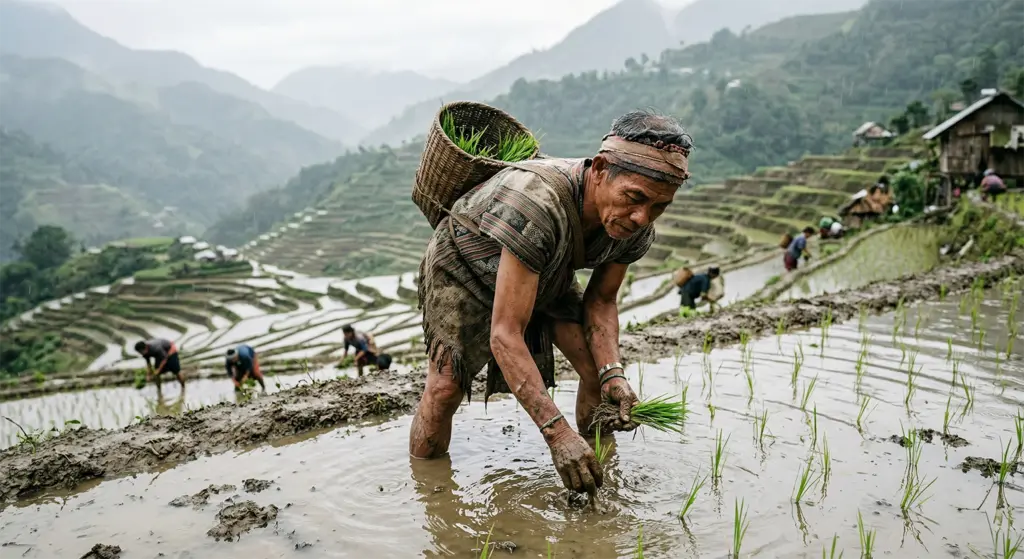
Because for most of those 2,000 years, the Ifugao highlands had a stable, land-connected population that provided the labor the terraces required. The system is not self-maintaining. Every section of the bund wall requires constant monitoring and repair. The muyong forest above the terraces needs active management. Irrigation channels need to be cleared after each significant rain. The heirloom rice varieties are planted, tended, harvested, and threshed by hand. None of this is mechanizable on terrain this steep, and all of it requires people who live on the land and know it well.
That labor requirement sustained the system for two millennia because generations of Ifugao families stayed on the land. The modern threat is economic migration. Young Ifugao have access to urban employment, education, and economic opportunities that do not require living at 1,500 meters and farming steep terraces by hand. The economics are rational: urban wages are higher, the work is less physically demanding, and the life options are broader. The result, documented in UNESCO conservation assessments and academic research, is a shrinking pool of active farmers who maintain a system that requires a critical mass of labor to remain intact.
The golden apple snail remains an active threat in clusters where control programs have lapsed. Climate variability, heavier and less predictable rainfall in particular, is stressing the irrigation system in ways the original design did not anticipate. Deforestation of the Muyong continues in some areas as cleared land is converted or timber is harvested. The Ifugao Rice Terraces survived 2,000 years of pre-modern adversity. The current threats are economic and demographic, and a UNESCO World Heritage designation does not address either.
Q6. What is the muyong, and why does it matter as much as the terraces themselves?
The muyong is a privately owned forest plot located on the slopes above a family’s rice terraces. In the Ifugao system, each family that owns terraces also owns and maintains a section of forested land upslope. The muyong absorbs rainfall and slowly releases it into the terrace irrigation system below through a network of gravity-fed channels. It is the source that feeds the entire paddy system, and it has done so for as long as the terraces have existed.
This is the component of the Ifugao agricultural system that is invisible to most visitors. From the viewpoint above Banaue or the trekking trail through Batad, what is visible is the engineered landscape: stone walls, flooded paddies, water moving between levels. What is not visible is the forested watershed above that makes it all possible. The muyong is essential infrastructure, not scenery.
It is also a part of the system under the most pressure from migration and land-use change. When an Ifugao family moves to the city and stops actively managing their muyong, that section of forest begins to degrade. Trees are sometimes cleared for agricultural conversion or timber. When the muyong degrades, the irrigation it feeds degrades as well, and the terraces below begin to fail due to reduced water supply. Conservation programs focused on the terraces increasingly recognize that protecting the muyong is as important as restoring the terrace walls themselves. One without the other does not work. The system is integrated, and any approach that treats the forest and the terraces as separate conservation problems will consistently miss the point.
Suggestions For Lodging and Travel
Lodging is widely available throughout the Philippines. However, you may want to consider getting assistance booking tours to some of the Philippines’ attractions. I’ve provided a few local agencies that we’ve found very good for setting up tours. For transparency, we may earn a commission when you click on certain links in this article, but this doesn’t influence our editorial standards. We only recommend services that we genuinely believe will enhance your travel experiences. This will not cost you anything, and I can continue to support this site through these links.
Local Lodging and Travel Assistance
Guide to the Philippines: This site specializes in tours across the Philippines, offering flexible scheduling and competitive pricing. I highly recommend them for booking local arrangements for a trip like this one. You can book flights and hotels through the Expedia link provided below.
Hotel Accommodations: I highly recommend The Manila Hotel for a stay in Manila. I stay here every time I travel to the Philippines. It is centrally located, and many attractions are easily accessible. Intramuros and Rizal Park are within walking distance. I have provided a search box below for you to find hotels (click “Stays” at the top) or flights (click “Flights” at the top). This tool will provide me with an affiliate commission (at no additional cost to you).
Kapwa Travel is a travel company focused on the Philippines. It specializes in customizing trips to meet customers’ needs.
Tourismo Filipino is a well-established company that has been operating for over 40 years. It specializes in tailoring tours to meet customers’ needs.
Tropical Experience Travel Services – Tours of the Philippines: This company offers a range of tour packages, allowing you to tailor your trip to your preferences.
Lastly, we recommend booking international travel flights through established organizations rather than a local travel agent in the Philippines. I recommend Expedia.com (see the box below), the site I use to book my international travel. I have provided a search box below for you to use to find flights (click “Flights” at the top) or Hotels (click “Stays” at the top). This tool will provide me with an affiliate commission (at no cost to you).