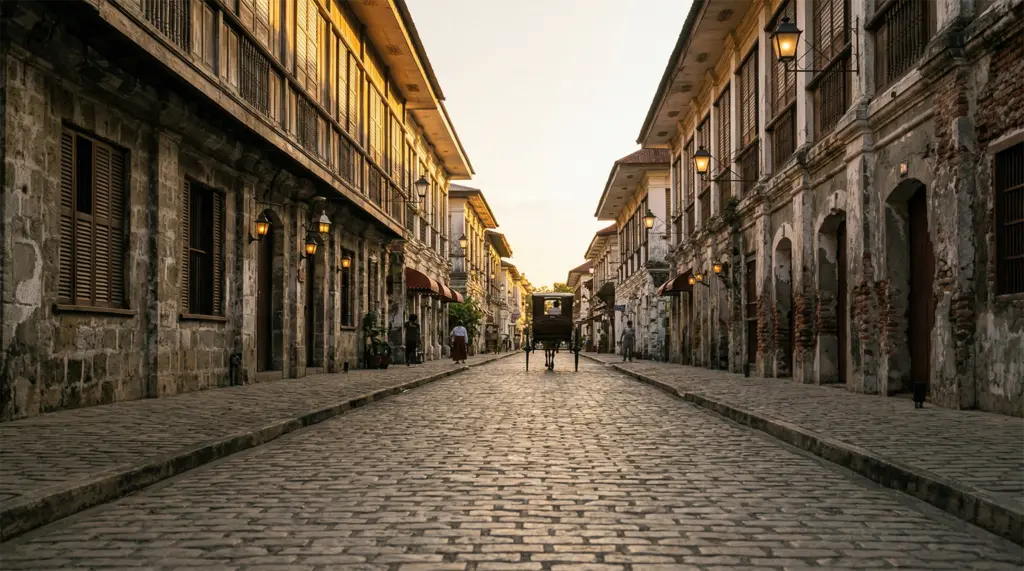
Vigan City survived the Second World War for a reason that is easy to overlook when you are standing on Calle Crisologo taking photographs. General Yamashita withdrew his forces from the city without fighting for it. His decision, whether strategic or otherwise, meant that no firebombing, no artillery, no urban combat carved through the colonial district. The result is a grid of 16th-century streets that remained standing when comparable towns across Asia were reduced to rubble.
That fact changes how the place feels. The city is not a reconstruction. It is not a heritage theme park built on the footprint of what used to be there. The ancestral houses on Calle Crisologo are original structures, the same ones that Augustinian missionaries and Chinese-Filipino merchant families commissioned four centuries ago. The cobblestones underfoot are the same ones that wagons crossed when the city was a major trading port on the galleon route.
UNESCO recognized the city as a World Heritage Site in 1999. The designation acknowledged what Yamashita’s retreat had preserved: one of the most complete surviving examples of a planned Spanish colonial town in Asia. The recognition also created pressure. Heritage tourism brings money and crowds, and both create incentives that do not always point toward preservation. The city manages this better than most. The center holds.
What Vigan City Actually Is
Vigan City is the capital of Ilocos Sur province in northwestern Luzon. It sits approximately 400 kilometers north of Manila, a distance that translates to eight to ten hours by bus depending on route and stops. The historic district, the reason most visitors come, is a grid of about eight blocks centered on Calle Crisologo and Plaza Salcedo. The rest of the city is a functioning provincial capital with markets, government buildings, and a population not there for heritage tourism.
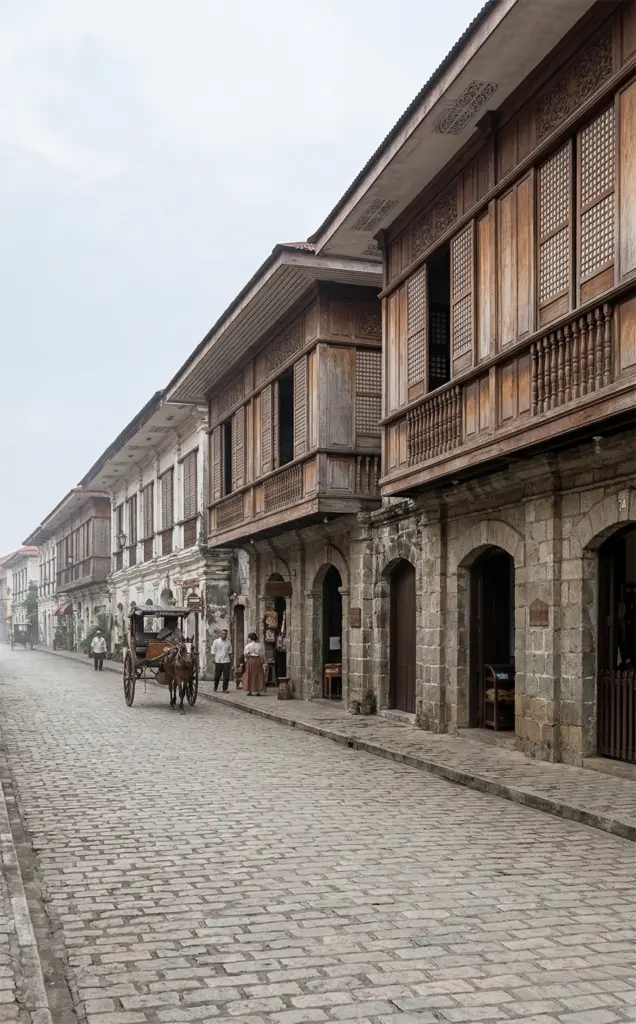
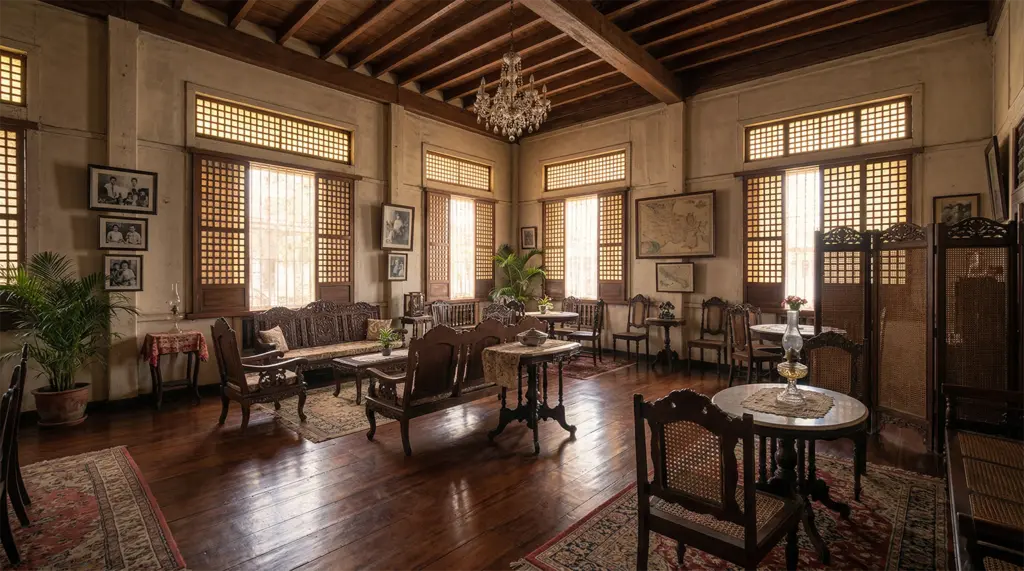
The architecture of the historic district reflects three converging influences. The Spanish colonial administration provided the grid plan, the baroque churches, and the civic architecture. The Chinese merchants who settled in the district brought the courtyard-centered house plan and the interior wooden joinery that Filipino craftsmen then adapted. The result is a building type found nowhere else: the Vigan ancestral house, with a stone ground floor built to withstand typhoons and fire, a wooden upper story designed for the tropics, and a central courtyard that serves as the house’s organizing principle. The style is called mestizo, which in the Philippine context refers not to mixed-race ancestry but to the mixed architectural vocabulary.
The galleon trade made the city wealthy. Manila-Acapulco galleons stopped in Ilocos on the return leg, and the port trade that ran through Vigan in the 16th through 18th centuries financed the ancestral houses still standing. The wealth stopped when the galleon trade ended. The city did not grow fast enough afterward to demolish and replace its colonial stock. That economic stagnation, which would have seemed like a misfortune at the time, turned out to be a form of preservation.
Calle Crisologo — The Street Worth Your Full Morning
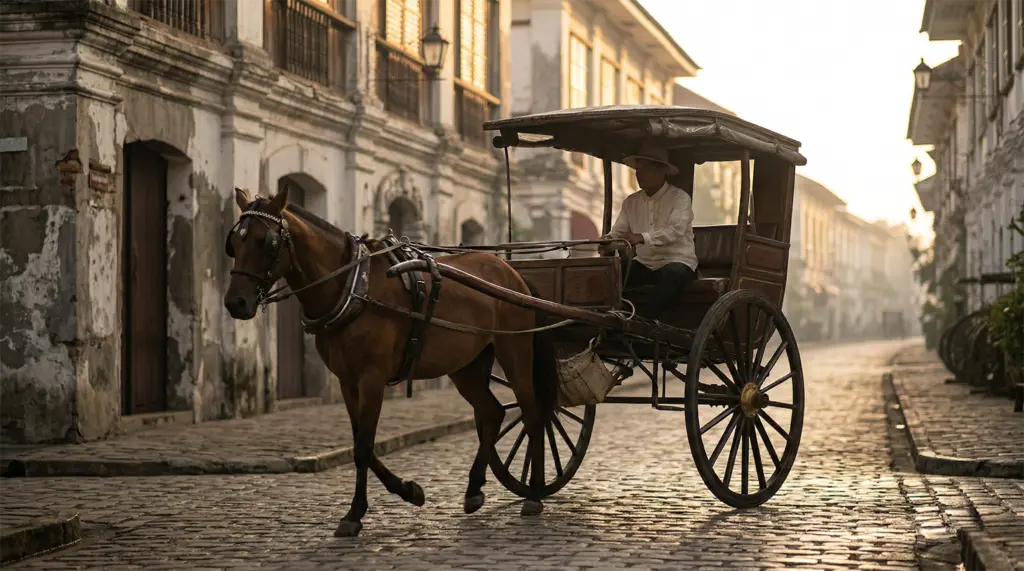
Calle Crisologo is the central street of the heritage district and the one that delivers the most consistent visual impact. The street is closed to motorized vehicles for most of the day, which means the only traffic consists of pedestrians and kalesas, the horse-drawn two-wheeled carriages that have operated here since the Spanish period. The combination of cobblestones, kalesas, and the unbroken row of ancestral house facades on both sides produces the image most people associate with Vigan.
The best time to walk Calle Crisologo is early morning, before 8 am. The light is directional and soft. The tour groups have not yet arrived from their hotels. The souvenir shops are still shuttered, and the street is quiet enough that you can hear the kalesa horses on the cobblestones without competition from recorded music and vendor calls. By 10 am, the streets have filled. It is still worth seeing at that hour, but the quiet is gone.
The ancestral houses along Calle Crisologo are not a uniform block. They vary in scale, in the degree of their preservation, and in what occupies them now. Some are family residences, still privately owned and inhabited. Some have been converted to boutique hotels, antique shops, or cafes. A few are visibly deteriorating, their wooden upper stories showing the strain of age and the difficulty of maintaining structures built for a different economy. The variation is honest. Not all heritage survives equally.
The Kalesa Ride
A kalesa ride along Calle Crisologo is one of those experiences that lands differently depending on what you bring to it. As a tourist attraction, it is straightforward: you hire a kalesa and driver, move through the heritage district at a horse’s pace, and see the streets from a different angle. As a piece of the city’s living culture, it is more interesting. The kalesa drivers have worked this street for decades. Some know the families behind the closed shutters of the ancestral houses. Ask your driver about the street. The answer will be more useful than the standard tour commentary.
The Ancestral Houses Open to Visitors — Syquia Mansion and Crisologo Museum
Two of the ancestral houses on the perimeter of the heritage district are open as museums. Neither is extensive by international museum standards. Both are worth entering for the access they provide to the interior of structures that are otherwise closed to the public.
The Syquia Mansion Museum is one block from Calle Crisologo. The house was the home of the Syquia family and is associated with President Elpidio Quirino, who married into it. Quirino was the sixth president of the Philippines and served from 1948 to 1953. The mansion contains period furniture, family photographs, and personal effects that date from the late 19th and early 20th centuries. The house itself is the main exhibit: the floor plan, the wood-paneled sala, the interior courtyard, and the capiz shell windows are a better lesson in what domestic architecture in Vigan actually looked like than any of the signage. Allow 30 to 45 minutes.
The Crisologo Museum is the former residence of Floro Crisologo, a powerful Ilocos Sur congressman who was assassinated inside the Vigan Cathedral in 1970. The museum contains his personal memorabilia, political documents, and the family’s antique collection. The house is a good example of a Vigan ancestral house in its full interior scale. The museum’s interest lies partly in the collection and partly in the unresolved quality of what it commemorates: Crisologo was a polarizing figure, and the museum presents him without that ambiguity. Worth entering regardless.
St. Paul’s Metropolitan Cathedral
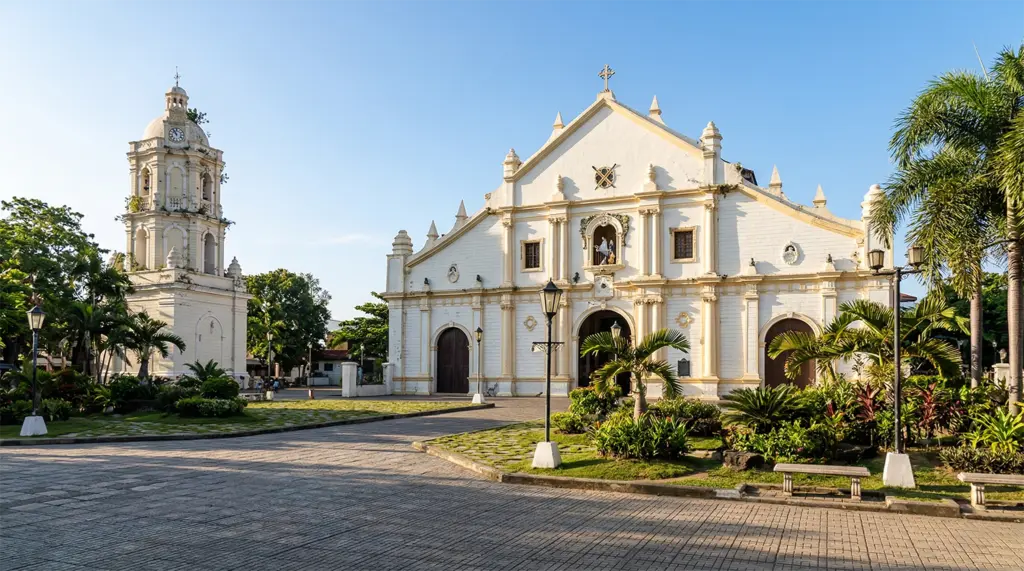
St. Paul’s Metropolitan Cathedral faces Plaza Salcedo at the center of the heritage district. The current structure dates primarily from the 17th century, though successive reconstructions after earthquakes mean the building is a composite of several periods. The facade is baroque, the bell tower is earthquake-era thick-walled construction, and the overall effect is of a building that has been repaired and adapted rather than built in a single campaign. The cathedral is an active parish church. Masses are held daily. Visitors are welcome outside of service times.
The interior is large and relatively plain by baroque standards, the nave painted in cream and gold, the side chapels containing the devotional images that Filipino Catholic practice centers on. The building earns attention from the outside as much as the inside: the facade as seen from Plaza Salcedo, with the bell tower to the left and the plaza’s colonial paving in the foreground, is the classic composition here.
What to Eat in Vigan City
Ilocano cuisine is the most distinctive regional culinary tradition in the northern Philippines. Vigan is its most accessible entry point. The two things to eat before anything else are Vigan longganisa and Vigan empanada. Neither is optional.
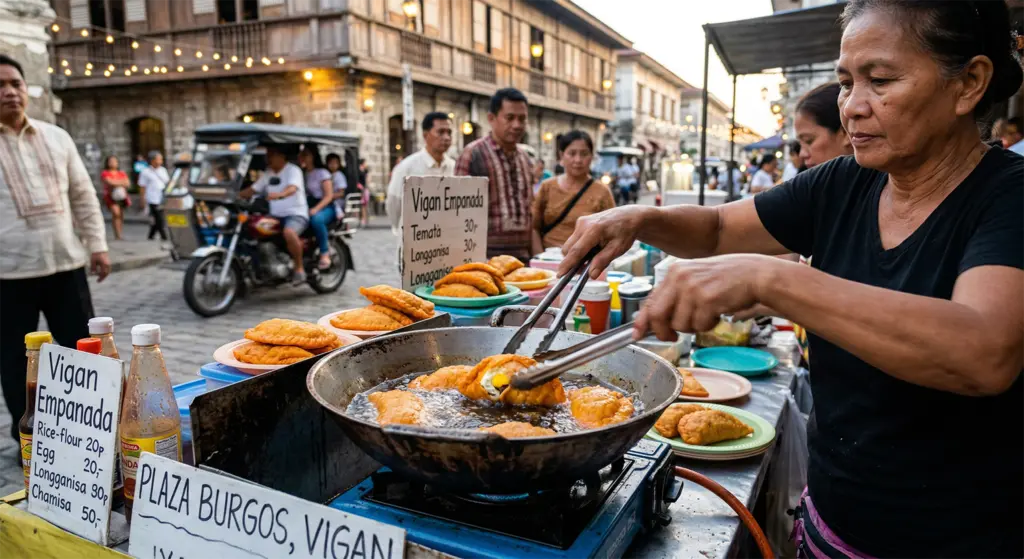
The longganisa here is garlicky, fatty, and slightly acidic: different from longganisa made elsewhere in the Philippines. The garlic content is aggressive. The skin crisps when fried. The interior stays loose and slightly greasy, the way sausage should be when it is made from good pork and not engineered for shelf life. It is best eaten for breakfast with garlic fried rice and a fried egg, which is the standard Ilocano morning meal and one of the better breakfasts in the Philippines.
The Vigan empanada is also distinct from empanadas made in Manila or the Visayas. The shell is made from rice flour, which makes it crispier and more fragile than wheat-based versions. The filling contains Vigan longganisa, bean sprouts, and a whole egg, cracked during assembly. The result is denser and more structurally interesting than it sounds. The empanada stalls near Plaza Burgos are the standard reference point, active from late afternoon through the evening.
Other Street Food
Bagnet is the Ilocano version of crispy pork: deep-fried twice until the skin shatters and the meat inside stays tender. It appears as a main dish and as an ingredient in other preparations. Dinengdeng is an Ilocano vegetable stew, light and slightly bitter from fermented fish sauce, which replaces the salt-heavy condiments used elsewhere in Luzon. Both are worth ordering in the local restaurants around the heritage district. Avoid the tourist-facing restaurants on Calle Crisologo’s main strip for these dishes; walk one block back, and the food quality improves, and the prices drop.
Pagburnayan Pottery and What Else Vigan City Has
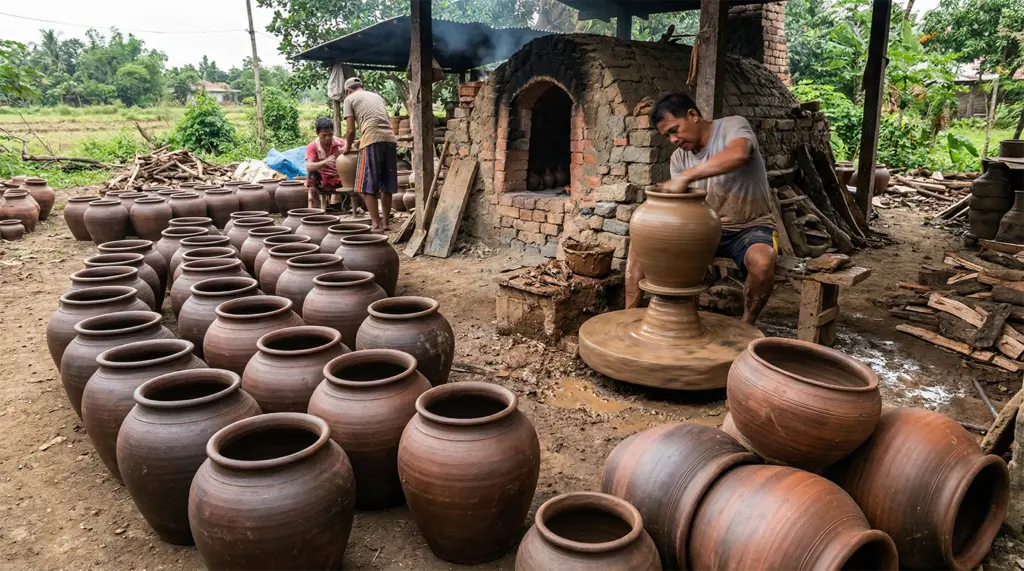
Pagburnayan is a barangay on the edge of the historic district where traditional burnay pottery has been made continuously for centuries. Burnay is the local term for the hand-thrown, wood-fired earthenware produced here. The pots are utilitarian in origin: large water jars, cooking vessels, storage containers. The burnay clay and the local firing method produce a distinctive dark surface that does not come from glaze but from the reduction process in the wood-fired kilns.
A Visit to the Workshop
Mang Ruben, one of the potters working at the Pagburnayan workshop, let me watch the wheel work for half an hour and explained the difference between burnay and the machine-made pottery sold in tourist shops in the heritage district. The distinction matters commercially and aesthetically. Burnay pots are sold at the workshop at prices that reflect the actual cost of production. The imitations in the souvenir shops are cheaper and correct for what they are. If you want the real thing, go to Pagburnayan and buy from the source.
Plaza Salcedo is the main civic square. The dancing fountain show runs in the evenings, synchronized to music, and draws a nightly crowd of local families and visitors. It is a genuine civic event rather than a tourist performance: the audience is predominantly Viganos rather than foreigners, which tells you something about the show’s actual quality. The fountain is at its best on weekends when the programming is extended. Baluarte is a private property on the southern edge of the city that operates as a mini-zoo and is sometimes included in Ilocos Sur itineraries. It is privately owned and contains unfamiliar animals, including large cats. The ethical questions surrounding private zoos with tiger enclosures are not resolved by their popularity or free admission. Including or excluding it from a Vigan visit is a personal decision. It is not a heritage attraction.
Getting to Vigan City from Manila
The overnight bus from Manila is the standard route and the right one. Victory Liner, Partas, and Florida Bus Line all operate services from the Pasay and Cubao terminals in Manila. The journey takes eight to ten hours, depending on the route and traffic in Metro Manila. Book the overnight bus. You arrive in the early morning when Calle Crisologo is quiet, the light is right, and the kalesa drivers are available without competition.
Day buses operate along the same route during daylight hours. They arrive mid-afternoon, which gives you the street at its most crowded and least photogenic. The overnight bus is not comfortable. The road through Ilocos is well-paved, and the distance is manageable. It is correct.
Flying to Laoag in Ilocos Norte and taking a van or bus south is an alternative. The drive from Laoag to Vigan is approximately two hours along the coastal highway. This option makes sense if you are combining a Vigan trip with a visit to Ilocos Norte, which has its own attractions, including the Paoay Church (another UNESCO World Heritage Site), the Bangui windmills along the coast, and the Ilocos Norte wine region.
Within the city, the heritage district is compact enough to walk. A kalesa covers the main circuit in 30 to 45 minutes. Tricycles are available for trips to Pagburnayan and other points outside the walkable center.
Step Back In Time Framing
The ‘step back in time’ framing does the city a small injustice. It implies that the city is frozen, preserved in amber, valuable as a museum piece. It is a functioning municipality. The ancestral houses on Calle Crisologo are home to families. The burnay pottery at Pagburnayan is still made for practical use, not just for tourists. The cathedral holds daily masses for Viganos who are not thinking about heritage tourism while they pray.
What the city preserved is not just a set of buildings. It preserved a way of organizing a city, a set of craft traditions, a food culture, and a civic rhythm that is continuous with the city’s past rather than reconstructed from it. That is rarer than a monument. It is also more demanding of the visitor. A monument asks you to look at it. The city asks you to pay attention to what is still alive.
Frequently Asked Questions
Q1: How do you get to Vigan City from Manila?
The overnight bus is the standard and recommended route. Victory Liner, Partas, and Florida Bus Line all run services from the Pasay and Cubao terminals in Manila. Journey time is eight to ten hours. Book the overnight departure: you arrive early in the morning, when it’s best to be on Calle Crisologo before the tour groups arrive. The road through Ilocos is well-maintained, and the overnight bus is manageable with a neck pillow and the expectation that you are traveling rather than sleeping comfortably.
Flying to Laoag in Ilocos Norte and traveling south by van is a viable alternative, particularly if you are combining a visit to Vigan with an Ilocos Norte itinerary. The Laoag-to-Vigan road runs along the Ilocos coast and is one of the better drives in northern Luzon. From Laoag, the drive south is approximately two hours. Book through a Laoag travel desk or arrange a shuttle through your Vigan accommodation.
Q2: Is Vigan City a UNESCO World Heritage Site?
Yes. The city was inscribed as a UNESCO World Heritage Site in 1999 under the name ‘Historic Town of Vigan.’ The designation recognized it as one of the few surviving examples of a planned Spanish colonial town in Asia, with its original grid plan, ancestral house architecture, and urban fabric largely intact. The survival was not accidental. The city was spared significant destruction during the Second World War, allowing the colonial-era structures to remain standing while comparable towns across the region were rebuilt or lost.
The UNESCO designation brings both benefits and pressures. Heritage tourism has increased since 1999, and the resulting income has helped fund some restoration work. It has also increased development pressure at the edges of the protected zone. Its management of this tension is generally considered successful by preservation standards, though concerns about the condition of some of the ancestral houses and the creep of non-heritage development remain topics of active discussion among conservation professionals.
Q3: What is Calle Crisologo, and why is it significant?
Calle Crisologo is the main street of Vigan City’s historic district and the most intact surviving example of a Spanish colonial street in the Philippines. It is closed to motorized vehicles during the day, leaving the cobblestone surface clear for pedestrians and the kalesas that have operated here since the colonial period. The ancestral houses on both sides of the street are original structures built primarily in the 18th and 19th centuries in the mestizo architectural style: stone ground floors, wooden upper stories, capiz shell windows, and interior courtyards.
The street’s significance is not just visual. It represents a continuous chain of ownership and habitation going back several centuries. Some of the houses are still occupied by the families who built them. Others have been converted to hotels, shops, or museums. The combination of continuous habitation and heritage designation is what makes Calle Crisologo unusual: it is a street that is both protected and alive, not a replica or a restoration.
Q4: What food should you eat in Vigan City?
Three things before anything else. Vigan longganisa is the city’s most famous food: a garlicky, fatty pork sausage with an aggressively seasoned interior and a skin that crisps when fried. It is best eaten at breakfast with garlic fried rice and a fried egg. The combination is among the best breakfasts in the Philippines, and you will find it at any local restaurant in the heritage district. Vigan empanada uses a rice-flour shell rather than a wheat pastry, making it crispier and more fragile than versions made elsewhere. The filling includes the local longganisa and a whole egg. The stalls near Plaza Burgos are the standard, operating from late afternoon onward.
Bagnet is the Ilocano version of crispy pork belly: deep-fried twice, shatteringly crisp on the outside, tender inside. Dinengdeng is a light Ilocano vegetable stew seasoned with fermented fish sauce rather than salt; it is mild, slightly bitter, and pairs well with rice and fried fish. For all of these dishes, step one block back from the tourist-facing restaurants on the main heritage strip. The food quality is the same or better, and the prices reflect that you are eating at a local restaurant rather than a heritage-district premium one.
Q5: How long should you stay in Vigan City?
Two nights is the right duration for a complete visit. One full day covers Calle Crisologo in the morning, the Syquia Mansion and Crisologo Museum in the mid-morning, lunch at a local restaurant, the cathedral and Plaza Salcedo in the afternoon, and the empanada stalls and dancing fountain in the evening. The second day allows for a morning at Pagburnayan to see the burnay pottery, a longer walk through the less-visited streets of the heritage district, and a more relaxed final afternoon before the overnight bus back to Manila.
A single overnight gives you the morning on day one, but forces you to leave before you have absorbed the pace of the place. The city is not a destination that requires rushing. The streets change throughout the day, and the quality of light varies by hour. Arriving on the overnight bus, spending two full days, and leaving on the overnight return gives you a balanced visit without the logistics of an extended Ilocos itinerary.
Q6: What else is worth seeing near Vigan City in Ilocos Sur?
Bantay Church and its detached bell tower are 10 minutes north of the city center by tricycle. The bell tower was used as a watchtower during the colonial period and sits on a hill with views over the surrounding plain. The church itself dates from the 16th century and is a different architectural proposition from St. Paul’s Cathedral: older, more fortified in character, with thicker walls and smaller windows. The bell tower is the visual highlight and is accessible to climb.
Santa Maria Church in the municipality of Santa Maria, about 30 kilometers south, is a UNESCO World Heritage Site in its own right. It is one of four Baroque Churches of the Philippines, inscribed by UNESCO in 1993. The church sits on a hilltop above the town and is reached by a long staircase. The structure is in excellent condition and more architecturally complex than the Vigan Cathedral. If you have a full spare day and access to transport, Santa Maria is a significant addition to the Ilocos Sur visit.
Other Related Articles that may be of Interest
You may also find the following articles interesting.
- The History and Modern Relevance of the Ifugao Rice Terraces
- Luzon Region macro page
Suggestions For Lodging and Travel
Lodging is widely available throughout the Philippines. However, you may want to consider getting assistance booking tours to some of the Philippines’ attractions. I’ve provided a few local agencies that we’ve found very good for setting up tours. For transparency, we may earn a commission when you click on certain links in this article, but this doesn’t influence our editorial standards. We only recommend services that we genuinely believe will enhance your travel experiences. This will not cost you anything, and I can continue to support this site through these links.
Local Lodging Assistance
Guide to the Philippines: This site specializes in tours across the Philippines, offering flexible scheduling and competitive pricing. I highly recommend them for booking local arrangements for a trip like this one. You can book flights and hotels through the Expedia link provided below.
Hotel Accommodations: I highly recommend The Manila Hotel for a stay in Manila. I stay here every time I travel to the Philippines. It is centrally located, and many attractions are easily accessible. Intramuros and Rizal Park are within walking distance. I have provided a search box below for you to find hotels (click “Stays” at the top) or flights (click “Flights” at the top). This tool will provide me with an affiliate commission (at no additional cost to you).
Kapwa Travel is a travel company focused on the Philippines. It specializes in customizing trips to meet customers’ needs.
Tourismo Filipino is a well-established company that has been operating for over 40 years. It specializes in tailoring tours to meet customers’ needs.
Tropical Experience Travel Services – Tours of the Philippines: This company offers a range of tour packages, allowing you to tailor your trip to your preferences. Lastly, we recommend booking international travel flights through established organizations rather than a local travel agent in the Philippines. I recommend Expedia.com (see the box below), the site I use to book my international travel. I have provided a search box below for you to use to find flights (click “Flights” at the top) or Hotels (click “Stays” at the top). This tool will provide me with an affiliate commission (at no cost to you).