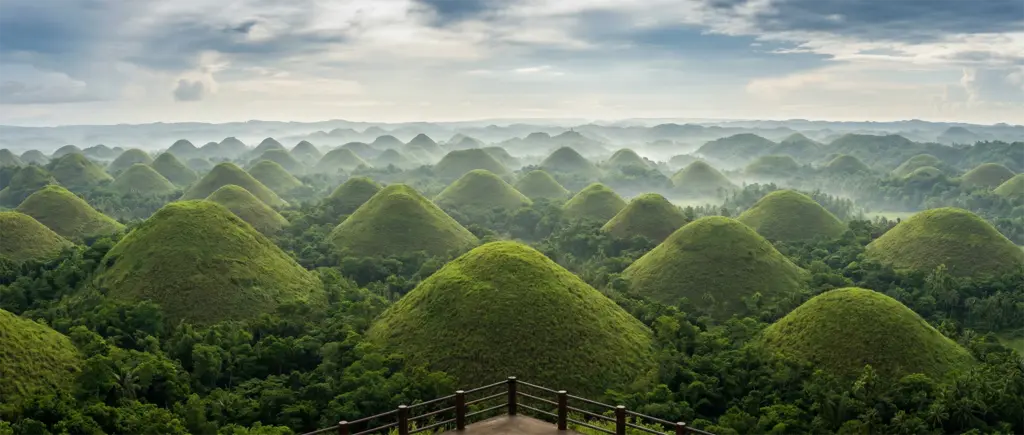
The first thing the Chocolate Hills Bohol delivers is a problem of scale. You stand at the top of Viewpoint One in Carmen, and the hills extend in every direction to the horizon. More than a thousand of them. All are roughly conical and the same height. All are wearing the same brown coat of dead grass in the dry season.
The problem is that they look designed. That is the unsettling part. A single dramatic hill is geology. A thousand identical ones arranged across fifty square kilometers of Bohol’s interior, all turning brown at the same time, looks like someone planned it. Nobody did. The explanation is limestone and about two million years of rain.
That tension between what the hills look like and what actually made them is the thing worth understanding before you drive up to Carmen. The geology is not complicated once it’s explained. The legend is better storytelling. Both versions are true to what the Chocolate Hills of Bohol are: a landscape that resists easy explanation.
What the Chocolate Hills of Bohol Actually Are
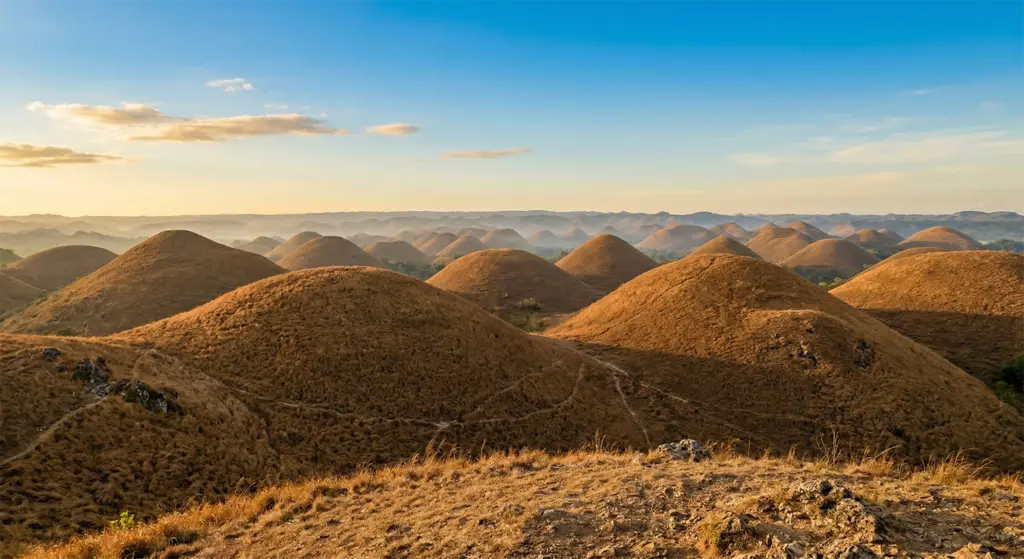
The Chocolate Hills are a geological formation of between 1,268 and 1,776 conical limestone hills scattered across roughly 50 square kilometers in the municipalities of Carmen, Sagbayan, and Batuan in Bohol province. The range in the count is not imprecision. Different surveys have applied different criteria for what qualifies as a discrete mound versus a connected ridge section. The figure of 1,268 appears in most Philippine tourism documentation. The National Commission for Culture and the Arts uses 1,776. The number you cite matters less than the experience of standing at the viewpoint and trying to count them yourself, which is impossible.
The Science Behind the Hills
The geology begins with the ocean. The Bohol interior was once a shallow seabed. The limestone making up the hills is composed of compressed coral and marine shells. Over millions of years, tectonic movement pushed the seabed above the waterline. Rainwater, made acidic by absorbing atmospheric carbon dioxide, dissolved into the exposed limestone from above in a process called karst formation. The result should have been the jagged, irregular terrain typical of most karst landscapes. In Bohol, the result was cones. The regularity is what makes the formation scientifically unusual and visually striking.
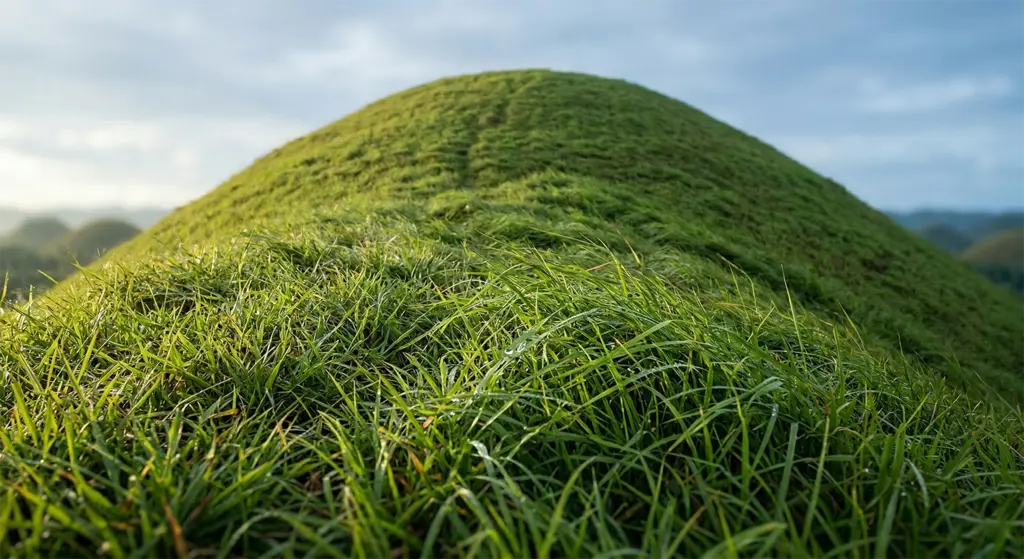
The cogon grass covering the hills dies in the dry season, turning brown. The dry season in Bohol runs from November through May. This is when the hills match their photographs: a thousand brown domes that make the name make sense. From June through October, the hills are green. Both versions are worth seeing. They look entirely different. Visitors who arrive in the rainy season expecting the calendar version of the Chocolate Hills, Bohol, will find a different landscape. Neither is worse. One is named.
The Arogo legend is the more entertaining explanation. Arogo was a giant who fell in love with a mortal woman named Aloya. When she died, Arogo wept for so long and with such force that his tears fell and hardened into the hills now covering Bohol’s interior. It is a better story than the karst formation. It is not a better explanation. A good guide will tell you both and let you choose.
The Carmen Viewpoints — and What You See from Each One
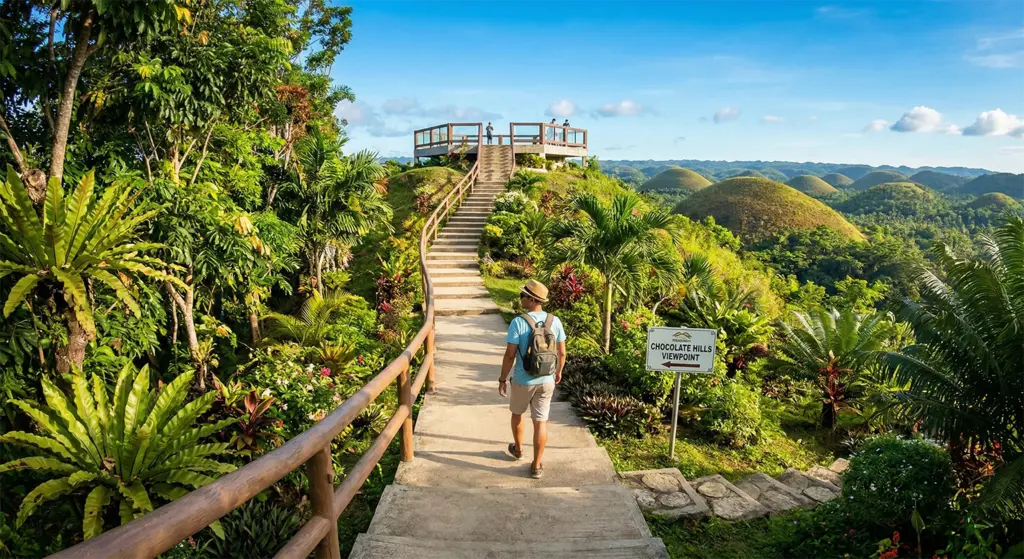
The main access point is Carmen, approximately 55 kilometers north of Tagbilaran. The viewpoint complex has two platforms. Viewpoint One is the primary one, the one in the photographs, the one the tour buses use. It requires climbing 214 concrete steps from the base to the observation deck. The climb takes about ten minutes at a moderate pace. It is not strenuous. It feels longer on the way down when your knees remind you of the angle.
Lito, a local guide hired through the Carmen tourism desk, walked up with me on a morning when the hills were still carrying the last of the dry season’s brown. He had the particular ease of someone who has seen the same reaction five thousand times. At the top, he pointed out the ridge on the far horizon where the hills disappear into haze. They do not actually end at any visible distance. The platform at Viewpoint One is large enough to spread out. The view in all four directions is unobstructed. This is the platform that delivers the panorama.
Viewpoint Two is smaller and set at a different angle from the main cluster. It receives fewer visitors and offers a different perspective on the formation. The late-afternoon light falls differently on this orientation, which makes it useful for photography. If your visit is purely for the experience rather than varied shots, Viewpoint One is sufficient. If you have a camera and twenty minutes to spare, Viewpoint Two earns both.
Crowds and Timing at the Viewpoint
Tour buses from Tagbilaran tend to reach Carmen between 10 am and 11 am. Arriving at 8 am puts you ahead of that wave. The morning light is better at that hour. The air in Bohol’s interior is cooler before 9 am. The platform at Viewpoint One is large enough that crowds are manageable rather than impossible, but the photographs improve considerably without forty other visitors in the frame. Early arrival is the simplest upgrade available. Note also that there is an entrance fee of about PHP 150 ($2.50 – $3.00) for adults, and about PHP 75 ($1.50) for children 6-12 years old, so plan accordingly.
When to Go — The Season That Makes Them Look Like Chocolate
The name ‘Chocolate Hills’ refers specifically to the dry season color. The cogon grass covering the slopes dies as rainfall decreases through November, and by January and February, the hills are at their brownest. The transformation is not sudden. It builds across weeks as the season takes hold. Late October and early November are transitional: some hills are greening up from the previous rains; others are beginning to turn. March and April are the most reliably brown.
The rainy season version is a different place. From June through October, the hills are intensely green, the grass thick and healthy, the slopes lush. This is the more dramatic of the two agricultural landscapes, but it does not explain the name. Photographs taken in the rainy season look like any tropical hill country. The dry-season photographs look like the Chocolate Hills in Bohol.
A practical note: Bohol’s rainy season often brings typhoon-track weather between June and September. Roads remain open in most conditions, but the viewpoint experience is limited in heavy rain. If timing is flexible, January through March offers the brown hills, cooler temperatures, and a lower likelihood of rainfall. December is the peak domestic tourism season, bringing crowds. April is hot but quiet.
Getting to the Chocolate Hills, Bohol, from Tagbilaran
Tagbilaran is the practical entry point for Bohol. You reach it either by fast ferry from Cebu City (approximately two hours) or by flying into Bohol-Panglao International Airport. The ferry from Cebu is the most common route for travelers already in the Visayas. From Tagbilaran, Carmen is roughly 55 kilometers north by road, taking 90 minutes to two hours depending on traffic and road conditions.
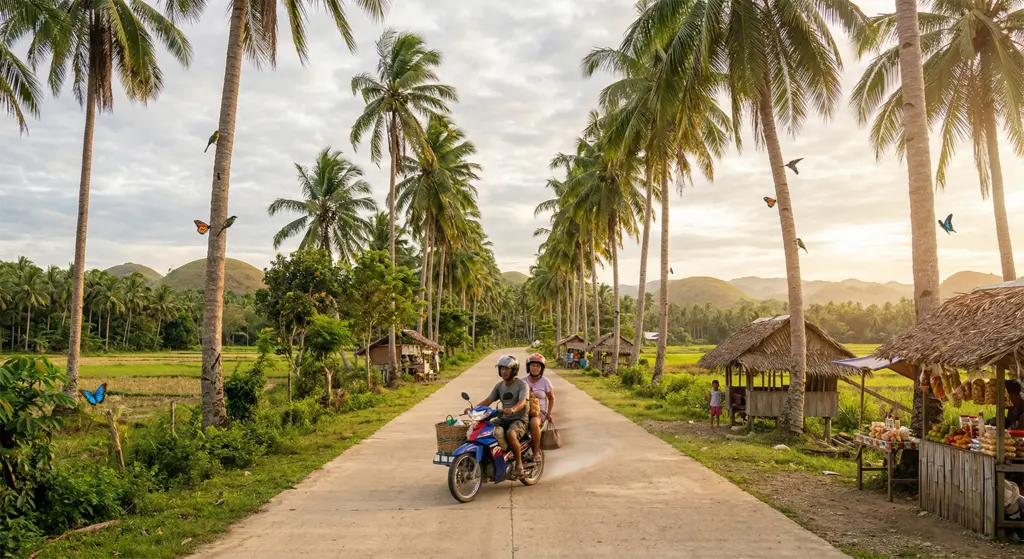
A rented van with a driver, arranged through any Tagbilaran guesthouse or hotel, is the most efficient option. A full-day van covers the Chocolate Hills, the tarsier sanctuary in Corella, and the Loboc River cruise comfortably in one circuit without rushing. The cost varies; ask your accommodation to arrange it and confirm the rate covers all three stops. Scooter rental is practical and popular among independent travelers. The road to Carmen is paved and well-marked. Bohol’s interior is one of the better scooter routes in the Visayas on a dry day, with coconut palms and river crossings along the way.
Habal-habal motorcycle taxis are available at the Tagbilaran terminal and cover the Carmen route. Negotiate the fare before departing. There is no direct public transport from Tagbilaran to the viewpoint complex, making the trip impractical for a day visit. Jeepneys connect the municipalities, but not on a schedule that suits day-trip timing.
Loboc River, Tarsiers, and What Else Bohol Offers
The hills are not an isolated stop. The interior and the coastline of Bohol offer enough variety that two or three days give you a different island than a single-day visit does.
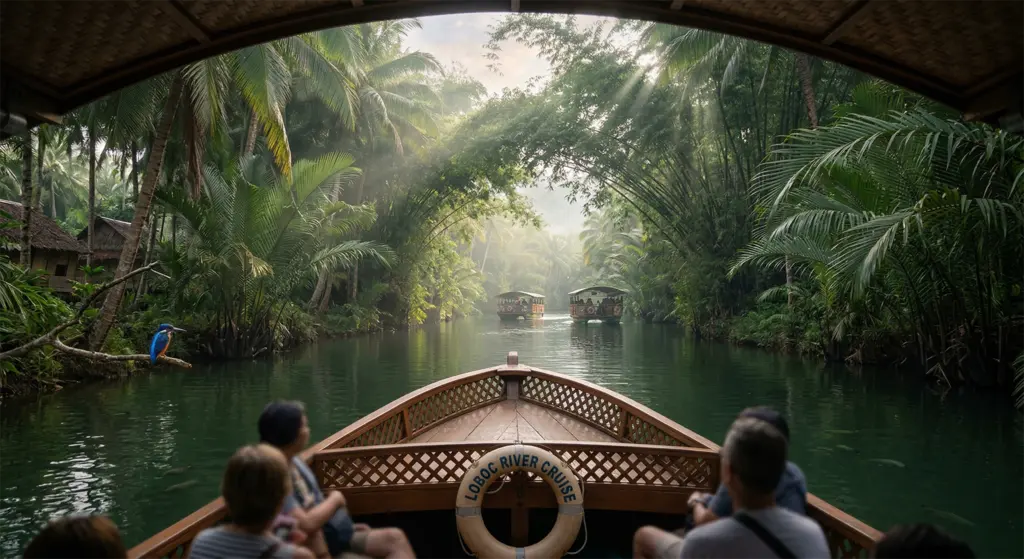
The Loboc River cruise is the most natural complement to a visit to Carmen. The river runs through the jungle, about 40 minutes by road south of Carmen, between Loboc town and the municipality of Loay. Lunch cruises run on flat-bottomed boats moving slowly upriver under a canopy of nipa palm and bamboo. The food is a buffet served onboard. The pace is slow. The river scenery is genuinely good, the kind of green and quiet that earns its reputation without requiring superlatives. It is not an adventure. It is a good hour of slow travel with lunch included.
A Definate ‘Don’t Miss’
The Philippine Tarsier Sanctuary in Corella sits between Tagbilaran and Carmen, making it a natural stop on the way to or from the viewpoint. Tarsiers are nocturnal primates the size of a fist with eyes that are, proportionally, the largest of any mammal. During the day, they rest on thin branches, sleeping in semi-wild habitat. The sanctuary keeps them in a naturalistic enclosure where the light is low, and visitor movement is controlled. Photography without flash is strictly enforced. The animals are close enough to observe properly. They are strange to look at in a way that justifies the stop.

Ubi Kinampay is a purple yam variety specific to Bohol. It tastes noticeably different from purple yams found elsewhere in the Philippines, with a more intense, sweeter flavor. It appears in local markets, in desserts, and on restaurant menus in Tagbilaran and the interior towns. Order it if you see it. It is not found this way outside Bohol.
The Conservation Question at the Chocolate Hills
The Chocolate Hills of Bohol are designated as a protected landscape under Philippine law and are on the UNESCO World Heritage tentative list. Protection has not resolved all pressures. Development within the protected area has been a recurring point of tension. A zipline operation approved within the conservation zone drew significant criticism from conservation groups and researchers who argued it introduced permanent infrastructure that altered the character of what the designation was meant to protect. The debate was public and unresolved at the time of my visit.
The ecological pressure on the hills themselves is quieter but ongoing. The cogon grass covering the slopes requires seasonal die-back to maintain the brown color and the open hillside ecology. Overgrazing by livestock reduces grass density and weakens the soil binding that holds the terrace-like slopes together. Climate variability that affects the timing of the dry season changes when and whether the hills reliably turn brown. These are not catastrophic threats at present. They are the kind of slow pressure that becomes catastrophic when left unaddressed.
What a visitor can do is not complicated. Stay on marked paths. Do not attempt to walk up the surface of the hills. The slopes are steeper than they appear, and the grass cover does not recover quickly from foot traffic. Hire guides through the official Carmen tourism desk rather than informal operators at the entrance. The guide fee is small and goes to the right people. Both choices cost you nothing significant and direct money toward the community that is most invested in the hills’ survival.
The Lasting Impression
‘Enigmatic’ is the word most articles about the Chocolate Hills of Bohol reach for. It is not the right word. The geology is understood. The formation process has been documented and peer-reviewed. What makes the hills extraordinary is not mystery but scale and uniformity. There are over a thousand of them. They all look the same. Twice a year, the season changes them from green to brown and back.
‘Enigmatic’ protects you from having to say what the place actually does. What it does is make you stand still. The panorama from Viewpoint One is one of those landscapes that takes a moment longer to process than you expect. You look at a thousand identical hills, and your brain keeps trying to find the explanation for the regularity. There is one. It just takes two million years to tell.
Go in the dry season. The green version is beautiful. The brown version is the point.
Frequently Asked Questions
Q1: How many hills are in the Chocolate Hills, Bohol?
The most commonly cited figure is 1,268 individual hills. This number appears in most Philippine tourism documentation and in the original designation of the Chocolate Hills as a national geological monument. The National Commission for Culture and the Arts uses a higher figure of 1,776. The discrepancy reflects differences in survey methods and criteria for distinguishing a discrete mound from a section of connected ridgeline.
The practical answer for a visitor is that the count is high enough that the exact number is irrelevant to the experience. Standing at Viewpoint One and trying to count them yourself is not possible. The hills extend past the visible horizon. Whether the total is 1,268 or 1,776 does not change what you see on the platform or how the view affects your sense of scale. The number to remember is ‘more than a thousand, all roughly the same shape.’ The rest is for the geological record.
Q2: When do the Chocolate Hills in Bohol turn brown?
The hills turn brown during the dry season, which runs approximately from November through May in Bohol. The cogon grass covering the slopes dies back as rainfall decreases, and the color shifts from green to the dry brown that justifies the name. The transformation builds gradually through November and December. By January and February, the hills are at their brownest and most reliable for the chocolate color. March is also dependable. April is brown but hot.
Visitors who arrive between June and October will find the hills green. This is a different kind of impressive: the hills look like lush tropical highlands rather than chocolate confectionery. It is still a striking landscape. It is not the version most travelers have in mind when planning their visit. If the brown color is your primary reason for going, January through March gives you the most reliable conditions. Check the weather forecasts before departing, as Bohol’s rainy season can occasionally extend into November.
Q3: How do you get to the Chocolate Hills in Bohol from Tagbilaran?
Carmen, where the main viewpoint complex is located, is approximately 55 kilometers north of Tagbilaran by road. The drive takes between 90 minutes and two hours, depending on conditions. A rented van with a driver arranged through your Tagbilaran accommodation is the most practical option for a day trip that includes the Chocolate Hills, the tarsier sanctuary, and the Loboc River cruise. Most hotels and guesthouses in Tagbilaran can arrange this, and a full-day van tour comfortably covers all three stops.
Scooter rental is a good alternative for independent travelers comfortable with Philippine roads. The route to Carmen is paved and well-marked, and Bohol’s interior is one of the more enjoyable scooter rides in the Visayas on a dry day. Habal-habal motorcycle taxi drivers at the Tagbilaran terminal know the Carmen route and are available for hire. Negotiate the rate before departure. Public jeepney transport exists between municipalities, but it does not run on a schedule that makes a day trip to the viewpoint complex practical.
Q4: Are the Chocolate Hills in Bohol worth visiting?
Yes, with accurate expectations. The Chocolate Hills of Bohol are genuinely singular. No other landscape in the world looks like this. The viewpoint from Carmen delivers exactly what it promises, and that experience is worth the two-hour drive from Tagbilaran. It is also a specific kind of experience: you arrive, climb the 214 steps to the platform, spend twenty to forty minutes at the top, and descend. The encounter is front-loaded into the platform’s time.
The Chocolate Hills are not an adventurous landscape. You do not walk through them or among them. You observe them from the viewpoint platforms. The value is in what the panorama does to your understanding of scale and geology. Come in the dry season for the brown color that earns the name. Come early to beat the tour buses. Go with one question in mind: not ‘what are these?’ but ‘how did something this regular happen naturally?’ The viewpoint will answer it.
Q5: What is the entrance fee at the Chocolate Hills viewpoint in Carmen?
Entrance fees at the Chocolate Hills viewpoint complex are set by the local government and change periodically. The fee structure typically differs between domestic and international visitors. Before publishing or visiting, confirm the current rate directly through the Carmen local government unit or the Philippine Tourism Authority. Arriving with small denominations of Philippine pesos is practical regardless of the amount, as change at the entrance counter is not always available in large bills.
The entrance fee covers access to the viewpoint complex, including both Viewpoint One and Viewpoint Two. Guide fees, if you hire one through the Carmen tourism desk, are separated and negotiated directly with the guide. The tourism desk is located near the main entrance. Hiring through the desk rather than from informal operators at the gate is recommended: the rates are regulated, and the money goes into the official guide program.
Q6: What else can you do near the Chocolate Hills, Bohol?
Three stops combine well with the Chocolate Hills into a single day. The Philippine Tarsier Sanctuary in Corella sits between Tagbilaran and Carmen, making it a natural stop in either direction. The tarsiers are nocturnal and rest during the day, but the sanctuary environment allows close observation in low-light conditions. Allow 30 to 45 minutes. The Loboc River cruise runs from Loboc town, about 40 minutes south of Carmen. Lunch cruises on flat-bottomed boats move slowly upriver through the jungle canopy with a buffet meal included. Allow two hours for the round trip.
If you are staying an extra day in Bohol, Panglao Island is a 30-minute drive from Tagbilaran and offers a completely different environment: a flat coastline, clear water, reef diving, and beach accommodation. Alona Beach is the most established strip on Panglao. The interior hills and the Panglao coast are the two distinct sides of Bohol. They complement rather than duplicate each other. A two-night Bohol visit covers the island more honestly than a single-day pass-through: spend one day on the interior circuit, one day at Panglao.
Other Related Articles that may be of Interest
You may also find the following articles interesting.
- The History and Modern Relevance of the Ifugao Rice Terraces
- Luzon Region macro page
Suggestions For Lodging and Travel
Lodging is widely available throughout the Philippines. However, you may want to consider getting assistance booking tours to some of the Philippines’ attractions. I’ve provided a few local agencies that we’ve found very good for setting up tours. For transparency, we may earn a commission when you click on certain links in this article, but this doesn’t influence our editorial standards. We only recommend services that we genuinely believe will enhance your travel experiences. This will not cost you anything, and I can continue to support this site through these links.
Local Lodging Assistance
Guide to the Philippines: This site specializes in tours across the Philippines, offering flexible scheduling and competitive pricing. I highly recommend them for booking local arrangements for a trip like this one. You can book flights and hotels through the Expedia link provided below.
Hotel Accommodations: I highly recommend The Manila Hotel for a stay in Manila. I stay here every time I travel to the Philippines. It is centrally located, and many attractions are easily accessible. Intramuros and Rizal Park are within walking distance. I have provided a search box below for you to find hotels (click “Stays” at the top) or flights (click “Flights” at the top). This tool will provide me with an affiliate commission (at no additional cost to you).
Kapwa Travel is a travel company focused on the Philippines. It specializes in customizing trips to meet customers’ needs.
Tourismo Filipino is a well-established company that has been operating for over 40 years. It specializes in tailoring tours to meet customers’ needs.
Tropical Experience Travel Services – Tours of the Philippines: This company offers a range of tour packages, allowing you to tailor your trip to your preferences.
Lastly, we recommend booking international travel flights through established organizations rather than a local travel agent in the Philippines. I recommend Expedia.com (see the box below), the site I use to book my international travel. I have provided a search box below for you to use to find flights (click “Flights” at the top) or Hotels (click “Stays” at the top). This tool will provide me with an affiliate commission (at no cost to you).