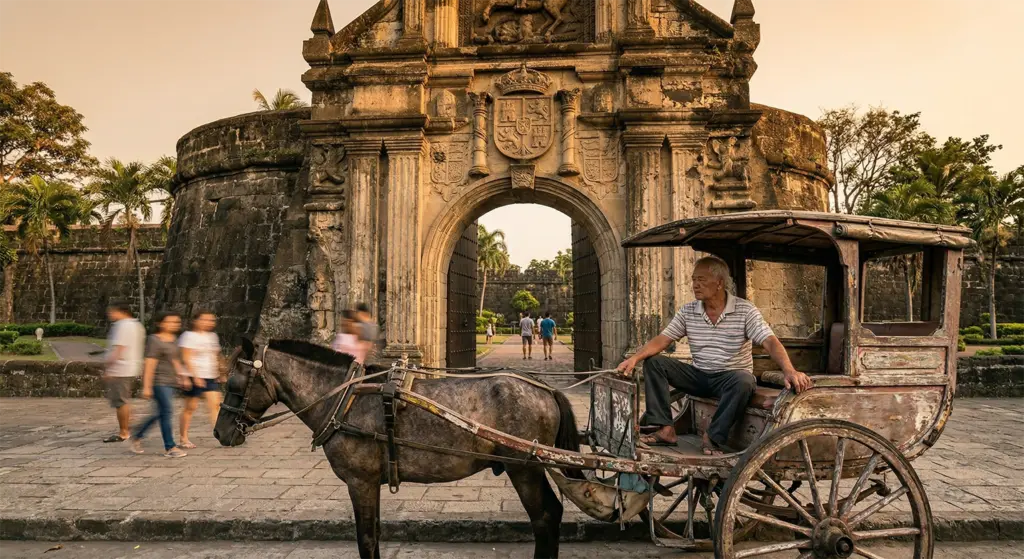
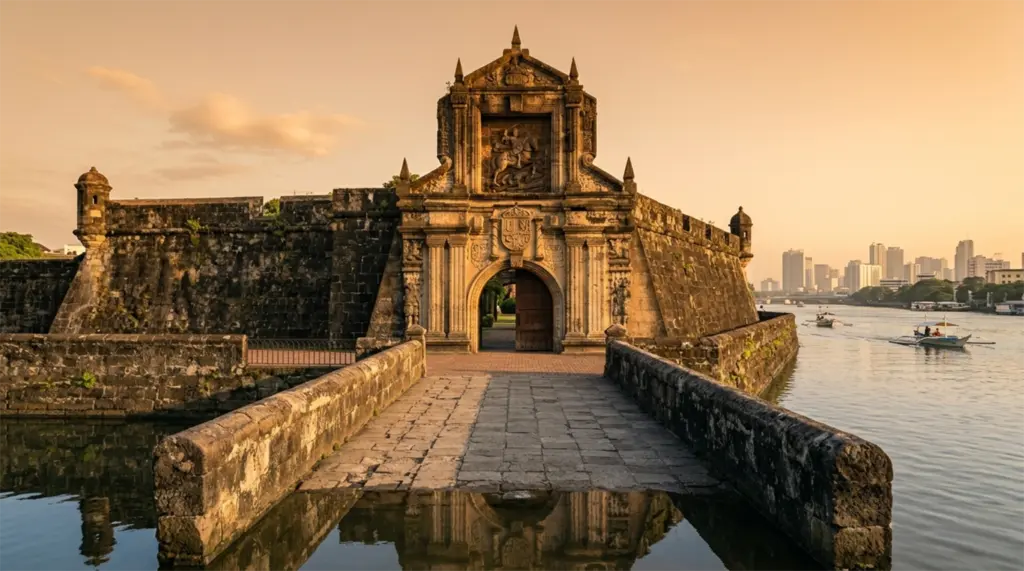
The approach to Fort Santiago never loses its effect, no matter how many times you make it. You cross the stone bridge over the moat, the Pasig River visible to your left, the bay somewhere behind the walls to your right, and then you pass under the main gate. The archway is massive. The stonework above your head dates to the 17th century. The courtyard opens in front of you, and for a moment, the noise of Manila simply stops.
I have been to Fort Santiago more times than I can count. It pulls you back, this place. Not because it is beautiful, though parts of it are, but because the history is so dense that a single visit cannot hold it all. Each time I walk in, I find something I missed before, or the same thing lands differently because I know more than I did the last time. That is what a truly significant historical site does. It grows with you.
The readers who have told me they want more of the history here are right to want it. Fort Santiago’s story runs through four and a half centuries of Philippine experience: the end of a pre-colonial kingdom, the construction of a colonial empire, the imprisonment and execution of the man who dismantled it, the American chapter that followed, and the Japanese occupation that turned the fort’s darkest spaces into something worse than anyone who built them had imagined. The full story earns attention.
What Was Here Before the Fort
In 1570, when Spanish forces under Juan de Salcedo and Martín de Goiti first reached the mouth of the Pasig River, the site that would become Fort Santiago was not empty. A wooden fortification stood there, under the control of a Malay chieftain named Rajah Sulayman. He was young, some accounts suggest barely in his twenties, and he commanded a settlement at the Pasig River’s mouth that the Spanish immediately recognized as the most strategically significant point on Manila Bay.
The initial Spanish contact was tense but not immediately violent. Sulayman was a Muslim leader with trade connections throughout the region and no particular interest in bending to European authority. Negotiations broke down. In June 1571, Miguel López de Legazpi arrived with the main Spanish force and engaged Sulayman’s defenders in what became known as the Battle of Bangkusay Channel. Sulayman died in that battle. On the precise ground where his fortification had stood, Legazpi began building what would become Fort Santiago.
That origin matters. The Spanish did not build their colonial stronghold on neutral ground. They built it on the ruins of the power they had just defeated. For the next three and a half centuries, Fort Santiago would remain the symbol and instrument of whoever held authority over the Philippines. The irony is that colonial power concentrated most intensely at Fort Santiago — and met its most dramatic challenge there, and ultimately its end.
What the Spanish Built and Why
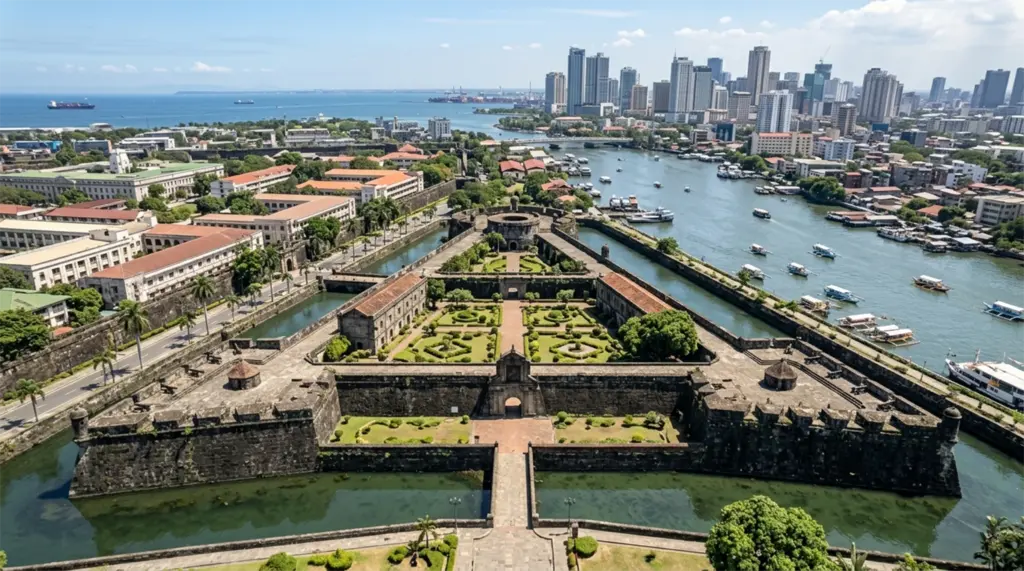
Legazpi named the fort for Santiago, Saint James of Spain, patron of the Spanish military, whose name the conquistadors invoked as both prayer and battle cry. The first structure was wooden and burned. Builders reconstructed the second fort in stone, expanded and reinforced it, rebuilt it again after earthquake damage, and refined it across more than a century of construction into the form that still largely survives today.
The design is triangular, following the Italian star-fort principles that Spanish military engineers had been applying across their empire since the 16th century. Triangular layouts allowed defenders on any one wall to provide covering fire for soldiers on either adjacent wall, eliminating the blind spots that straight-walled fortifications created. The two main bastions project from the river-facing corners, their angled faces designed to deflect cannonballs rather than absorb them directly.
Coral stone and volcanic tuff, both locally sourced, make up the primary construction materials. The volcanic tuff in particular is worth understanding: it is porous and relatively light when first quarried, hardening significantly over decades of exposure. The walls you lean on at Fort Santiago today are harder than they were when they were built. Time worked in the fort’s favor.
What the Location Meant
The fort sits at the precise point where the Pasig River meets Manila Bay. That is not a coincidence. Any ship entering the bay from the South China Sea and attempting to move up the Pasig River into the Philippine interior passed directly under the fort’s guns. Any land force approaching Intramuros from the north had to cross the river first. The fort controlled the water approach, the river approach, and the northern flank of the walled city simultaneously. Legazpi’s engineers understood the geography perfectly. Three centuries of attacks and sieges would prove them right.
The Dutch tried to take Manila in 1609 and 1617. The British actually succeeded in 1762, capturing the city and holding it for two years before the Treaty of Paris returned it to Spain. In both cases, Fort Santiago was central to the contest. The fort stood through all of it, not always undamaged, but always standing.
The Dungeons — Where the River Did the Work
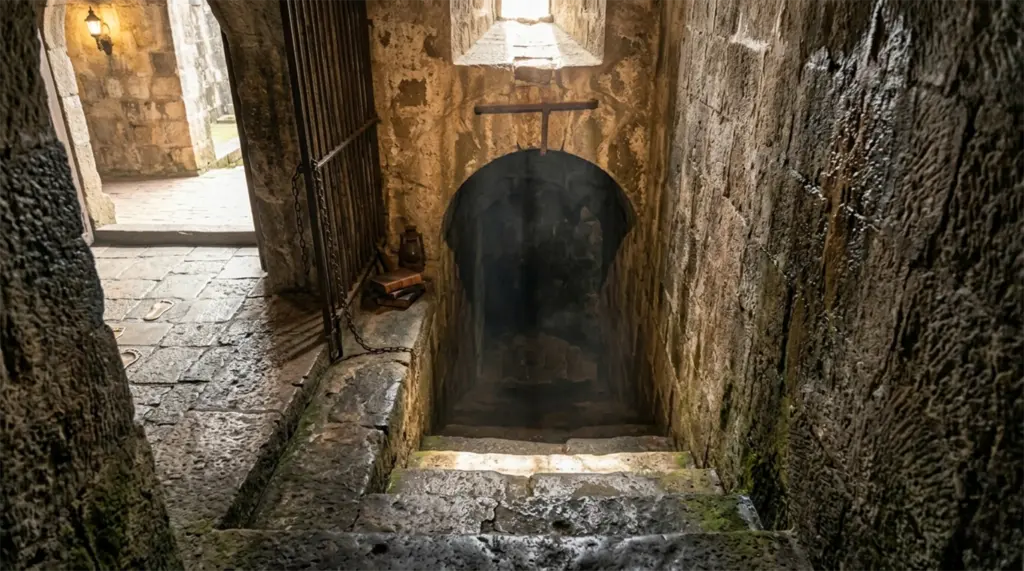
Below the fort’s main level, cut into the ground near the river wall, the dungeons sit at a depth that made them something worse than ordinary cells. The Pasig River’s tidal fluctuations meant the dungeon floors flooded regularly. When the tide came in and the river rose, water entered the cells. Prisoners who could not get high enough drowned. Spanish colonial authorities understood exactly what the location of these cells meant. The river was not an inconvenient design flaw. It was a feature.
The political prisoners held in the dungeons during the Spanish period were not ordinary criminals. They were Filipino intellectuals, religious figures, community leaders, anyone the colonial administration identified as a threat to its authority. The dungeons were where the Spanish put the people they considered too dangerous to release and too useful as warnings to simply execute. Some died of the flooding. Others died of disease. Most were held in darkness for periods that the historical record, where it survives, describes in terms that still disturb.
I have walked through those dungeons. The space is low, the air is heavy, and the walls are wet in a way that has nothing to do with recent rain. Standing in that space and understanding what it was designed to do changes how you look at the beautiful colonial architecture. The ceiling hangs low, the air presses heavy, and the walls sweat in a way that has nothing to do with recent rain. Both things are real. The fort, built to be impressive, and the dungeon, built to be lethal, are the same structure.
José Rizal’s Last Days
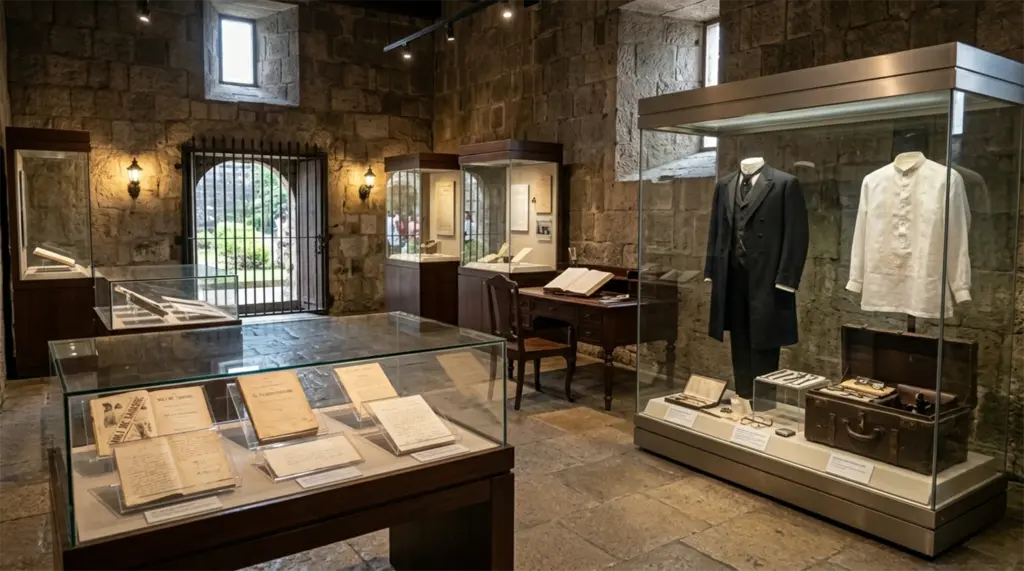
José Rizal was brought to Fort Santiago for the last time in December 1896. Arrested in Barcelona while traveling to Cuba as a military doctor, and transported back to the Philippines under Spanish guard, and tried for sedition, rebellion, and conspiracy. The verdict is predetermined. The Spanish colonial government had decided that the man whose novels had given the Philippine independence movement its language and its moral framework was too dangerous to live.
He was thirty-five years old. He had spent the years since his medical training in Europe writing, organizing, arguing for reform through peaceful means, and watching the revolution he had opposed growing into exactly the confrontation he had tried to prevent. In the rooms that now make up the Rizal Shrine inside the fort, he spent his final days. He wrote letters. He received visitors, including his family. And on the night of December 29, 1896, he wrote the poem that would outlast everything the Spanish colonial government ever built.
Mi Último Adiós
“Mi Último Adiós, ” My Last Farewell, was inked the night before his execution and concealed inside an alcohol lamp, which he gave to his family the following morning as he was led out. It is a poem of farewell to the Philippines, to the land, the sea, the air, the people. It is not a protest or a call to arms, t’is quieter than that, and more devastating for its quiet.
The poem was found after his death. It was published. It spread. Within months, Rizal’s execution had done precisely what the Spanish government had tried to prevent: it had transformed a reform movement into a revolution and given that revolution a martyr whose words were already in print. The Spanish had silenced Rizal, the man. They had made the idea of Rizal impossible to suppress.
The Footsteps in the Floor
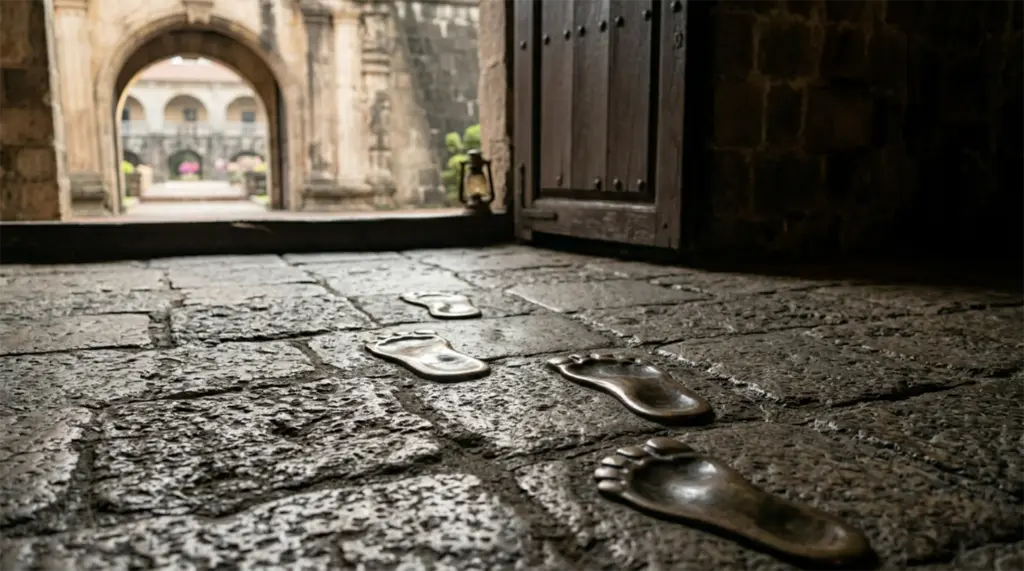
Bronze footsteps are embedded in the stone floor, tracing the path Rizal walked from his cell on the morning of December 30, 1896, through the fort, out of the gate, across the ground toward Bagumbayan Field, where the execution was carried out. The footsteps continue outside the fort and across Intramuros, all the way to Rizal Park.
I have followed those footsteps more than once. It takes about twenty minutes to walk the full path at a deliberate pace. Each time, I am aware that I am walking in the opposite direction from a man who knew he would not return. The shrine exhibit is carefully done: his manuscripts under glass, his clothing, his personal effects. None of it is dramatized. The facts are presented and allowed to speak for themselves. That restraint is exactly right.
The American Chapter
The Spanish-American War of 1898 ended Spain’s colonial presence in the Philippines within months. Fort Santiago was transferred from Spanish to American military control. The transition was less dramatic than the three centuries that preceded it: the Americans recognized the fort’s strategic value, maintained it as an active military installation, and added their own barracks and administrative structures to the complex.
The American colonial period, which lasted formally until 1946, with Japanese interruption, produced a Philippines that was neither fully colonial nor fully independent. During this period, Fort Santiago was a military base rather than a colonial prison, though the distinction mattered less to Filipinos, who found themselves under a new flag but not yet governing themselves. The fort watched that era pass the same way it had watched everything else: from its position at the mouth of the Pasig River, without comment.
1942–1945 — The Darkest Years
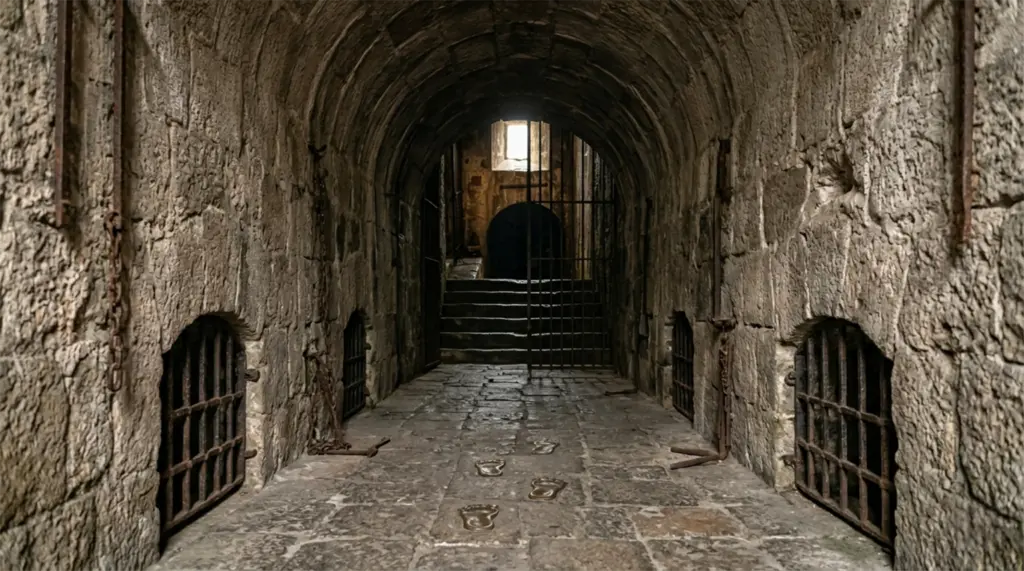
On January 2, 1942, Japanese forces entered Manila. They quickly seized Fort Santiago, and within weeks, they had converted it from an American military base into something that drew directly on the fort’s worst historical functions. The Japanese military administration filled the Spanish-built dungeons — the same cells the Pasig River tides had flooded for centuries — with Filipino civilians, American and Filipino prisoners of war, and anyone they identified as a threat or a source of intelligence.
The numbers are in dispute, but historians estimate that thousands of prisoners passed through Fort Santiago during the Japanese occupation. The conditions were catastrophic. The dungeons held far more people than their builders had ever intended. The tides still flooded the cells. Overcrowding spreads disease. Japanese forces carried out executions in the fort’s interior spaces. Many prisoners died before anyone transferred them elsewhere. The accounts that survive — from the few who did survive — describe dungeon conditions that the Spanish colonial administration, for all its brutality, had never quite managed to achieve.
World War II Impact
The Battle of Manila in February and March of 1945 ended the Japanese occupation and destroyed most of the city in the process. Fort Santiago’s stone walls survived, as they had survived everything before. The people who had been held inside during the occupation did not all share that outcome.
When I stand in the dungeons today, which are open to visitors and should be visited, because the discomfort you feel in that space is the point, I think about both periods: the Spanish prisoners who drowned in the tides and the prisoners of the Japanese occupation who died in the same space 300 years later for different political reasons but with the same result. Fort Santiago has a long memory, and it does not keep the comfortable parts.
What You Experience Today
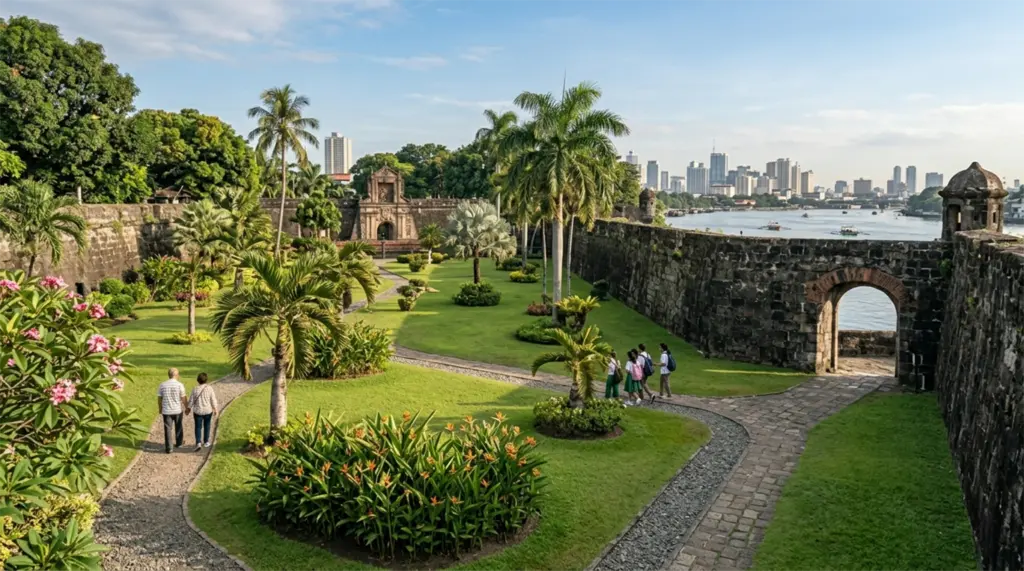
The contrast between the fort’s history and what you encounter on arrival is the first thing to register. The grounds are green. Manicured gardens fill the interior courtyard. The riverside walk offers a clear view across the Pasig toward the modern city beyond. Birds move through the trees. It offers a genuinely beautiful space, and it is not in conflict with what happened here; it is simply the same ground, four and a half centuries later, still standing.
The Rizal Shrine occupies the rooms in the northwest section of the fort where Rizal spent his final days. Curators have carefully assembled the exhibit: his manuscripts, personal belongings, clothing, and a replica of the desk where scholars believe he wrote his final poem. The bronze footsteps begin here and lead visitors through the fort and beyond. Allow time in this space. It is not a room to pass through.
The Dark Side of History
The dungeons are accessible from within the fort and clearly marked. They are not dramatized for tourism; there are no theatrical lighting effects or staged recreation. The space simply is what it is: low, damp, dark, and historically documented. That is enough.
The Postigo Gate, the secondary entrance to the fort facing away from the river, is one of the finest surviving examples of Spanish colonial military architecture in the Philippines. The stone carving above the arch is detailed and largely intact. The cannons positioned along the bastions are original period pieces, preserved in place. The riverside walk offers the best views of the fort’s exterior geometry; the triangular layout is most legible from there. Early in the morning, before the tour groups arrive, the combination of light on the stone walls and the river below is worth the effort.
Visiting Fort Santiago — What Older Travelers Need to Know
Fort Santiago is open daily, typically from 8:00 a.m. to 9:00 p.m., with evening visits offering a different atmosphere as lighting plays across the stone walls. A modest Admission fee is charged; reduced rates apply for older people. Verify current hours and pricing at the entrance or through the Intramuros Administration website, as both occasionally change.
The grounds are largely flat and navigable, with no significant mobility demands. The main courtyard, the riverside walk, the Postigo Gate area, and the approach to the Rizal Shrine are all accessible at a comfortable pace. The dungeons require descending a staircase and navigating a low-ceilinged space; visitors with mobility or claustrophobia concerns should assess the entrance before committing. The staircase is manageable for most older travelers if taken slowly.
The best visiting window is early morning, before 9:30 a.m., for cooler temperatures, better light on the stone walls, and smaller crowds before organized tour groups arrive. The dry season (December through February) offers the most comfortable conditions. The afternoon heat can be intense from March through May; the shade within the fort walls provides some relief, but water and a hat are advisable year-round.
Fort Santiago pairs naturally with San Agustín Church, a five-minute walk south through Intramuros, and with the Manila Cathedral on the Plaza de Roma. A full day in Intramuros, covering the fort, the church, and the cathedral, is a well-structured itinerary for older travelers who want depth without excessive distance. Rizal Park, which holds the distinction of being where Rizal’s execution was carried out and where the bronze footsteps from the fort ultimately lead, is ten minutes south.
The Manila Series — Where This Fits
Fort Santiago is where this series closes, and it is the right place to close it. The five articles cover the geography of central Manila in a rough arc: Manila Bay to the west, Intramuros at the center, Rizal Park to the south, San Agustín Church within the walls, and Fort Santiago at the northern tip where the Pasig River meets the Manila Bay. Walk the full arc, and you have covered the physical and historical core of what Manila has been for 450 years.
The connections between sites are not incidental. The man buried in the museum cloister of San Agustín, Miguel López de Legazpi, is the same man who defeated Rajah Sulayman and built Fort Santiago on the ground where Sulayman’s fortification had stood. The man imprisoned in the rooms of the Rizal Shrine was executed in the park where another article begins its morning. A separate article walks through the walls of Intramuros—the same walls that builders anchored and defended by constructing Fort Santiago.
History rarely presents itself in neat sequences. But sometimes a set of places cluster closely enough, geographically and temporally, that moving between them produces something like understanding. That is what this part of Manila offers, if you give it the time it needs. Fort Santiago is where I always end up when I am in Intramuros. Every time I leave, I have more questions than when I arrived. That seems like exactly the right outcome for a place with four and a half centuries of answers still embedded in its walls.
Frequently Asked Questions About Fort Santiago
Q1: What makes Fort Santiago significant in Philippine history?
Fort Santiago is significant for reasons that span nearly five centuries. Built on the site of the pre-colonial settlement of Rajah Sulayman, whose defeat by Spanish forces in 1571 marked the beginning of Spanish colonial rule. It served as the primary military stronghold of the Spanish colonial empire in Southeast Asia. Its dungeons held Filipino political prisoners across three centuries of colonial rule. It stands as the place where the Spanish imprisoned José Rizal, the national hero, before executing him in 1896. During World War II, the Japanese military seized it as a detention facility, where they held thousands of Filipino and Allied prisoners under catastrophic conditions. No single site in the Philippines concentrates this much history in one place.
Q2: What is the Rizal Shrine inside Fort Santiago?
The Rizal Shrine occupies the rooms in the fort’s northwest section where José Rizal spent his final days before his execution on December 30, 1896. The exhibit includes personal belongings, manuscripts, clothing, and reproductions of the desk where he penned “Mi Último Adiós,” the poem he concealed in an alcohol lamp and gave to his family on the morning of his execution. Bronze footsteps embedded in the floor trace the path he walked from his cell to his death. The shrine is the emotional center of any visit to Fort Santiago and deserves time accordingly. It is not a room to move through quickly.
Q3: What is the purpose of the Fort Santiago dungeons, and can visitors enter?
Spanish colonial authorities used the dungeons as political detention cells, and during World War II, Japanese forces turned them into mass detention facilities. Their location near the Pasig River caused the floors to flood regularly with tidal changes. The flooding is not accidental; designers deliberately created these conditions to physically break prisoners. During the Japanese occupation, authorities held thousands of prisoners there, far exceeding the dungeons’ capacity. Today, visitors can enter the dungeons. The site is not dramatized or recreated; it stands as it is, which is enough. The experience feels uncomfortable in the way honest historical spaces should.
Q4: How long should I plan to spend at Fort Santiago?
Most visitors spend 1.5 to 2 hours covering the main areas: the Rizal Shrine, the dungeons, the Postigo Gate, the riverside walk, and the courtyard and bastions. If you intend to spend real time in the Rizal Shrine, which I recommend, or if you want to follow the bronze footsteps through the fort and into Intramuros toward Rizal Park, budget three hours. Fort Santiago pairs well with San Agustín Church (a five-minute walk south) and the Manila Cathedral on Plaza de Roma. A full morning covering all three is a well-structured day in Intramuros without requiring excessive walking.
Q5: Is Fort Santiago accessible for older travelers and those with mobility considerations?
The main grounds of Fort Santiago are flat and well-maintained, making them accessible for most older travelers. The Rizal Shrine, the riverside walk, the Postigo Gate area, and the courtyard are all reachable without significant physical demand. The dungeons require descending a staircase and navigating a low-ceilinged interior; this is manageable for most visitors if taken slowly, but travelers with significant mobility limitations or claustrophobia should assess the entrance before proceeding. Senior admission rates apply at the entrance. The fort is open early in the morning, and the cooler hours before 9:30 a.m. are the most comfortable for older visitors.
SUGGESTIONS FOR LODGING AND TRAVEL
Lodging is widely available throughout the Philippines. However, you may want to get some assistance booking tours to some of the Philippines’ attractions. I’ve provided a few local agencies that we’ve found to be very good for setting up tours. For transparency: We may earn a commission when you click on certain links in this article, but this doesn’t influence our editorial standards. We only recommend services that we genuinely believe will enhance your travel experiences. This will not cost you anything, and I can continue to support this site through these links.
- For Hotel Accommodations in the Manila area, I highly recommend The Manila Hotel. It is centrally located and within walking distance of Rizal Park and Intramuros. Many other attractions are easily accessible from there as well. I have provided a search box below for you to find hotels (click on “Stays” at the top) or flights (click on “Flights” at the top). This tool will provide me with an affiliate commission (at no cost to you).
Local Lodging Assistance
- Guide to the Philippines: This site specializes in tours throughout the Philippines. They seem to have some flexibility in scheduling, and pricing is very competitive.
- Kapwa Travel: A travel company offering travel services throughout the Philippines. It specializes in customizing trips to meet customers’ needs.
- Tourismo Filipino is a well-established company that has operated for over 40 years. It focuses on tailoring tours to meet customers’ needs.
- Tropical Experience Travel Services – Tours of the Philippines: This company offers a range of tour packages, allowing you to tailor your trip to your preferences.
Lastly, we recommend booking international travel flights through established organizations rather than a local travel agent in the Philippines. I recommend Expedia.com (see the box below), the site I use to book my international travel. I have provided a search box below for you to use to search for flights (click on “Flights” at the top) or Hotels (click on “Stays” at the top). This tool will provide me with an affiliate commission (at no cost to you).