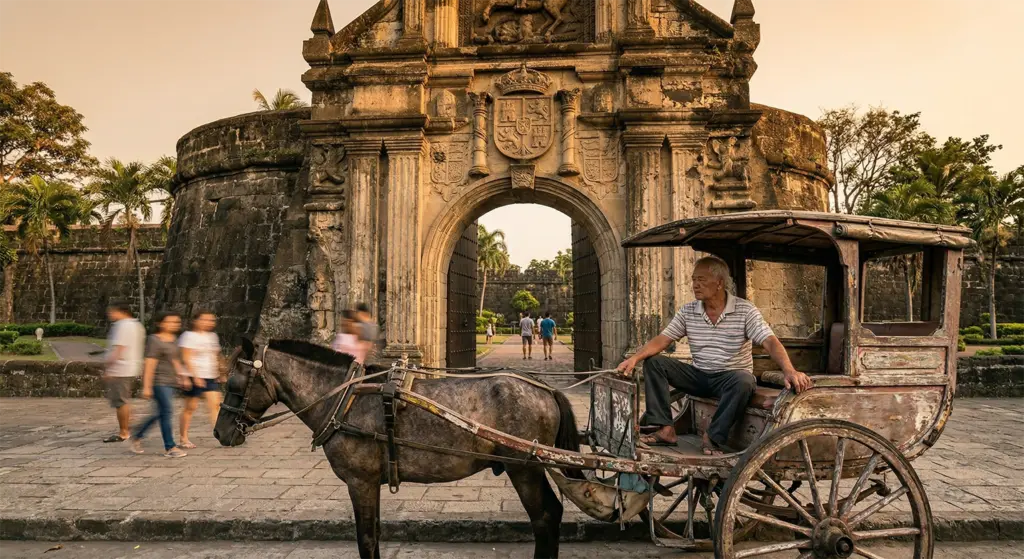
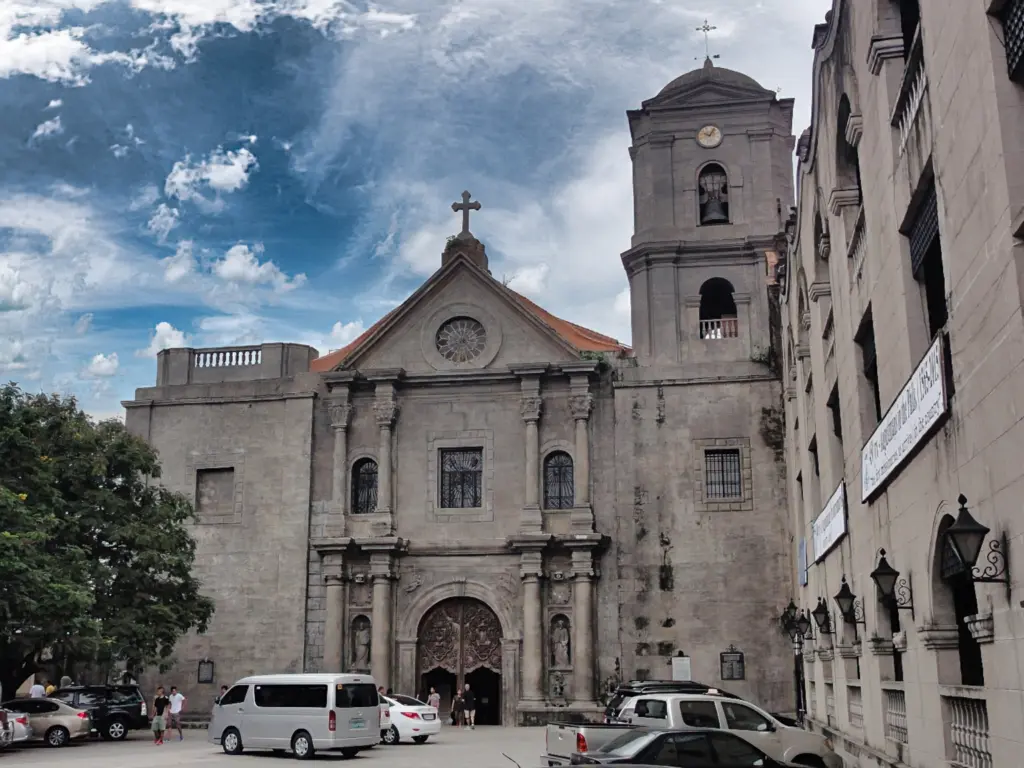
I have been to San Agustín Church more times than I can count, and the approach still gets me every time. You come through the streets of Intramuros — past the walls, past the vendors, through the shade of the old city — and then the façade appears. Four centuries of Spanish Baroque stonework rising out of the middle of Manila. The twin bell towers — well, one tower, technically, since an earthquake took the second one and it was never rebuilt — catch the morning light differently depending on the season. It never looks quite the same twice.
Walk through the main doors, and the heat drops. That is the first thing you notice every single time: the cool. Thick stone walls and a high interior do what no air conditioning can replicate. The second thing you notice is the ceiling. More on that shortly. The point is that San Agustín has a quality that very few structures in Manila possess: it stops you. You walk in, and you slow down.
That is worth something. This is the oldest stone building in the Philippines, and it earns that distinction not by being preserved behind barriers but by still being in active use. Mass is celebrated here. Weddings happen here. The church is alive in the way that only a place with genuine community roots can be. History in this building is not behind glass.
The Church That Has Outlasted Everything
San Agustín Church was built between 1587 and 1606 by the Augustinian friars who accompanied the Spanish colonization of the Philippines. It was not the first structure on this site. The first two churches the Augustinians built here — one of wood and bamboo, one of wood — were destroyed by fire. The third attempt used stone. That decision, made more than four centuries ago, is the reason the building still stands.
In 1993, UNESCO designated San Agustín as a World Heritage Site as part of the “Baroque Churches of the Philippines” group. The recognition is warranted. But it understates the specific quality that makes this church remarkable: the sheer number of things it has survived.
Four Centuries of Near-Misses
The list of events that should have destroyed San Agustín Church and did not is long enough to be its own argument for the building’s exceptionalism. Major earthquakes: The Philippines sits on the Pacific Ring of Fire and has been shaking Manila regularly for 400 years. Fires that swept through Intramuros when the district was still largely built of wood and bamboo. A Dutch naval siege in the early 17th century. The British occupation of Manila from 1762 to 1764, an episode most histories underemphasize, during which the church served as a barracks and warehouse for occupying forces.
The Philippine Revolution of 1896–1898 changed everything in the islands without physically touching the church. The Spanish-American War of 1898 ended three centuries of Spanish colonial rule in a matter of months. In the chaos of the American takeover, Spanish governor-general Fermín Jaudénes and his staff took refuge within Intramuros. The old walled city, and the church at its heart, stood at the precise moment when one colonial power replaced another.
And then came 1945, which started the story that puts all the others in context.
1945 — The City Burned Around It
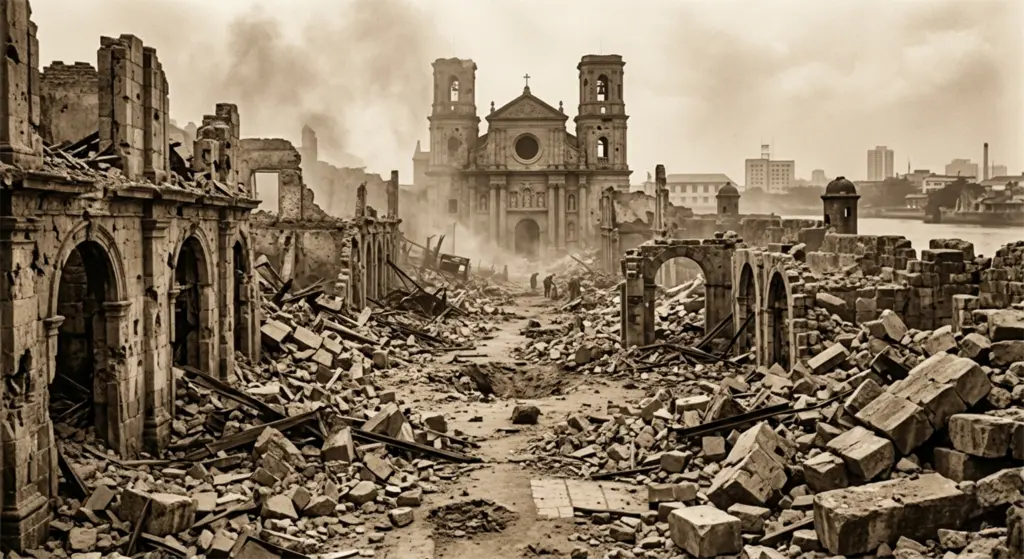
The Battle of Manila, fought between February and March 1945, was among the most devastating urban battles of the entire Second World War. American forces fought Japanese defenders street by street through the city. Civilians were caught between them. By the time the fighting ended, an estimated 100,000 Filipino civilians had died, a figure that places Manila alongside Warsaw as one of the most destroyed Allied capitals of the war. The historic core of Intramuros, built over more than three centuries, was reduced to rubble.
San Agustín Church survived. Not undamaged, shells and fire left marks on the exterior, but standing, intact, with its interior preserved in a way that virtually nothing else within the walls was. Walk through Intramuros today and look at what was rebuilt after the war versus what was already there: San Agustín is one of the very few structures that did not need to be rebuilt from the ground up. Those stone walls the Augustinian friars chose in 1587 made the difference.
The church functioned as a refugee center during the battle, sheltering civilians while the city around it burned. When I stand inside San Agustín and think about what these walls held in those weeks, the people who waited there, not knowing what would be left when it was over, the age of the place becomes something more than a number. It becomes weight.
What You’re Standing In — The Architecture
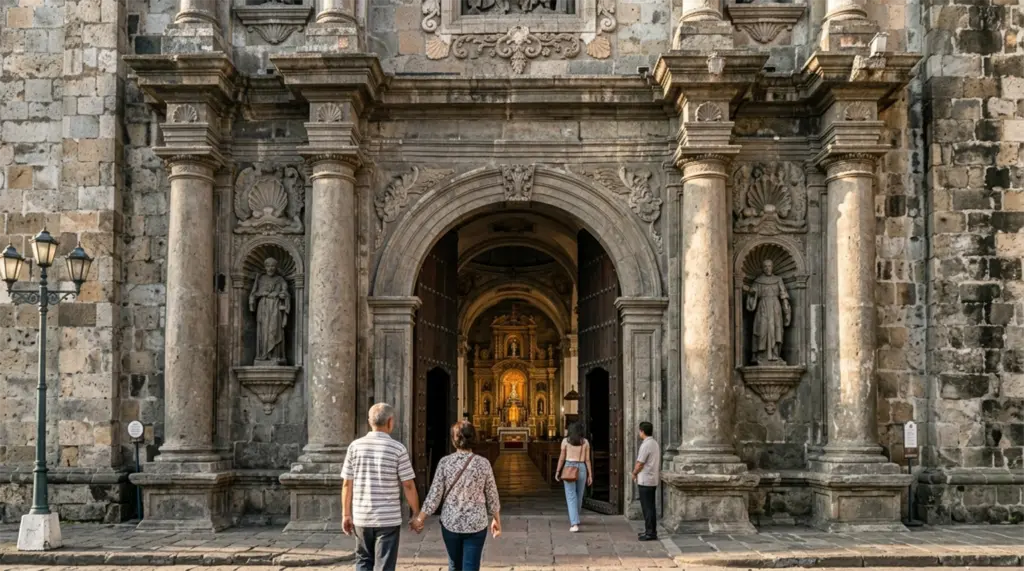
The façade of San Agustín is the first thing most visitors photograph, and it earns the attention. Two levels of carved stone decoration rise above the main portal in the Spanish Baroque style: geometric patterns, shell motifs, and niches that once held and still hold religious figures. The single surviving bell tower anchors the left side. The asymmetry is jarring at first, but then it makes a kind of sense once you know what took the second tower. Earthquakes don’t care about symmetry.
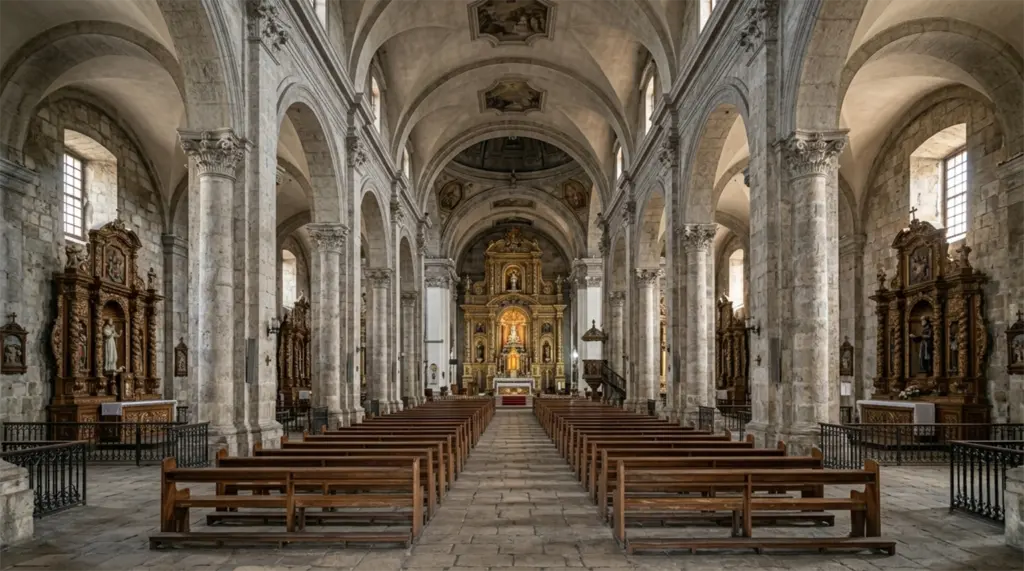
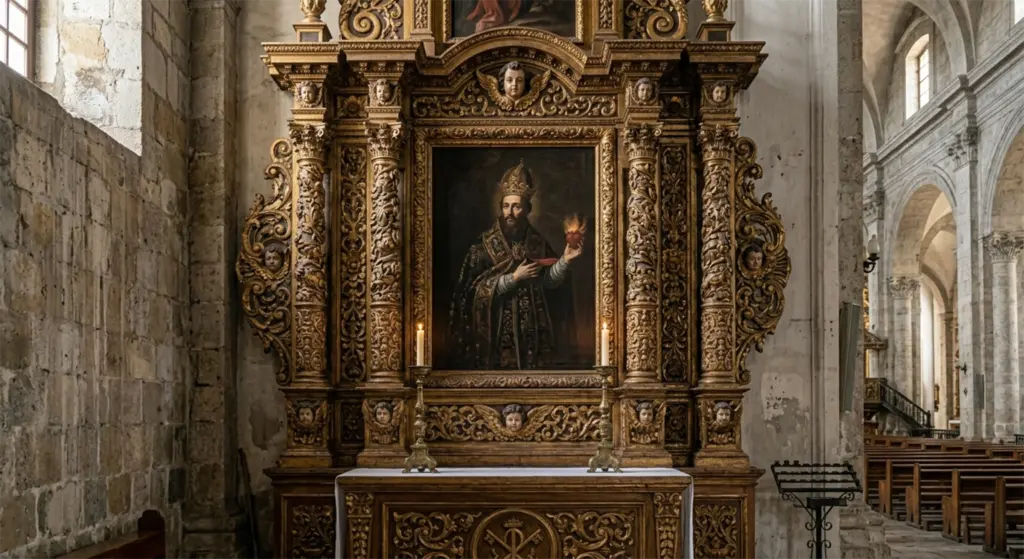
Inside, the floor plan is cruciform, the classic cross shape of European cathedral design adapted for the tropical Philippines. The nave runs the length of the building toward the main altar, flanked on both sides by fourteen carved-wood lateral altars, each representing a different saint. The stone columns are massive and undecorated, which only throws the altars’ detail into sharper relief. The contrast is intentional. Heavy structure, elaborate devotion.
The choir loft above the main entrance is one of the finest examples of 17th-century Philippine woodwork in existence. The detail in the carved balustrade and the supporting structure below it is worth a long look. It is the kind of craftsmanship that reminds you how seriously the people who built this place took the task.
The Ceiling — Stop and Look Up
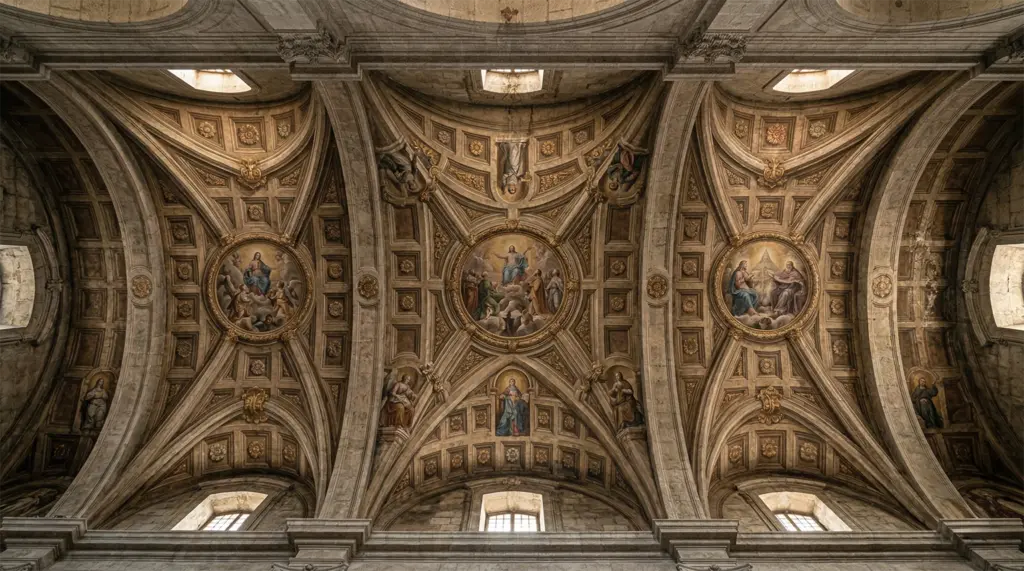
The ceiling of San Agustín is what most visitors remember the longest, and it deserves a separate heading because a passing mention does it no justice.
What you are looking at is a flat surface painted to look like a three-dimensional stone vault. The trompe-l’œil technique, French for “fool the eye,” creates the illusion of arched masonry, carved ribs, and receding depth. The actual ceiling is relatively flat. The vaulting you see does not exist. It is painted in perspective, executed with the kind of precision that only becomes obvious when you are told to look for the seam and cannot find one.
The frescoes date to the late 19th century, painted in a period when the church was making significant interior improvements. The scale of the deception runs the full length of the nave. From every angle you view it from, the illusion holds.
I have brought people to this church who walked in with no particular interest in religious architecture, only to watch them stop in the middle of the nave and stare at the ceiling for five minutes without saying anything. It works on everyone. My recommendation: walk in, get your bearings, then stop, look up, and take as long as you need. That ceiling is the reason the word “impressive” falls short.
The Museum — Four Centuries in One Cloister
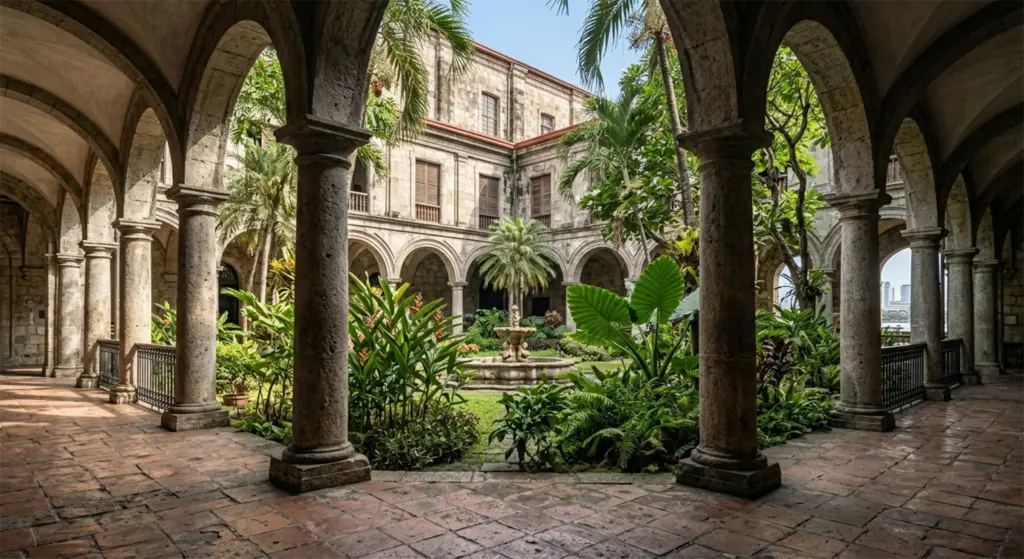
The Museo de San Agustín occupies the cloister attached to the church, a shaded, arcaded courtyard space that is one of the more peaceful spots in all of Intramuros. The museum charges a separate admission fee from the church itself. It is worth paying.
The collection spans four centuries of religious and colonial history. Ivory santos, carved religious figures brought from China and Mexico via the Manila Galleon trade, are displayed alongside vestments embroidered with gold thread, ecclesiastical objects in silver, paintings from the Spanish colonial period, and documents that have survived multiple disasters that destroyed so much else. Each object carries its own provenance, its own path through history to this room. The museum does a reasonable job of explaining that context for visitors who are willing to read the labels.
The pipe organ in the choir loft is among the oldest surviving organs in Asia. Restored but not replaced, it retains its original mechanical action and some of its original pipes. Hearing it played, if you happen to attend a Mass when it is in use, is an experience with no modern equivalent.
In the floor of the museum cloister, there is a tomb. Miguel López de Legazpi, the Spanish conquistador who founded Manila in 1571 and established the colonial capital that became the city you are standing in, is buried here. He died in 1572, a year after he founded the city. His tomb is easy to miss if you are not looking for it. Look for it. The man who decided that Manila would exist is buried in the church that became the heart of everything he built. That connection is worth a moment.
What This Church Has Witnessed
The historical record of San Agustín runs through almost every significant event in Philippine colonial history, making the building function as more than a church. It is a primary source. It was here before the Galleon Trade reached its peak, before the Dutch tried to take Manila, before the British succeeded briefly, before Filipino revolutionaries dismantled three centuries of Spanish authority, before American forces raised their flag over the islands, before the Second World War nearly erased everything the colonizers left behind.
Spain’s final hours in the Philippines played out with Intramuros as the stage. When Commodore George Dewey’s fleet destroyed the Spanish armada in Manila Bay in May 1898, the writing was clear. Governor-General Jaudénes negotiated the formal surrender of Manila to American forces on August 13, 1898. The Spanish colonial era, 326 years of it, ended within the walls of Intramuros, in the shadow of a church that had been standing since before any living person’s great-great-grandparents were born.
That continuity is what I keep returning to when I visit San Agustín. Every era of Philippine history is layered into this building: the founding, the empire, the resistance, the conquest, the war, the survival. You can engage with all of it in a single morning if you are paying attention.
Visiting San Agustín — What Older Travelers Need to Know
San Agustín is located within Intramuros, roughly a five-minute walk from Fort Santiago and the Manila Cathedral on Plaza de Roma. The church itself is free to enter; the museum charges a modest admission fee. Both are worth your time, and the combination of a church visit and a museum visit runs two to three hours at a comfortable pace.
The interior is accessible without significant mobility demands. The floor is level stone throughout the nave. The museum cloister requires navigating one level of the flat arcade. There are no significant steps between the main entrance and the church’s primary areas. The cool interior is genuinely welcome in Manila’s heat, making it a compelling reason to spend time here during the hotter parts of the day, when outdoor sites become uncomfortable.
Dress code applies: shoulders and knees should be covered out of respect for the active place of worship. Scarves or wraps are often available at the entrance for visitors who arrive unprepared. Photography is generally permitted in the nave, but check at the entrance; rules around flash and tripods vary. During Mass, photography is not appropriate.
Attend a Mass
Mass is still celebrated regularly at San Agustín. If your schedule allows you to attend a Sunday morning Mass, the combination of the acoustic space, the pipe organ, and the congregation that has been worshipping in this building across generations produces something that no museum exhibit can replicate. This is not a preserved ruin. It is a living church that happens to be 400 years old.
Morning visits before 10:00 a.m. offer the best combination of cooler temperatures, better interior lighting for photography, and smaller crowds before the tour groups arrive. The church is open year-round. The dry season (December through February) offers the most comfortable weather in Intramuros overall.
The Manila Series — How San Agustín Connects
San Agustín sits at the center of the geography covered by this series. Manila Bay to the west, whose history is covered in the series’ opening article, is visible from the Intramuros walls, a short walk from this church. Rizal Park, where the man whose execution is inseparable from this church’s history stood before a firing squad in 1896, is ten minutes south. Fort Santiago, where José Rizal spent his final days and where the Augustinian order maintained a presence during the colonial period, is ten minutes north.
The series closes with Fort Santiago for a reason. San Agustín and the fort are products of the same colonial moment: both built by the Spanish in the late 16th century, both survivors of everything that followed, both carrying the full weight of Philippine history in their stones. The church represents the spiritual architecture of the colonial project. The fort represents its military reality. Together, they tell the story of Intramuros more completely than either does alone.
The Augustinian friars who finished this church in 1606 could not have predicted what it would outlast. Four centuries of typhoons, earthquakes, occupations, revolutions, and the most destructive urban battle in the Pacific Theater. All of it, and the building is still here. Still cool inside. Still, stopping people in the middle of the nave to stare at a ceiling that is not what it looks like.
Frequently Asked Questions About San Agustín Church
Q1: Is there an entrance fee for San Agustín Church?
The church itself is free to enter. The Museo de San Agustín, housed in the adjacent cloister, charges a modest admission fee. Visiting both together is strongly recommended; the museum’s collection of religious art, ivory santos, vestments, and historical artifacts adds significantly more depth to the church visit. Budget two to three hours for the full combination.
Q2: How long should I plan to spend at San Agustín?
A quick visit focused on the church interior and the ceiling takes 30 to 45 minutes. Adding the Museo de San Agustín brings that to two hours comfortably. If you are interested in the history in depth, the tomb of Legazpi, the pipe organ, and the specific artifacts in the museum collection, three hours is not too much. The church is a natural anchor for a full day in Intramuros, combined with Fort Santiago and the Manila Cathedral.
Q3: Can I attend Mass at San Agustín Church?
Yes. San Agustín is an active parish church, and Mass is celebrated regularly, including daily Mass and multiple Sunday Masses. Check the current Mass schedule at the church entrance or with the parish office, as times shift seasonally. Attending a Sunday Mass here is one of the more unusual experiences in Manila: a 400-year-old church, an ancient pipe organ, and a congregation with roots in this community for generations. Dress respectfully; the usual dress code (shoulders and knees covered) applies.
Q4: What makes San Agustín Church’s ceiling so famous?
The ceiling is a trompe-l’œil painting — French for “fool the eye.” The actual ceiling of the nave is relatively flat, but it is painted in such precise perspective that it appears to be a three-dimensional stone vault with carved ribs and receding arches. The effect holds from every angle in the nave. The frescoes date to the late 19th century and run the full length of the church interior. Most first-time visitors are told about the ceiling before they enter, but still cannot identify the flat surface once inside. Stop in the middle of the nave. Look up. Take your time.
Q5: Is San Agustín Church accessible for older travelers or those with mobility concerns?
The church is well-suited for older travelers. The interior floor is level stone throughout the nave and the museum cloister. There are no significant steps between the main entrance and the primary areas of interest. The cool interior provides genuine relief from Manila’s heat, making it a practical midday stop when outdoor sites become uncomfortable. If walking the full extent of Intramuros is a concern, San Agustín is worth prioritizing: it offers the most within the smallest physical space, and it can be visited in depth without significant physical demands.
SUGGESTIONS FOR LODGING AND TRAVEL
Lodging is widely available throughout the Philippines. However, you may want to get some assistance booking tours to some of the Philippines’ attractions. I’ve provided a few local agencies that we’ve found to be very good for setting up tours. For transparency: We may earn a commission when you click on certain links in this article, but this doesn’t influence our editorial standards. We only recommend services that we genuinely believe will enhance your travel experiences. This will not cost you anything, and I can continue to support this site through these links.
- For Hotel Accommodations in the Manila area, I highly recommend The Manila Hotel. It is centrally located and within walking distance of Rizal Park and Intramuros. Many other attractions are easily accessible from there as well. I have provided a search box below for you to find hotels (click on “Stays” at the top) or flights (click on “Flights” at the top). This tool will provide me with an affiliate commission (at no cost to you).
Local Lodging Assistance
- Guide to the Philippines: This site specializes in tours throughout the Philippines. They seem to have some flexibility in scheduling, and pricing is very competitive.
- Kapwa Travel is a travel company focused on the Philippines. It specializes in customizing trips to meet customers’ needs.
- Tourismo Filipino is a well-established company that has operated for over 40 years. It focuses on tailoring tours to meet customers’ needs.
- Tropical Experience Travel Services – Tours of the Philippines: This company offers a range of tour packages, allowing you to tailor your trip to your preferences.
Lastly, we recommend booking international travel flights through established organizations rather than a local travel agent in the Philippines. I recommend Expedia.com (see the box below), the site I use to book my international travel. I have provided a search box below for you to use to search for flights (click on “Flights” at the top) or Hotels (click on “Stays” at the top). This tool will provide me with an affiliate commission (at no cost to you).