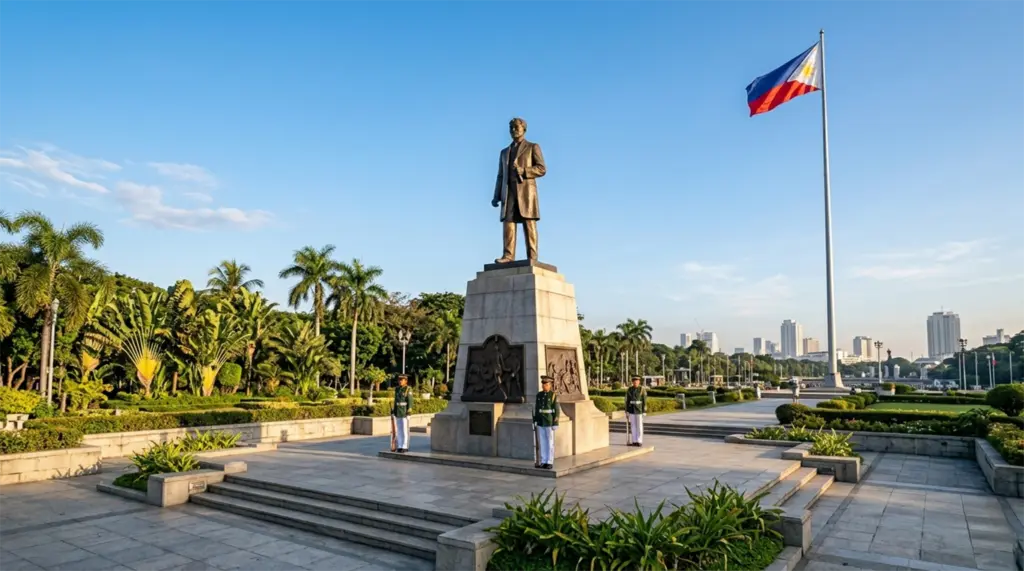
The first time you pass through the gates of Intramuros, you feel the shift before you understand it. Modern Manila disappears. The noise doesn’t. This is still a city, but the register changes. Cobblestones replace asphalt. Walls that have absorbed four centuries of history rise on either side. You are no longer in contemporary Manila. You are in the oldest continuously occupied district in the Philippines.
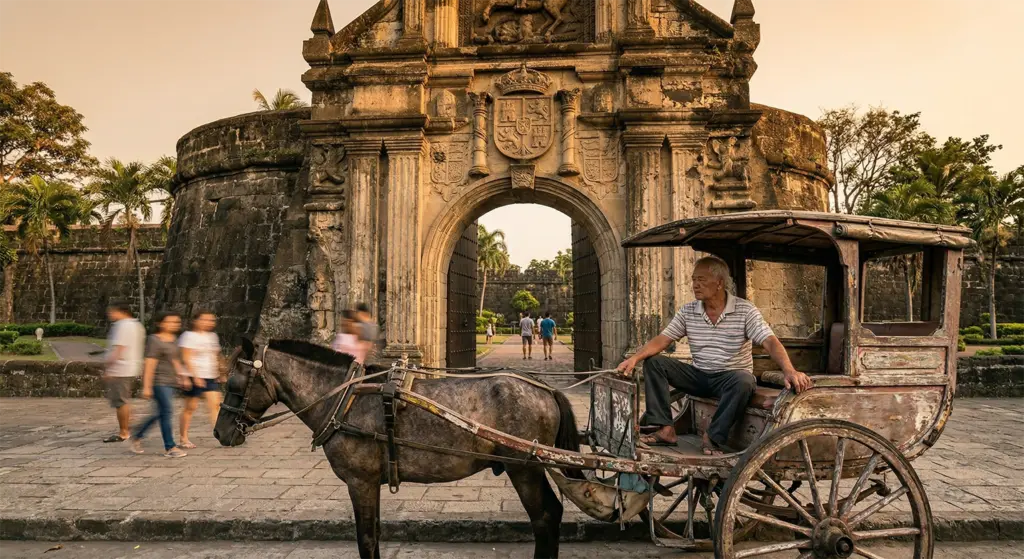
I have walked these streets many times. On most of those visits, a kalesa driver named Tomas has been in his usual spot near the main gate, in the same easy manner, with the same willingness to wait while you take one more photograph of the walls. He is as much a part of Intramuros as the stones he navigates every day.
For older travelers making their way through Manila, Intramuros is the stop that changes how the rest of the city makes sense. You don’t just see the Philippines’ colonial past here. You walk through it.
A City Built to Last
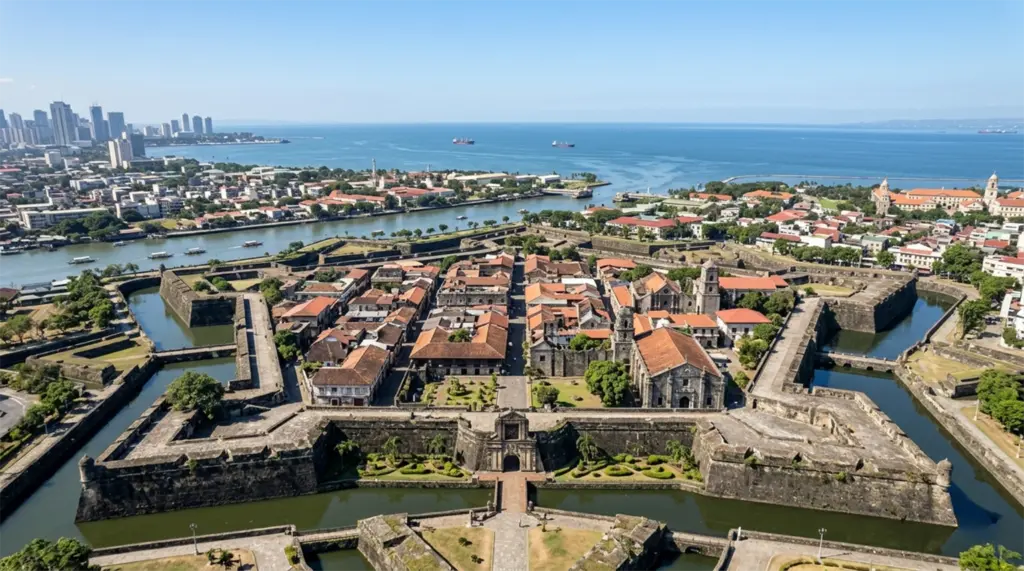
Intramuros was established in 1571 by Spanish conquistador Miguel López de Legazpi, who recognized the strategic value of the land where the Pasig River meets Manila Bay. The name means “within the walls” in Latin. That is exactly what it was designed to be: a fortified enclave for Spanish colonial administration. The walls stretched 4.5 kilometers, built to hold out foreign invaders.
The city followed a grid pattern centered on the Plaza Mayor, now Plaza de Roma. Government. Church. Military. Each institution reinforces the others. For more than three centuries, Intramuros served as the political and religious hub of the Spanish East Indies.
Its walls were tested repeatedly. The Dutch tried. The British succeeded briefly in 1762, occupying Manila for two years before Spain reclaimed it. Fort Santiago, positioned at the city’s northwest corner where the Pasig River meets the bay, was the primary line of defense through all of it.
Through Revolution and War
By the late 19th century, the walls that were built to protect Spanish power had come to represent something else entirely. Filipino nationalists viewed Intramuros as the physical embodiment of colonial oppression. The events of 1898 changed everything. The Spanish-American War. Commodore Dewey’s destruction of the Spanish fleet in Manila Bay. The subsequent transfer of the Philippines to American authority. Three centuries of Spanish colonial rule ended in a single year.
What the Spanish and Americans never managed to destroy, the Second World War nearly did. The Battle of Manila in 1945 was among the most destructive urban battles in the Pacific Theater. American and Japanese forces fought street by street through Intramuros. By the time it was over, most of the district lay in ruins. The churches, the palaces, the residential buildings, much of it was gone.
What survived and what was subsequently restored is what you walk through today. That context matters. These are not buildings that have stood untouched for 400 years. They are buildings that were rebuilt by people who decided their history was worth the effort.
Fort Santiago — This Is Why You Come
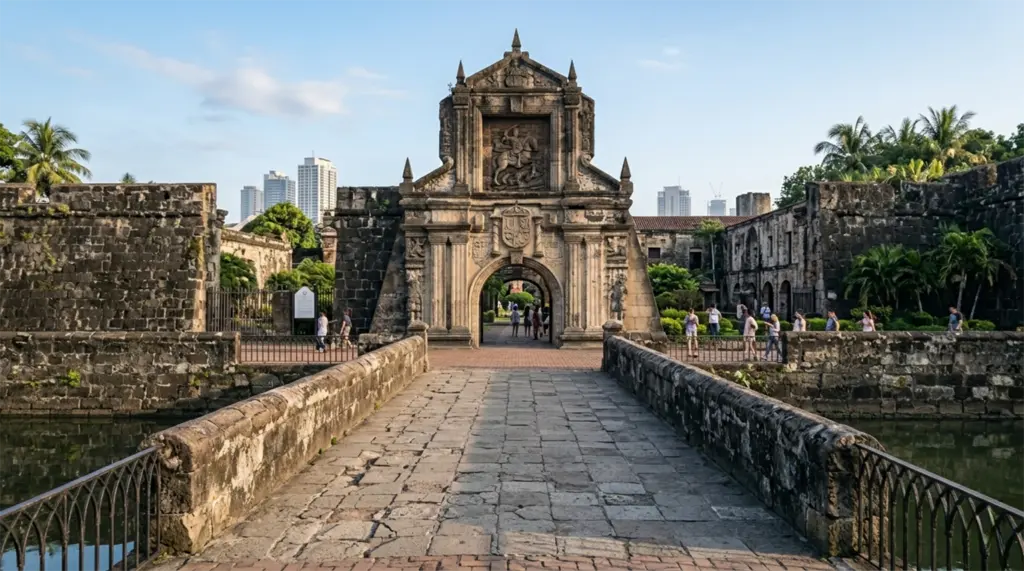
I have been to Fort Santiago, which has its own story in this series, more times than I can count, and it remains my favorite place in Intramuros. That’s saying something in a district this dense with significant sites.
The fort was originally constructed by Legazpi in 1571 on the same site as a previous Malay fortification. What stands today is the result of multiple reconstructions, the most recent following the devastation of 1945. But the bones are old, and you feel it the moment you cross the stone bridge over the moat and pass under the main gate.
Relationship to José Rizal
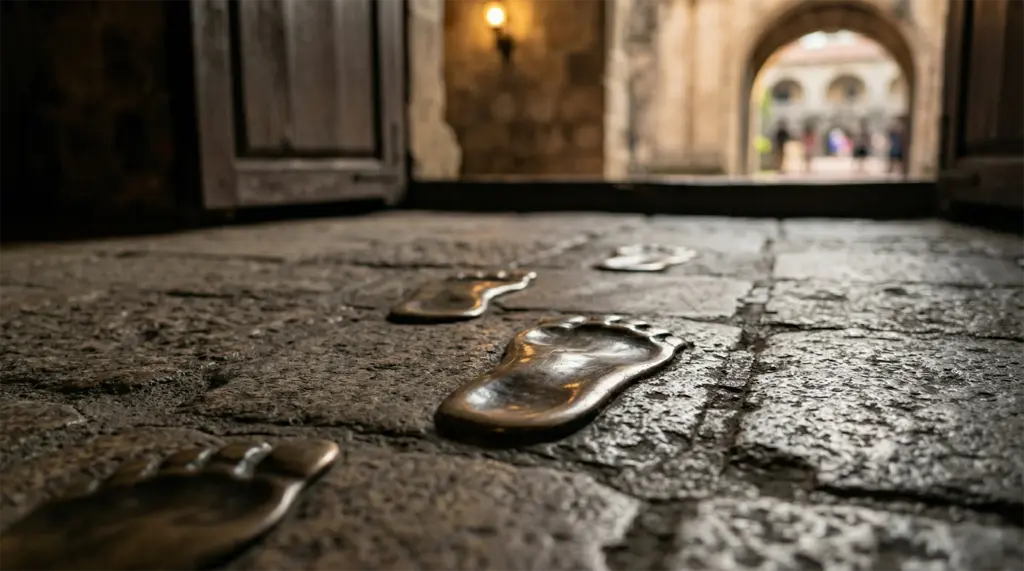
Inside, the Rizal Shrine occupies the rooms where national hero José Rizal spent his final days before his execution at Luneta on December 30, 1896. The exhibit is carefully done, his belongings, his final writings, the footsteps embedded in the floor tracing the path he walked to his death. I have stood in those rooms more than once. Each time, I stay longer than I planned.
The dungeons below the main structure are a different kind of experience. During the Spanish period, hundreds of prisoners were held in cells that flooded with the tides of the Pasig River. Many did not survive. The history is not comfortable. It is not meant to be. Intramuros earned its complexity the hard way.
For older travelers, the fort is accessible and manageable on foot. The grounds are shaded in places, the pace is yours to set, and there is enough to see that a full morning here is time well spent. Fort Santiago has its own dedicated article in this series; it deserves the depth it merits.
The Churches That Outlasted Empires
Two churches inside Intramuros are essential stops, and for very different reasons.
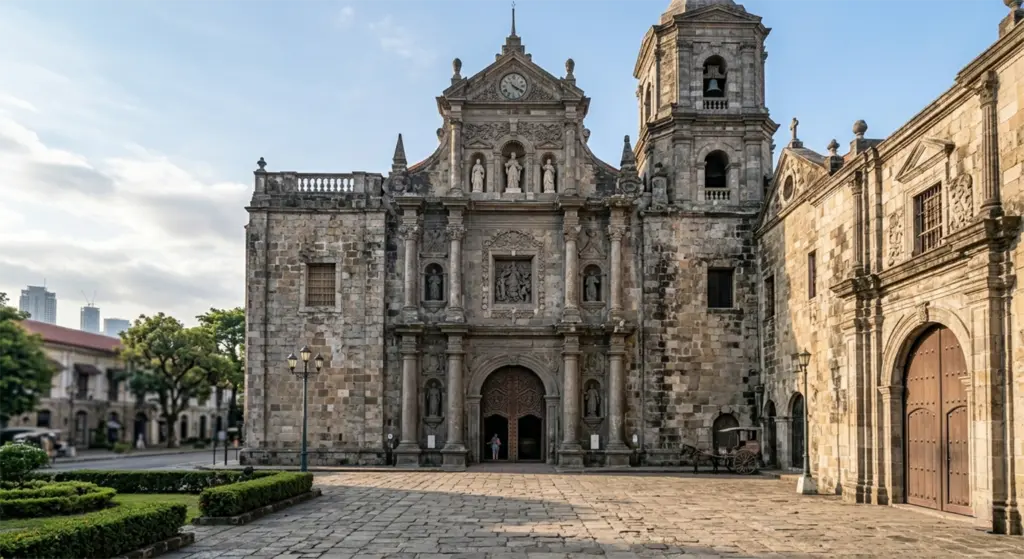
The Manila Cathedral, formally the Minor Basilica and Metropolitan Cathedral of the Immaculate Conception, has been destroyed and rebuilt eight times since its original construction in 1581. Earthquakes, fires, wars. The current structure dates to 1958 and incorporates Romanesque and Byzantine elements accumulated across centuries of reconstruction. It remains the seat of the Archbishop of Manila and the spiritual center of Philippine Catholicism. Attending a mass here, even briefly, gives you a different kind of access to what this city means to the people who live in it. Sitting in the nave on a quiet afternoon works just as well.
San Agustín Church is a different story entirely. Built between 1587 and 1606, it is the oldest stone church in the Philippines. It survived the Battle of Manila largely intact, one of the very few structures in Intramuros to do so. It is a UNESCO World Heritage Site, recognized for its Baroque architecture, its trompe-l’œil ceiling frescoes, and its extraordinary collection of religious art. San Agustín Church has its own article in this series. It earns one.
Walking Intramuros — What Older Travelers Need to Know
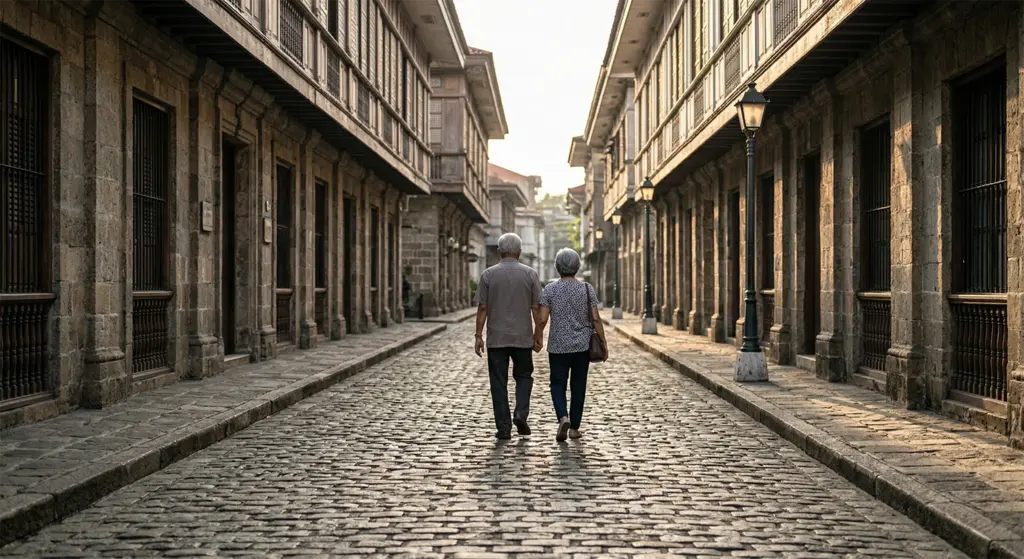
Intramuros is compact enough to walk, and that is exactly how it should be experienced. The cobblestone streets are uneven in places, worth knowing in advance if mobility is a consideration. Comfortable shoes are not optional. Bring water and a hat; the tropical sun is direct even in the dry season, and there is less shade than you’d expect.
The best months to visit are December through February, when temperatures are cooler, and the skies are more reliable. The rainy season (June through October) brings humidity and occasional flooding inside the walls, which can make the cobblestone streets genuinely difficult to navigate. Come during the dry season if you have a choice.
Kalesa rides, the horse-drawn carriages that have operated in Intramuros for generations, are both a practical option and an experience in themselves. They are slow, they are deliberate, and they give you a perspective on the walls and streets that walking does not. Tomas and his colleagues are typically available near the main gate. Negotiate the price before you get in.
Beyond Fort Santiago and the two churches, the district rewards slower exploration. Casa Manila recreates a Spanish colonial household in careful detail. The Bahay Tsinoy documents the Chinese-Filipino community’s role in shaping Philippine history. The Rizal Shrine within Fort Santiago has already been mentioned. Each adds depth without adding distance. Intramuros is small. You can cover the essential sites in a full day and leave with a clear picture of what happened here.
Photographers Delight
Photographers will find the district consistently rewarding. The gates, the walls, the interior courtyards of Fort Santiago, the facade of San Agustín, all of it photographs well at almost any time of day. Early morning offers cooler temperatures and fewer crowds. The Baluarte de San Diego provides elevated views of the bay and the surrounding district.
The Intramuros Golf Club — An Unusual Afternoon
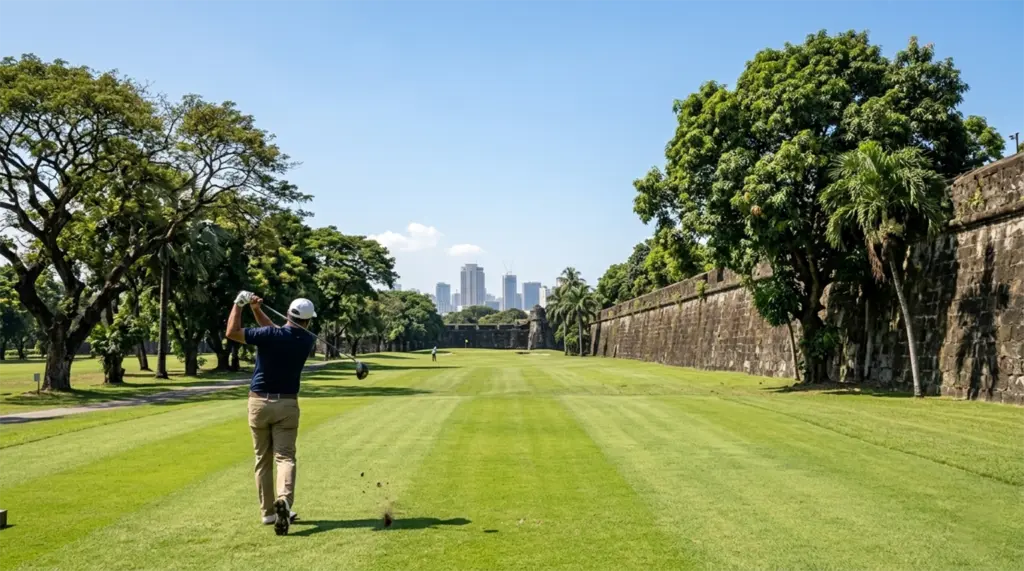
There is a golf course inside the walls of Intramuros. That sentence still sounds unlikely, no matter how many times I say it.
The Intramuros Golf Club has been operating since 1907, making it one of the oldest golf clubs in the Philippines and in Asia. The course runs through narrow fairways lined by ancient trees and bordered by 400-year-old ramparts. Playing here means navigating around colonial-era stonework that has no intention of moving for your ball. The wind direction shifts depending on which section of the walls you’re playing against. Experienced golfers, I’ve brought here walk off saying they’ve never played anything quite like it. People who have played courses around the world.
The clubhouse is worth a stop, even if you don’t play. Vintage photographs and memorabilia document decades of golf played against this improbable backdrop. It is the kind of place that reminds you that the Philippines has been accumulating stories for a very long time, and some of them are genuinely strange and wonderful.
For older travelers who golf, or who simply want to spend an afternoon somewhere unexpected, this is it. Book ahead, the course is popular with both local members and visiting golfers who make the trip specifically for the experience.
Eating Well Inside the Walls
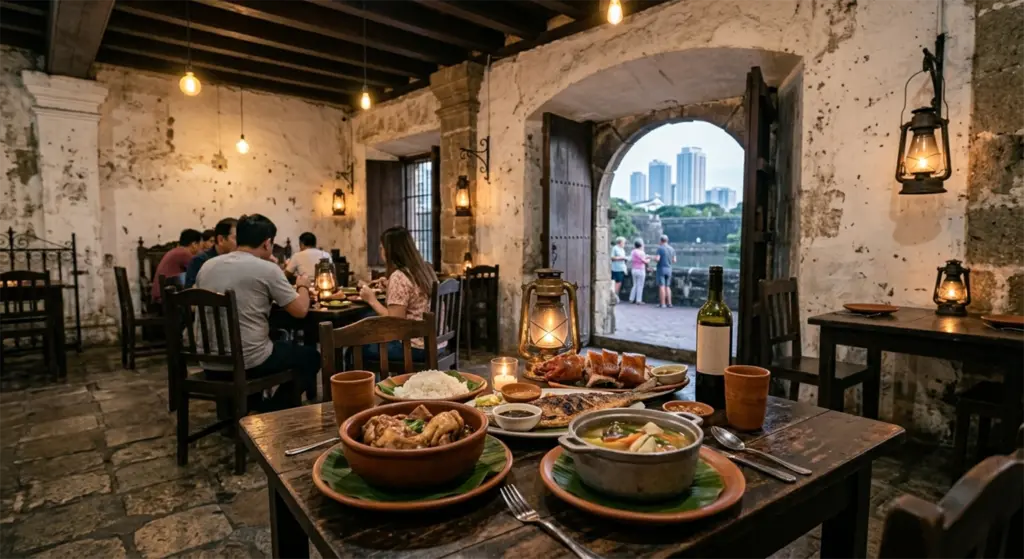
The restaurants inside Intramuros tend to lean into their setting, and that is the right instinct. Several have set up inside restored colonial buildings, where the stone walls and heavy wooden furniture do more for the atmosphere than any decorator could. The culinary history of the Philippines runs through this district. Four centuries of Spanish influence, layered over indigenous traditions, with Chinese and American contributions folded in over time. Dishes like adobo, sinigang, and lechon carry that history in their flavors.
For older travelers, the pace of dining in Intramuros is a feature rather than an inconvenience. Nobody is rushing you. The streets outside are quiet by Manila’s standards. An afternoon meal inside the walls, then a slow walk back toward the cathedral or Fort Santiago, that combination makes a travel day feel like it was worth the flight.
A District That Demands Something of You
Most tourist destinations ask very little of you beyond your presence and your money. Intramuros is different. The history here is not curated for comfort. The dungeons of Fort Santiago held people who died in them. The walls of Manila Cathedral have been rebuilt eight times because war and disaster kept taking them down. The cobblestones under Tomas’s kalesa were laid by hands that had no say in the matter.
Walking Intramuros with that understanding changes what you see. The buildings are not just architecture. The churches are not just for tourism. The golf course inside the ancient walls is not just a novelty. All of it is a record of what a people survived and what they chose to keep.
That is what the Philippines has always been good at. Keeping what matters. Building it back when it falls.
Go inside the walls. Pay attention. You’ll leave with more than photographs.
Frequently Asked Questions
Q1: How much time should older travelers plan to spend in Intramuros?
A full day is the right amount of time if you want to cover the essential sites without rushing. Fort Santiago alone warrants two to three hours if you spend time in the Rizal Shrine and walk the grounds properly. Add the Manila Cathedral and San Agustín Church, and you’ve filled a morning. An afternoon covers Casa Manila, the Bahay Tsinoy, a meal inside the walls, and whatever remains of the exploration list. If your mobility is limited or the heat is a concern, a half-day hitting the three major sites (Fort Santiago, Manila Cathedral, San Agustín) is a reasonable and rewarding alternative. The district is compact. You will not feel cheated by a shorter visit. Intramuros earns its reputation quickly.
Q2: Is Intramuros physically accessible for older travelers with mobility limitations?
Partially. The main sites, Fort Santiago, the Manila Cathedral, and San Agustín Church, are accessible to visitors who can manage some uneven ground and occasional steps. The cobblestone streets are the primary challenge. They are genuinely uneven in places, and proper footwear is essential, not optional. Kalesa rides are the practical solution for travelers who want to cover the district without extensive walking. The carriages move slowly enough to give you a proper look at the walls and buildings, and the drivers are accustomed to passengers who want to stop frequently. Within Fort Santiago, the dungeons require some descent and are less accessible, but the courtyard, the Rizal Shrine, and the rampart walls are manageable for most visitors.
Q3: What is the best way to get from Manila Bay to Intramuros?
The two are roughly two kilometers apart, which is walkable for travelers comfortable with that distance on a warm day. Rizal Park sits between them as a natural stopping point. Grab (the regional rideshare equivalent of Uber) is the simplest option for those who prefer not to walk: the fare is fixed before pickup, no negotiation required. Tricycles are available and cheaper but less predictable in their routes. Taxis are another reliable option, though confirming the meter is running at the outset is advisable. From the Roxas Boulevard hotels near Manila Bay, most drivers know how to get to Intramuros without further directions. The two destinations work well together as a single day’s itinerary, especially combined with a stop at Rizal Park in between.
Q4: What should I know about Fort Santiago before visiting?
Fort Santiago is open daily and charges a modest entrance fee. The grounds include the outer fortifications and moat area, the inner courtyard, the Rizal Shrine and museum, and access to sections of the rampart walls. The dungeons are accessible but require some navigation of tight, low-ceilinged spaces — worth knowing if claustrophobia is a concern. The Rizal Shrine is the emotional center of the visit: his belongings, his final writings, and the bronze footprints marking the path to his execution are presented with appropriate restraint. Morning visits are recommended, as cooler temperatures and fewer tour groups are present. If you want the experience of standing in those rooms without the noise, arrive early. The fort’s significance in Philippine history is hard to overstate, and the presentation does it justice.
Q5: Are the museums inside Intramuros worth visiting for older travelers?
Yes, selectively. Casa Manila recreates a late Spanish colonial household with period furniture, household objects, and architectural details that give you a concrete sense of what life inside the walls looked like for the upper class. It is compact, air-conditioned in parts, and worth an hour. The Bahay Tsinoy tells the story of Chinese-Filipino (Tsinoy) history and cultural contribution, a dimension of Philippine identity that is often underrepresented in broader historical accounts. The Rizal Shrine within Fort Santiago is the most emotionally significant museum in the district. For travelers who want a clear through-line rather than a comprehensive survey, the sequence Fort Santiago → San Agustín Museum → Casa Manila covers the major historical periods without becoming overwhelming.
Q6: How does Intramuros connect to other attractions in the Manila area?
Intramuros is the historical anchor of a cluster of significant Manila sites that work well together as a multi-day itinerary. Manila Bay and the Baywalk along Roxas Boulevard are immediately to the west. Rizal Park — where José Rizal was executed in 1896 — lies just outside the southern walls and connects Intramuros to both the colonial and revolutionary narrative. Fort Santiago has its own dedicated article in this series, given the depth of its history. San Agustín Church does as well. Taken together, these sites form a coherent picture of what Manila was, what it became, and how the Philippines arrived at its present state. No single site tells the complete story. All of them together come close.
Q7: Is the Intramuros Golf Club open to visiting golfers?
Yes. The Intramuros Golf Club accepts visiting golfers, though booking ahead is strongly recommended given the course’s limited capacity and its popularity with members and visiting enthusiasts alike. Green fees are reasonable by international standards. Caddies are available and are an asset here; the course’s quirks (narrow fairways, wall-adjacent rough, shifting wind from the ramparts) are the kind of thing a local caddy can brief you on before you start losing balls to 400-year-old stonework. The clubhouse is open to non-golfers who want to see the historical memorabilia and photographs. The course dates to 1907 and has a character that no modern course can replicate. If you golf, this is worth rearranging your schedule for.
SUGGESTIONS FOR LODGING AND TRAVEL
Lodging is widely available throughout the Philippines. However, you may want to get some assistance booking tours to some of the Philippines’ attractions. I’ve provided a few local agencies that we’ve found to be very good for setting up tours. For transparency: We may earn a commission when you click on certain links in this article, but this doesn’t influence our editorial standards. We only recommend services that we genuinely believe will enhance your travel experiences. This will not cost you anything, and I can continue to support this site through these links.
- For Hotel Accommodations in the Manila area, I highly recommend The Manila Hotel. It is centrally located and within walking distance of Rizal Park and Intramuros. Many other attractions are easily accessible from there as well. I have provided a search box below for you to find hotels (click on “Stays” at the top) or flights (click on “Flights” at the top). This tool will provide me with an affiliate commission (at no cost to you).
Local Lodging Assistance
- Guide to the Philippines: This site specializes in tours throughout the Philippines. They seem to have some flexibility in scheduling, and pricing is very competitive.
- Kapwa Travel is a travel company focused on the Philippines. It specializes in customizing trips to meet customers’ needs.
- Tourismo Filipino is a well-established company that has operated for over 40 years. It focuses on tailoring tours to meet customers’ needs.
- Tropical Experience Travel Services – Tours of the Philippines: This company offers a range of tour packages, allowing you to tailor your trip to your preferences.
Lastly, we recommend booking international travel flights through established organizations rather than a local travel agent in the Philippines. I recommend Expedia.com (see the box below), the site I use to book my international travel. I have provided a search box below for you to use to search for flights (click on “Flights” at the top) or Hotels (click on “Stays” at the top). This tool will provide me with an affiliate commission (at no cost to you).