The noise hits you before you see anything. The Sinulog Festival of Cebu fills the streets of Cebu City with an estimated two million people on the third Sunday of January, and their collective voice produces a sound you feel in your sternum before you locate its source. The chant is “Pit Señor,” a Cebuano phrase invoking the Santo Niño, the Child Jesus, and it moves through the crowd like a current. You do not learn it. You absorb it.
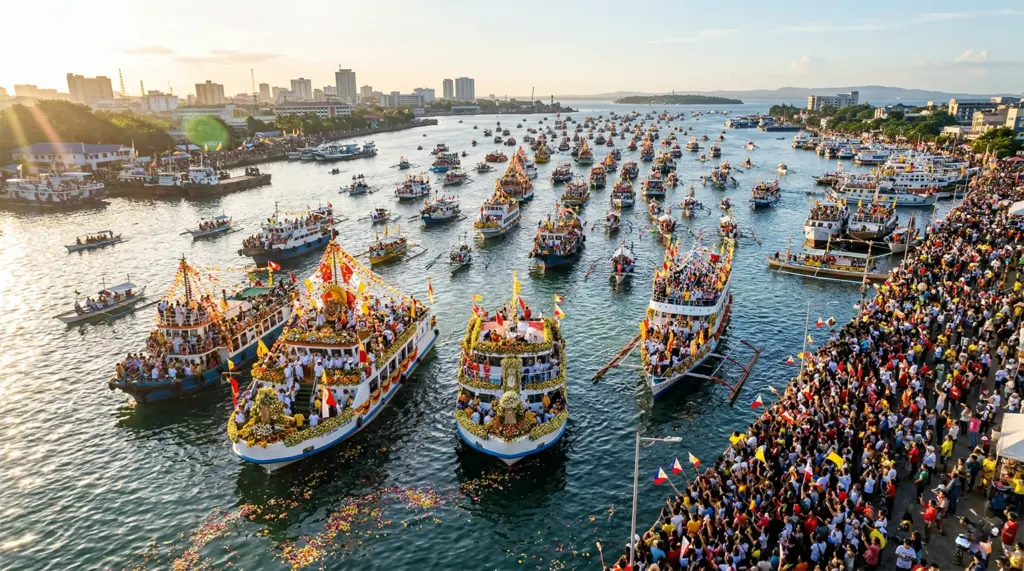
I was standing near the sea wall at the Cebu Harbor the day before the Grand Parade, watching the Fluvial Procession. The image of the Santo Niño traveled by boat across the water while thousands of people lined the shore. The people around me were not watching a spectacle. They were participating in something that has been continuous in this city since the 16th century.
That continuity is what separates this festival from every other I have attended in the Philippines. Most festivals celebrate the past. Sinulog is still in the present tense.
What the Sinulog Festival of Cebu Actually Is
The name comes from the Cebuano word sulog, meaning current of water. It describes the two-step movement of the Sinulog dance: forward one step, back one step, mimicking the flow of a river. The dance came first. The festival grew around it.
The roots go back to 1521. Ferdinand Magellan gifted an image of the Santo Niño, the Child Jesus, to Queen Juana of Cebu as part of the baptism ceremony that marked the introduction of Christianity to the Philippines. Cebuano tradition holds that the image was rediscovered in 1565 by a soldier named Juan Camus, serving in Legazpi’s expedition, inside a burned house and intact. That image, the Santo Niño de Cebu, is the one venerated in the Basilica del Santo Niño today.
The festival formalizes centuries of devotion into a structured annual celebration. The third Sunday of January is the feast of the Santo Niño across the Philippines, but Cebu is where it is largest. Participants dance the Sinulog while holding a lit candle or a replica of the Santo Niño above their heads, moving in a forward-and-back water-current motion.
The festival runs as three things simultaneously: a religious observance, a civic event, and a cultural competition. Understanding all three is the difference between watching the festival and understanding what you are watching.
The Fluvial Procession and the Grand Parade
The festival runs across roughly ten days, but two events define it.
The Fluvial Procession takes place on the Saturday before the Grand Parade. The Santo Niño image travels by boat from the Cebu Harbor area to the Basilica del Santo Niño, accompanied by decorated flotillas and followed by thousands of devotees along the shore. If you can attend one event during Sinulog, make it this one. The Grand Parade is more organized as a visual spectacle. The Fluvial Procession is more emotionally honest.
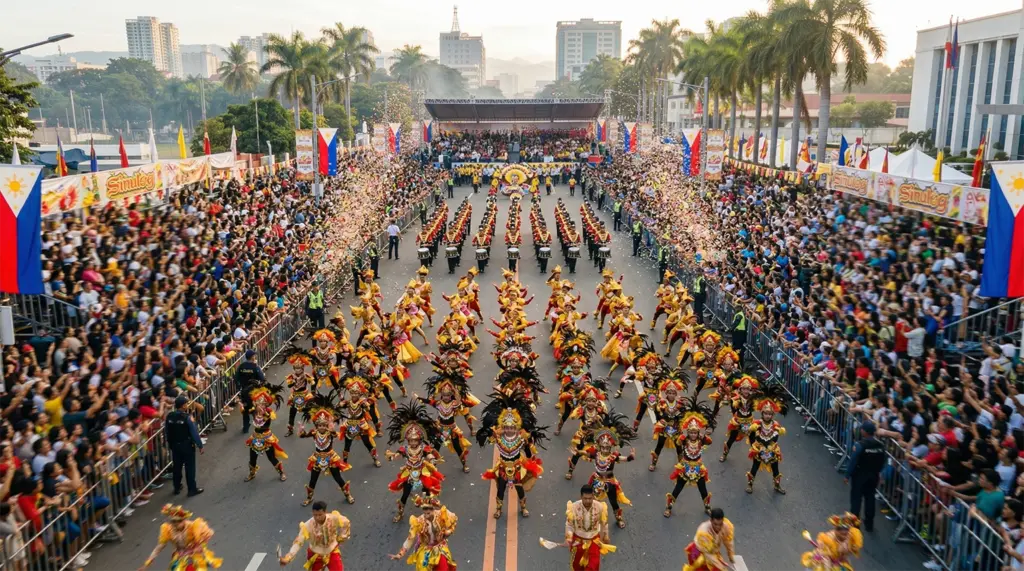
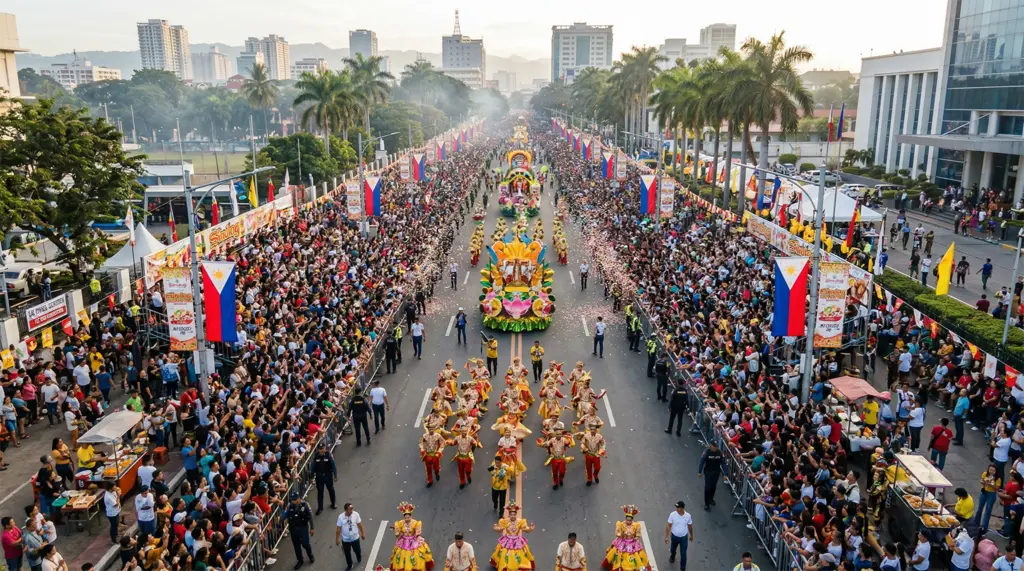
The Grand Parade happens on the third Sunday of January along Osmeña Boulevard, the main avenue through Cebu City. It is a competition. Contingents from across the Philippines compete for prizes in categories including dance performance, costume design, and musical accompaniment. Each contingent performs for roughly five to seven minutes as they pass the judging area.
A few things worth knowing before you go. The parade route runs from Fuente Osmeña Circle south through the city center. A position near the judging area gives the best performances. A position near the start gives smaller crowds. Arrive by 7 am. By 9 am, the viewing positions along the boulevard are five to seven people deep. By midday in the January heat, standing for another four hours becomes a real commitment.
Kuya Rolando, a contingent coordinator from Mandaue City, whom I spoke with near the start of the parade, explained the preparation timeline: six months of rehearsals for the main contingents. Costumes for the larger groups represent costs in the hundreds of thousands of pesos. The judging is taken seriously by every team involved.
The Basilica del Santo Niño
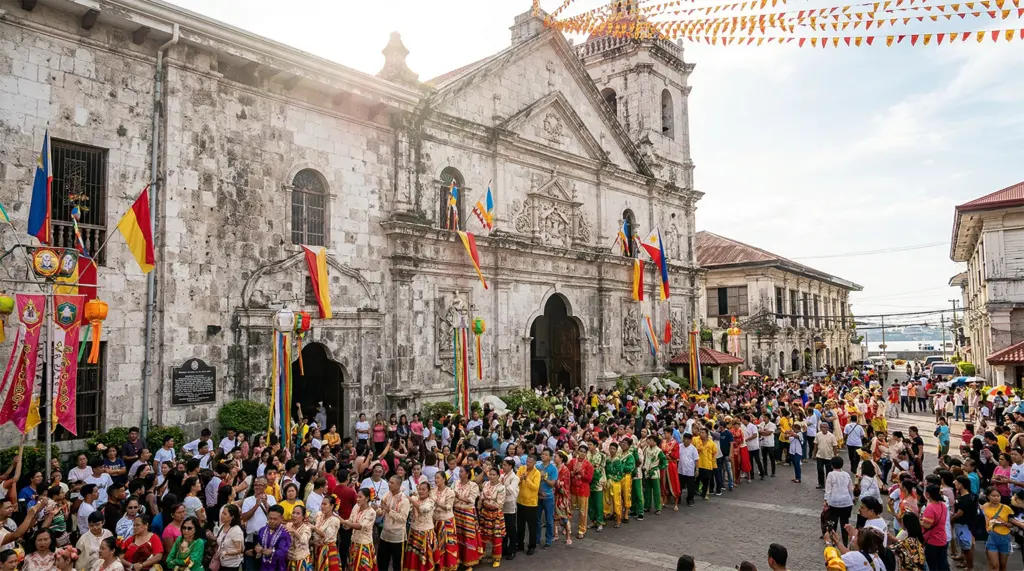
The Basilica Minor del Santo Niño is the oldest Roman Catholic church in the Philippines. The current building dates primarily from 1739, though a church has stood on this site since shortly after the Spanish arrived in the 16th century. The image of the Santo Niño de Cebu is kept in the basilica’s museum and brought out for public veneration during the festival period.
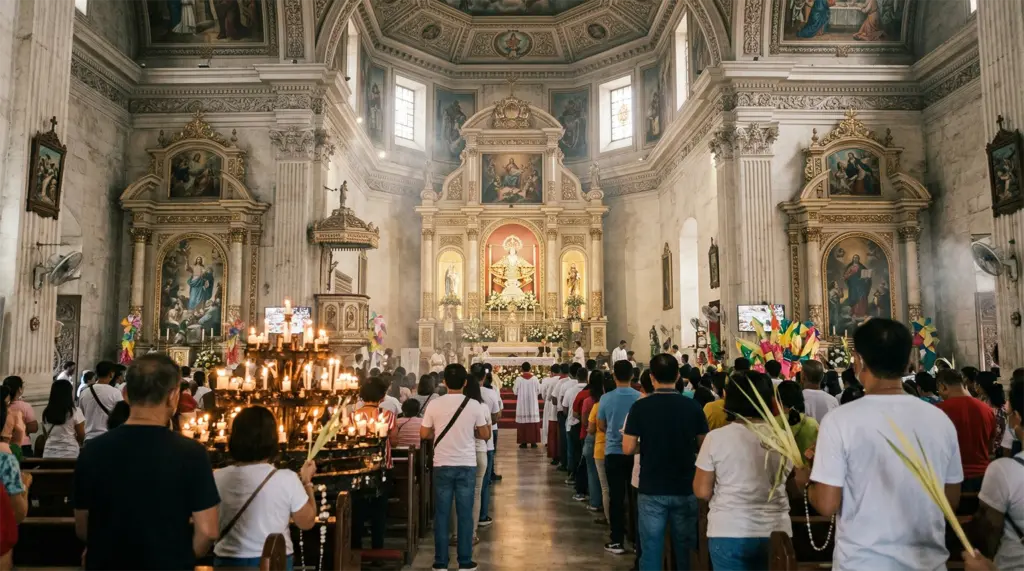
During Sinulog, the basilica does not close. It runs continuous masses. The line to venerate the Santo Niño image extends outside the church and down the street for most of the festival period.
What you experience inside during Sinulog is not an ordinary Sunday mass. The space holds several thousand people. The devotion is visible and physical. People press forward, touch the image, and pray aloud. The atmosphere is not performative. These are people engaging with something they consider genuinely present.
For that reason, visit the basilica either before 7 am or after 8 pm if your primary interest is the architecture and the museum collection. If your primary interest is understanding what the Sinulog Festival of Cebu means to its participants, go during peak hours and stand in line with everyone else. The two visits will give you entirely different things.
Sinulog Food
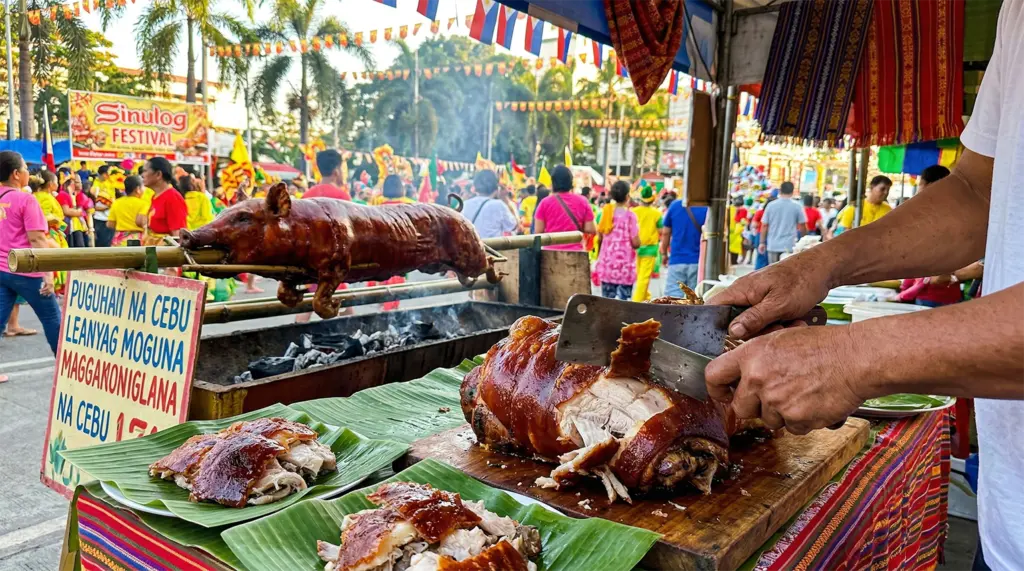
Cebu has the best lechon in the Philippines. That is not a tourist pitch. The Cebuano preparation differs from Manila and Batangas lechon in one significant way: the seasoning is internal. Lemongrass, garlic, green onions, and salt are stuffed inside the pig before roasting. The skin gets its crispness from slow rotation over open charcoal fire. The result is a skin that shatters when cut and a meat that tastes like pork, not like sauce. During Sinulog, lechon vendors line the streets around the festival grounds. The better ones sell out by early afternoon. Go early.
The other dish worth knowing is tuslob buwa, which translates as “dip in bubbles.” A clay pot of broth made from pig brain, liver, and soy sauce sits over an open flame. The broth bubbles. You dip puso, hanging rice cooked inside woven coconut fronds, directly into the boiling pot. Found primarily around the Carbon Market area of Cebu City. Ask a local where to find it. They will either tell you directly or take you there themselves.
Ginabot, deep-fried pork intestines, is the other festival staple. Sold from street carts. Eaten standing. Crispy, fatty, and considerably more approachable than the name suggests to someone trying it for the first time.
Sinuglaw combines grilled pork belly with raw fish ceviche in a single dish. The name joins sinugba (grilled) and kinilaw (ceviche). Order it at a sit-down restaurant rather than from a street cart.
The Contingents
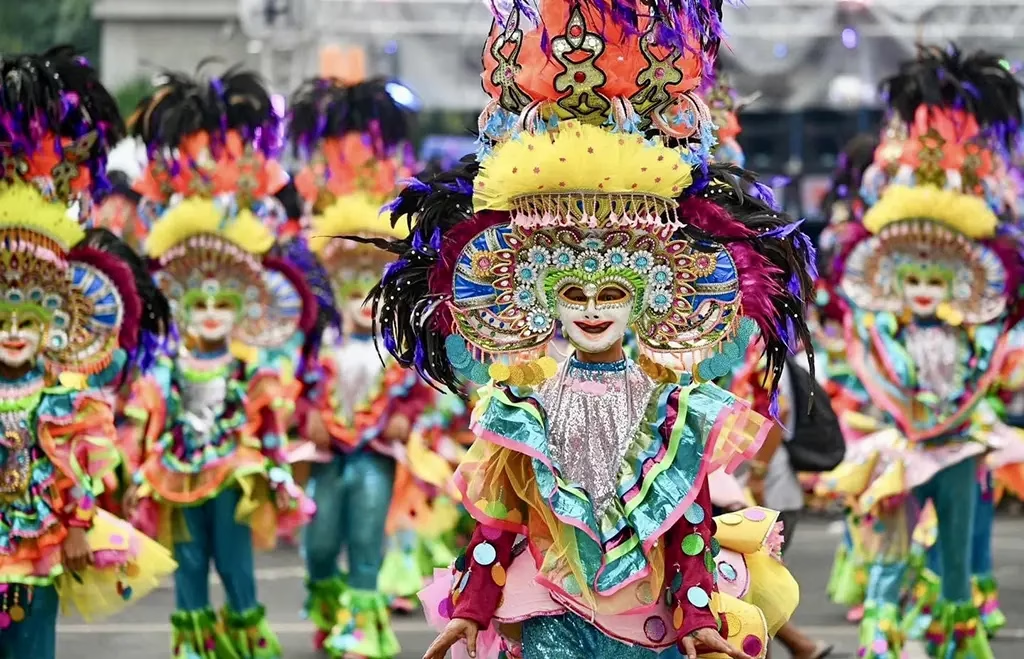
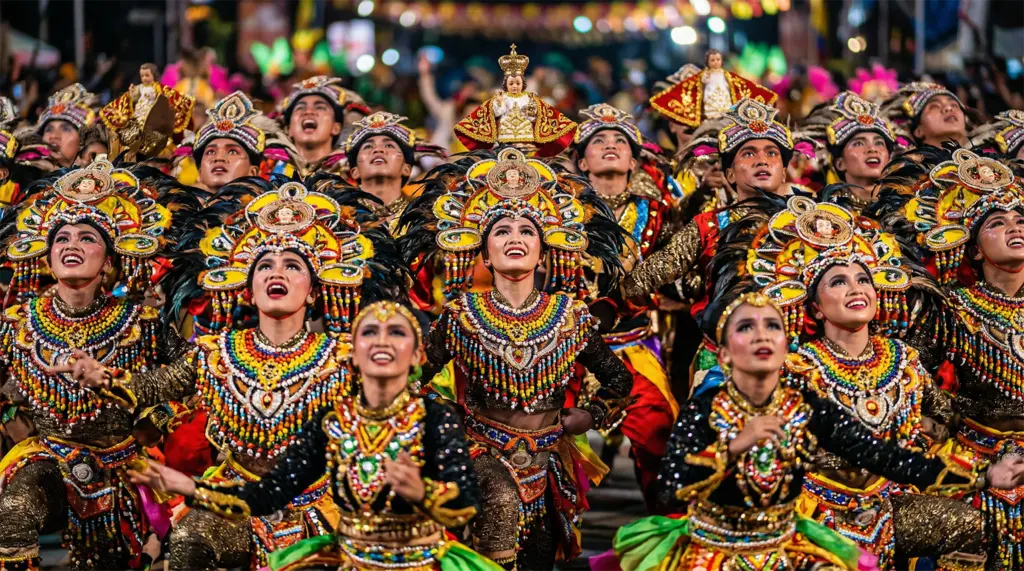
The Grand Parade is a competition, and that distinction matters. The street dancing performances are not spontaneous. They are choreographed, rehearsed, costumed, and evaluated by a panel of judges. Each contingent tells a story through movement and costume, drawn from Philippine history, religious narrative, or regional culture.
A major contingent can involve hundreds of dancers in coordinated formations with live drum corps accompaniment and costumes that cost more than most people’s monthly salaries. The aesthetic is closer to competitive carnival than to street parties, but the religious devotion underneath it is genuine.
The Free Interpretation category produces the most competitive performances. Contingents here have more creative latitude in interpreting the Sinulog theme. These performances tend to produce the photographs that define the festival in any given year.
Position yourself near the grandstand area if you have a choice of where to stand along the route. The contingents perform at full intensity as they pass the judges. Before and after that stretch, the energy is different.
Planning a Sinulog Festival of Cebu Trip
Book accommodation in Cebu City three to four months before the festival. The hotels within walking distance of Osmeña Boulevard sell out first. Serviced apartments and Airbnb properties in the IT Park and Lahug neighborhoods fill next. By December, what remains is overpriced or far outside the parade area.
Cebu City is accessible by direct flight from Manila in approximately one hour. Cebu Pacific, Philippine Airlines, and AirAsia all operate the route. During Sinulog week, flights sell out and prices rise significantly. Book early. International connections are served by Mactan-Cebu International Airport on Mactan Island, which is connected to Cebu City by two bridges. Budget ninety minutes to two hours from the airport to downtown during festival week due to bridge traffic.
Getting around during Sinulog requires adjusted expectations. Major roads will be closed for the parade. Jeepney routes shift. A taxi ride that normally takes twenty minutes can take ninety on parade day. Walk if the distance allows. Accept the pace if it does not. The city manages this crowd every year. You need to know what you are arriving at.
Prepare for the Crowd
The crowd size is real. Two million people over the festival period. The Grand Parade day is the peak. Carry water. Know where the nearest side street is relative to where you are standing. Keep your phone and cash inside your clothing, not in a bag. The crowd is not hostile. It is one of the densest you will encounter anywhere in Asia.
There is a version of the Sinulog Festival of Cebu that is easy to consume: the photographs, the costumes, the lechon, the fireworks. That version is real and it delivers what it promises. But consuming the spectacle without acknowledging the religious event underneath it is like applauding a mass for the organ music. The festival exists because millions of Filipinos believe the Santo Niño is present, real, and worth the annual crowd that chants, echoing off the seawall at Cebu Harbor. Whether you share that belief or not, you are standing inside it. Behave accordingly.
Frequently Asked Questions
Q1: When is the Sinulog Festival of Cebu?
Sinulog is held on the third Sunday of January each year, with the surrounding festival period running approximately ten days. The two defining events are the Fluvial Procession on the Saturday before the Grand Parade, and the Grand Parade itself on Sunday along Osmeña Boulevard. The Grand Parade day is when the estimated two million attendees are at peak density in the city. In 2026, the Grand Parade fell on January 18. In 2027, it falls on January 17. The exact date shifts by one to two days each year based on the calendar. Verify the specific date for the year you plan to attend through the Sinulog Foundation’s official announcements, which are published several months in advance. Block the entire third week of January to be safe: the week before the Grand Parade is when contingents do final rehearsals in public, and that alone is worth watching.
Q2: How do I get from Manila to Cebu for Sinulog?
Cebu Pacific, Philippine Airlines, and AirAsia all fly direct from Manila to Mactan-Cebu International Airport. The flight is approximately one hour. During Sinulog week, flights sell out, and prices rise significantly, sometimes doubling from their off-season rates. Book three to four months ahead. Do not leave this as an afterthought. The airport is on Mactan Island, connected to Cebu City by two bridges. Budget ninety minutes to two hours from the airport to downtown during festival week due to bridge and city traffic. Rideshare apps and taxis are available from the airport; rates are metered or set by the app. If you are arriving from outside the Philippines, most international flights to Cebu go through Manila or Kuala Lumpur. Cebu Pacific and a small number of regional carriers also operate limited direct international routes into Mactan from cities including Singapore, Hong Kong, and Seoul. Check the airport’s current international route list when planning.
Q3: What is the Sinulog dance, and what does “Pit Señor” mean?
The sinulog dance is a traditional Cebuano movement: one step forward, one step back, mimicking the flow of a river. The name comes from the Cebuano word sulog, meaning current of water. Performers hold a lighted candle or a replica of the Santo Niño image while dancing. In competitive contingents, this basic movement becomes the choreographic foundation for elaborate formations involving hundreds of dancers. “Pit Señor” is a Cebuano exclamation invoking the Santo Niño. “Pit” derives from the Spanish Viva, meaning long live, and “Señor” refers to the Child Jesus. During Sinulog, the phrase is chanted continuously: by the crowd at the basilica, by devotees along the Fluvial Procession route, by spectators at the parade, and by vendors in the food bazaars. If you are in Cebu during Sinulog and not yet familiar with the phrase, you will know it by the end of your first morning. It is impossible to miss.
Q4: Is the Sinulog Festival of Cebu only for Catholics?
No. Non-Catholics and visitors of no religious affiliation attend Sinulog as cultural participants. The festival has religious origins, and the core observances, including the Mass, the Fluvial Procession, and veneration of the Santo Niño at the basilica, are Catholic events. The Grand Parade, the street parties, and the food bazaars are open to everyone regardless of belief or background. Respect for the religious dimension is expected of all visitors. The basilica is an active place of worship during the festival. Entering it in beachwear, speaking loudly during mass, or treating the veneration queue as a photography stop without participating respectfully would be noticed and is not appropriate. The practical guidance is straightforward: treat the basilica and the procession route as you would any active place of worship. Everywhere else at Sinulog, you are welcome as you are. The Philippine approach to visitors at religious events is genuinely open. Do not mistake that openness for indifference to what is happening.
Q5: What food should I not miss at Sinulog?
Three dishes are non-negotiable for a Sinulog visit to Cebu. First, lechon Cebu: the roasted pig stuffed with lemongrass, garlic, and green onion before roasting. Find a vendor with a line. The line means the skin is still crackling. Second, tuslob buwa: boiling pig brain broth into which you dip puso, the hanging rice cooked inside woven coconut fronds. It is found primarily around the Carbon Market area of Cebu City. Ask a local where to find the right spot, not a hotel concierge. Third, ginabot, deep-fried pork intestines sold from street carts. It sounds more complicated than it tastes. For a sit-down meal, order sinuglaw, which is grilled pork belly combined with raw fish kinilaw, at any of the restaurants in IT Park or Lahug. Skip the international chains during Sinulog week. Everything they do is better elsewhere in the city for a third of the price.
Q6: What else is worth doing in Cebu during Sinulog week?
The Basilica del Santo Niño and Fort San Pedro are both within walking distance of the festival center. Fort San Pedro is a small triangular fort from the Spanish colonial period; it is worth an hour. Magellan’s Cross, next to the basilica, marks the site of the 1521 baptism that laid the historical foundation of Sinulog. Carbon Market is Cebu City’s main public market and is worth a morning visit for the seafood section and the general atmosphere of a working Filipino market. If you have a day free from the festival program, the bus to Moalboal on Cebu’s southwest coast takes approximately 2 hours from the South Bus Terminal. The sardine shoal there, a moving mass of millions of fish in very shallow water, is one of the more unusual wildlife encounters in the Philippines. The sea turtle colony at the dive sites off Panagsama Beach is accessible without certification. Plan the day trip for a non-parade day when transport options are more predictable.
Other Related Articles that may be of Interest
You may also find the following articles interesting.
- The History and Modern Relevance of the Ifugao Rice Terraces
- Luzon Region macro page
Suggestions For Lodging and Travel
Lodging is widely available throughout the Philippines. However, you may want to consider getting assistance booking tours to some of the Philippines’ attractions. I’ve provided a few local agencies that we’ve found very good for setting up tours. For transparency, we may earn a commission when you click on certain links in this article, but this doesn’t influence our editorial standards. We only recommend services that we genuinely believe will enhance your travel experiences. This will not cost you anything, and I can continue to support this site through these links.
Local Lodging Assistance
Guide to the Philippines: This site specializes in tours across the Philippines, offering flexible scheduling and competitive pricing. I highly recommend them for booking local arrangements for a trip like this one. You can book flights and hotels through the Expedia link provided below.
Hotel Accommodations: I highly recommend The Manila Hotel for a stay in Manila. I stay here every time I travel to the Philippines. It is centrally located, and many attractions are easily accessible. Intramuros and Rizal Park are within walking distance. I have provided a search box below for you to find hotels (click “Stays” at the top) or flights (click “Flights” at the top). This tool will provide me with an affiliate commission (at no additional cost to you).
Kapwa Travel is a travel company focused on the Philippines. It specializes in customizing trips to meet customers’ needs.
Tourismo Filipino is a well-established company that has been operating for over 40 years. It specializes in tailoring tours to meet customers’ needs.
Tropical Experience Travel Services – Tours of the Philippines: This company offers a range of tour packages, allowing you to tailor your trip to your preferences.
Lastly, we recommend booking international travel flights through established organizations rather than a local travel agent in the Philippines. I recommend Expedia.com (see the box below), the site I use to book my international travel. I have provided a search box below for you to use to find flights (click “Flights” at the top) or Hotels (click “Stays” at the top). This tool will provide me with an affiliate commission (at no cost to you).