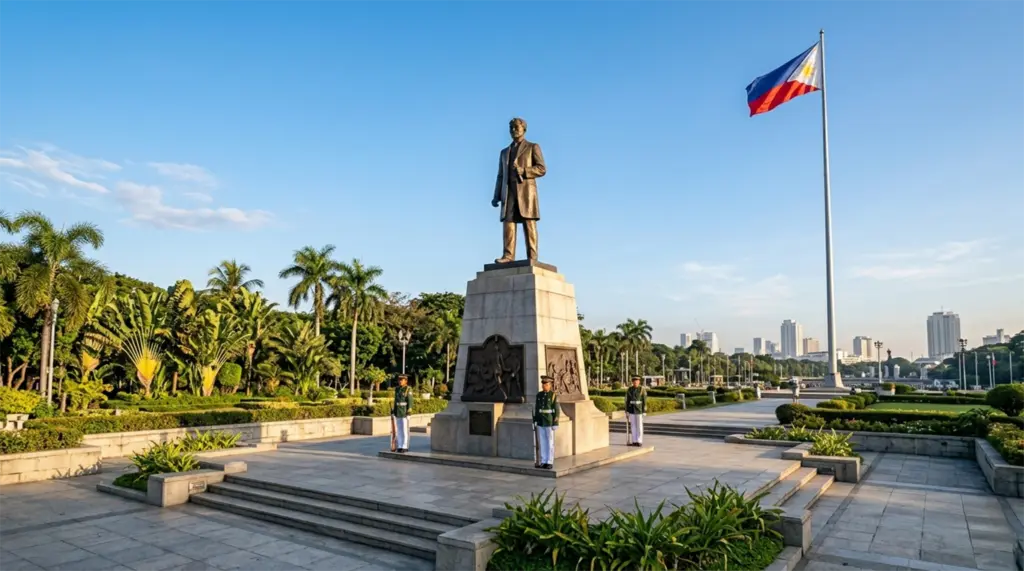
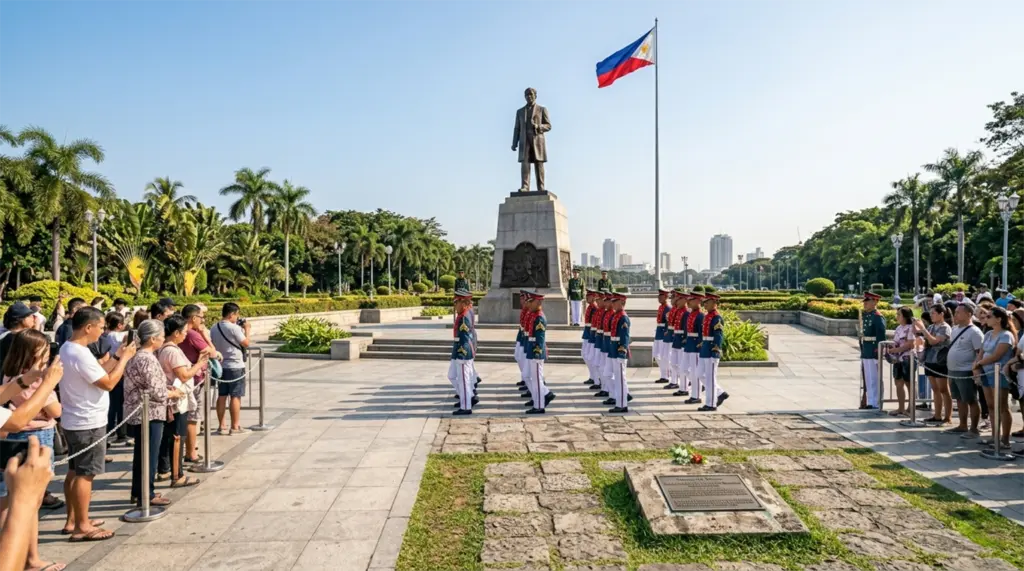
From The Manila Hotel, Rizal Park is right there. Cross Roxas Boulevard in the morning, early enough to beat the heat and the crowds, and you walk straight into it. The Rizal Monument is visible almost immediately. A 12-meter bronze figure rising above the sunken garden at the park’s eastern end. The honor guard flanking the base stands at attention. They are not decorative. They rotate in a ceremony. The changing of the guards is one of the more quietly impressive things you will see in Manila.
I have made that walk from the hotel more times than I can count. Each time, the park feels a little different depending on the hour, the season, and who else is there. Morning joggers, families setting up picnics, school groups arriving with matching shirts and clipboards, and vendors who have been working these grounds for years. A man named Mang Ernesto, who sells bottled water from a cart near the monument and seems to know the schedule of every guard rotation and every tour bus. He once told me he had been coming to this park every day for twenty-three years. “This is my office,” he said, without irony.
For older travelers staying near the bay, Rizal Park is not a side trip. It is the anchor of everything else you do in central Manila. The history here is not behind glass. You are standing on it.
The Man the Monument Remembers
José Rizal was not a soldier. That is the first thing to understand when you stand before his monument. He was a novelist, a poet, a surgeon, a sculptor, and a polyglot who spoke more than a dozen languages. He traveled throughout Europe and Asia and wrote two novels, Noli Me Tángere and El Filibusterismo. The Spanish government immediately saw them as a threat and banned them both. Not a threat of arms. A threat to consciousness. Those books told Filipinos what they were, what had been done to them, and what was possible. The Spanish banned both.
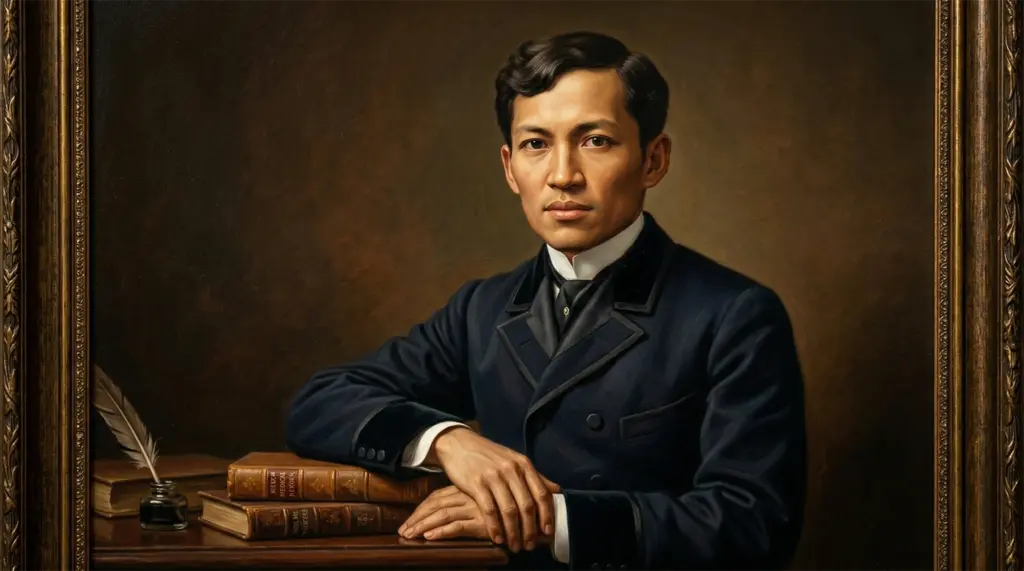
Rizal consistently and explicitly opposed armed revolution. He believed change had to come through reform, through education, through the power of ideas articulated clearly enough to be unignorable. The Spanish colonial authorities did not share his distinction between the pen and the sword. In their view, a man capable of making five million people question their colonial situation was as dangerous as any general. They arrested him, tried him for sedition, and sentenced him to death.
The Last Walk
On the night of December 29, 1896, Rizal wrote “Mi Último Adiós,” My Last Farewell, a poem he concealed in an alcohol lamp and left for his family. He was thirty-five years old. The following morning, December 30, he was marched to Bagumbayan Field, now Rizal Park, and shot by a Filipino firing squad ordered by the Spanish authorities. His death had the opposite effect from what Spain intended. The Philippine Revolution, which Rizal had tried to prevent through peaceful means, ignited in the weeks that followed. Within two years, three centuries of Spanish colonial rule had ended. The man who chose a pen over a gun became the face of a nation that took up arms without him. The Filipinos declared him their national hero in 1901. The park where he was executed carries his name.
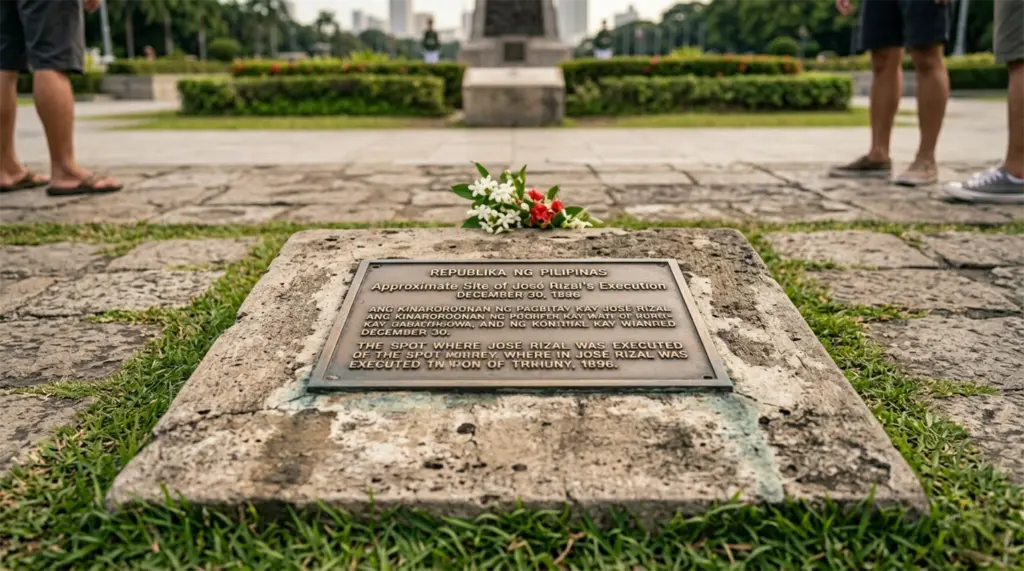
A concrete marker on the park grounds indicates the approximate spot where he stood on that morning. It does not announce itself loudly. You can walk past it without noticing. Worth finding.
The Monument and the Changing of the Guards
The Rizal Monument was unveiled on December 30, 1913 — the seventeenth anniversary of his execution. The bronze figure, cast by Swiss sculptor Richard Kissling, shows Rizal in the final moment before the firing squad: collar open, hands at his sides, his posture the same steady composure his contemporaries described at his actual death. His remains are interred in the base of the monument.
The sunken garden surrounding the monument gives it scale. Descend the shallow steps and look back up at the figure, and the proportions work. It is a well-designed memorial space: open enough that it does not feel confined, but structured enough to direct your attention where it belongs.
The honor guard, soldiers from the Philippine Army, Navy, Marine Corps, and Air Force rotating in assigned periods, stand at attention at the four corners of the monument base. The changing of the guards ceremony takes place every hour. I have watched it probably a dozen times over the years. Each ceremony takes roughly ten minutes: the incoming guard marches in formation from the park edge, the exchange is conducted with the kind of precision that requires more rehearsal than most people realize, and the outgoing guard marches out. It is worth positioning yourself with a clear sightline to the front of the monument. The ceremony is solemn, well-executed, and free.
Significant Dates
The Philippine flag flies from the monument’s tall mast to the south. On national holidays, and particularly on June 19 (Rizal’s birthday) and December 30 (Rizal Day, which is also the anniversary of his execution), the park fills with ceremonies, wreaths, and officials. If you happen to be in Manila on either of those dates, the park is worth the effort to visit, even if your schedule is already full.
The Park Beyond the Monument
Rizal Park covers 58 hectares. The monument is the reason most visitors come, but the park is considerably more than one statue and a sunken garden. Give yourself at least half a day if you want to see it properly.
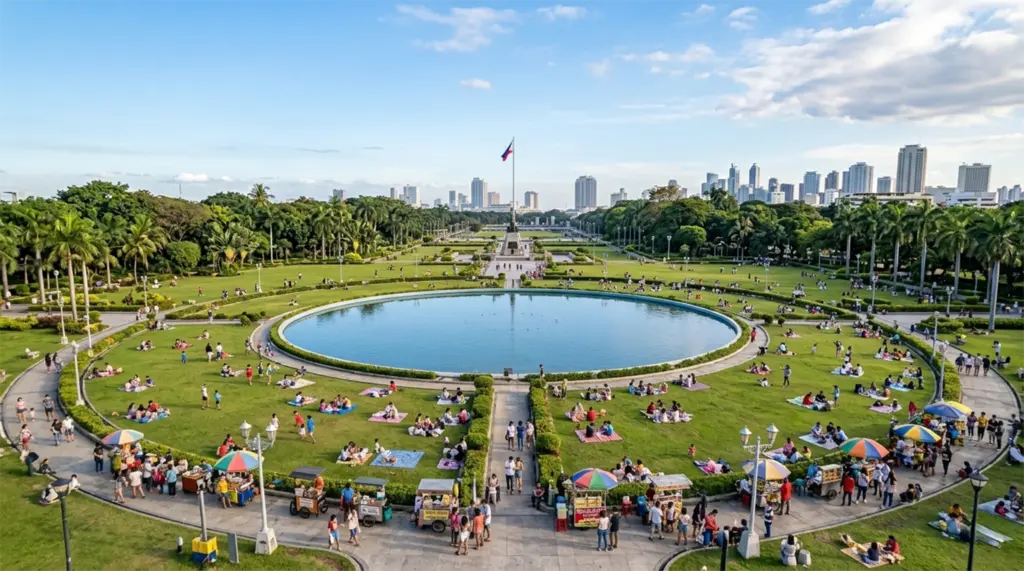
The Agrifina Circle lagoon sits at the park’s center, a large reflecting pool surrounded by open lawn, making for good photographs in the early morning light before the crowds arrive. Families gather here on weekends. Vendors circle the perimeter. The atmosphere is more that of a neighborhood park than of a national monument, which is exactly what it is meant to be.
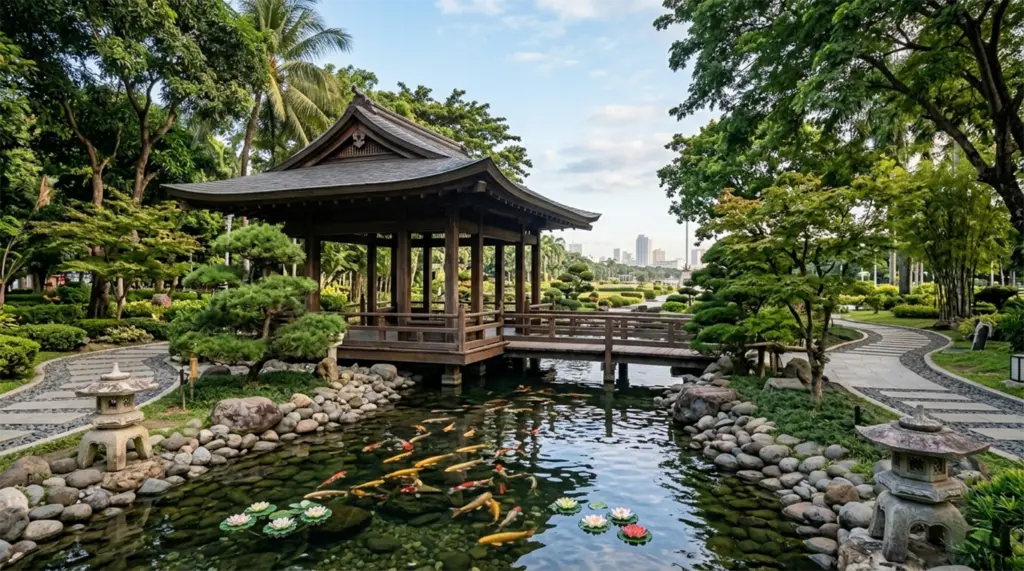
The Chinese Garden and the Japanese Garden occupy the southern section of the park, each constructed as a diplomatic gift from its respective government. Neither is large, but both provide genuine shade and a change of atmosphere from the open lawns. The Japanese Garden, in particular, has a quiet quality that the rest of the park does not. The Orchidarium and Butterfly Pavilion is tucked into the park’s southern area and often overlooked by first-time visitors focused on the monument. That is a mistake. Philippine orchid varieties are well-represented, the butterfly collection is genuinely diverse, and the pavilion is one of the few genuinely air-conditioned spaces in the park, a practical consideration when the Manila heat is at its peak.
Other Areas of Interest
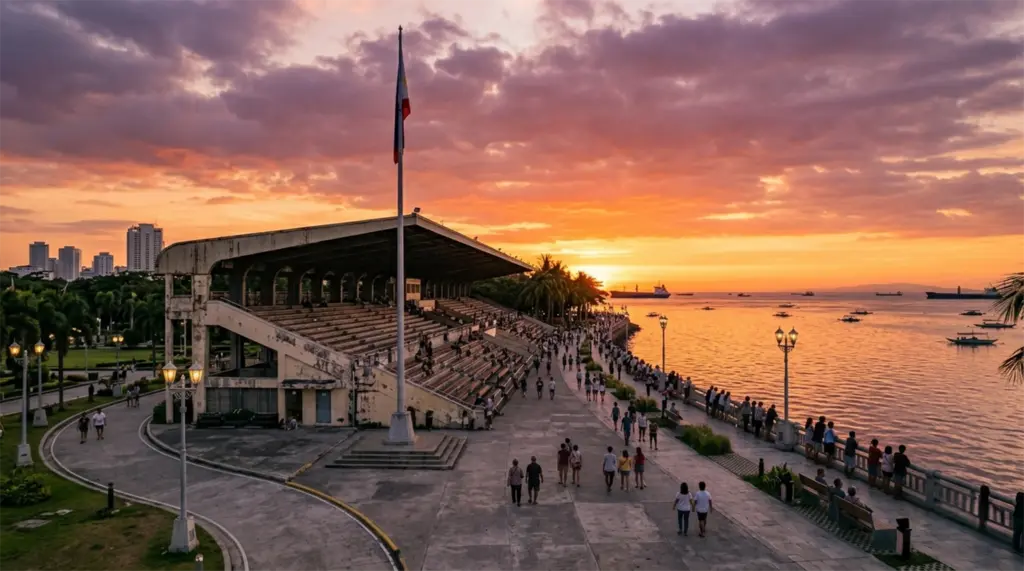
Historical markers are scattered throughout the grounds. Most are modest bronze plaques that require you to stop and read them, which most visitors do not. Doing so adds significant depth to a visit. The Quirino Grandstand at the park’s western edge, facing Manila Bay, is where Philippine presidents have been inaugurated since 1946. Pope John Paul II celebrated Mass here in 1981 before a crowd estimated at 4 million, one of the largest gatherings in the park’s history. The grandstand looks its age, but its record speaks for itself.
The History Beneath the Grass
Long before it was Rizal Park, this ground was known as Bagumbayan Field, a public space on the edge of the old city walls where the Spanish colonial authorities conducted public executions. It served as a promenade for Manila’s elite during the colonial period, which gives the site an uncomfortable duality that Filipinos have not forgotten. The beauty and the blood are on the same ground. The Americans redesigned the park during the colonial period that followed Spanish rule, expanding it toward the bay and renaming it Luneta Park, a name still used interchangeably with Rizal Park by Manila residents today. The landscaping and much of the visible layout date from that period, with subsequent additions through the mid-twentieth century.
The park suffered significant damage during the Battle of Manila in 1945, when fighting between American and Japanese forces reduced much of the surrounding city to rubble. Recovery was gradual. The park, as it exists today, reflects decades of restoration and additions that followed the war, with the monument, which survived intact, remaining the constant anchor throughout.
Rizal Park for Older Travelers — What You Need to Know
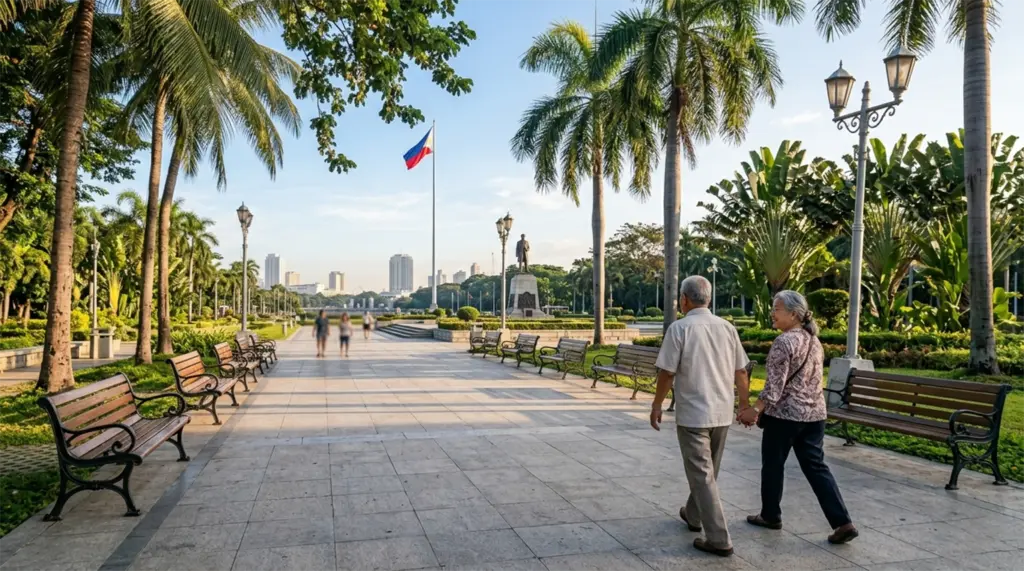
Rizal Park is one of the more accessible major sites in Manila for travelers with mobility considerations. The terrain is flat throughout. The paths between major attractions are paved. There are benches positioned across the grounds, and the park is large enough that you can pace yourself without rushing.
Shade is the variable to plan around. The open lawns near the monument and the Agrifina Circle lagoon offer limited cover, and Manila’s tropical sun is direct even during the dry season. A hat and water are not optional. If the heat becomes a factor, the Orchidarium and the two garden areas provide genuine relief without requiring you to leave the park. The best hours to visit are early morning before 9:00 a.m. or late afternoon after 4:00 p.m. Midday is survivable but is not recommended if you have a choice. The dry season (December through February) offers the most comfortable temperatures. The rainy season brings humidity and occasional afternoon downpours; the park’s open spaces drain well enough, but the sun provides no cover when the sky opens up.
Getting Around
Electric tourist carts operate within the park and are available for hire near the main entrances. For travelers who want to see the full 58 hectares without walking the entire distance, they are a reasonable option. The monument, the gardens, the lagoon, and the grandstand are all accessible by cart. Negotiate the price and route before you board.
Staying at or near The Manila Hotel puts you within a ten-minute walk of the park’s main entrance via Roxas Boulevard. The hotel itself looks directly onto the park from its lower floors. If your schedule allows, the view from the hotel toward the monument in the early morning, before the city fully wakes up, is worth setting an alarm for.
Making Sense of the Manila Series
Rizal Park sits at the geographic and historical center of everything this series covers. To the west, Manila Bay stretches toward the South China Sea, the subject of the series’ second article, and the source of the sunsets visible from the park’s Quirino Grandstand on any clear evening. To the north, a ten-minute walk or short ride through the streets brings you to Intramuros, where four centuries of colonial history are embedded in cobblestones and walls. The series covers Intramuros in detail; the two districts make more sense together than either does alone.
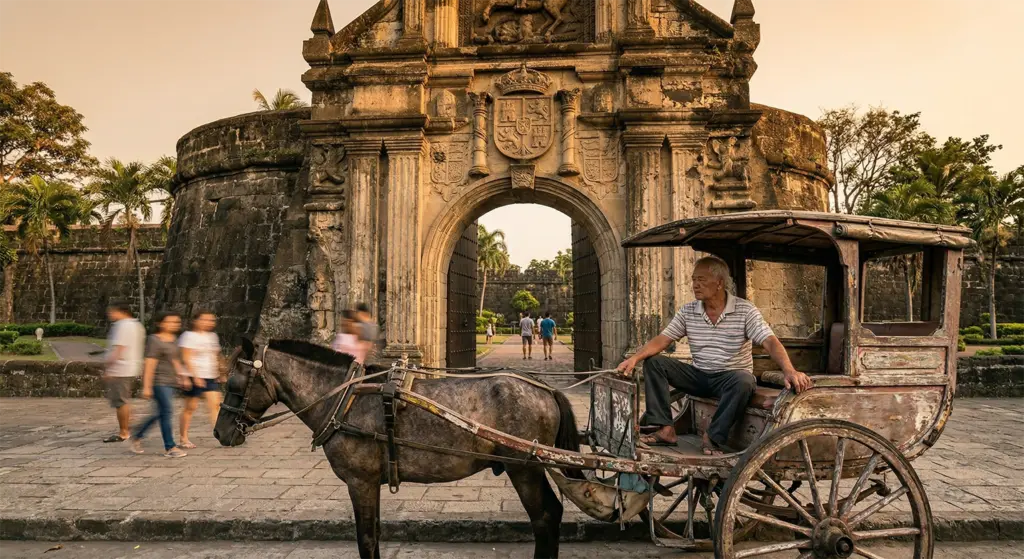
Within Intramuros, San Agustín Church, the oldest stone church in the Philippines, is the subject of another Article. Fort Santiago, where Rizal spent his final days before the execution carried out here in this park, is the subject of still another Article. The geography is tight. The history moves between these sites. A traveler who visits all of them in sequence, the bay, Intramuros, the park, San Agustín, the fort, gets something that no single visit can provide: a coherent picture of how Manila became what it is.
Rizal’s path ended here. The story of the city he helped change continues in every direction from this park. It is a reasonable place to start, or to end, or to return to when everything else begins to feel like too much. Mang Ernesto will be at his cart near the monument. The guards will change every hour. The flag will fly.
Frequently Asked Questions About Rizal Park
Q1: How long does a visit to Rizal Park take?
Most visitors spend one to three hours at the park. If you limit yourself to the monument, the sunken garden, and a walk along the main promenade, an hour is enough. If you include the Chinese and Japanese gardens, the Orchidarium, the Quirino Grandstand, and a full circuit of the Agrifina Circle lagoon, plan for a half-day. The park rewards slower exploration rather than a quick pass-through.
Q2: When does the changing of the guards take place?
The changing of the guards ceremony at the Rizal Monument takes place throughout the day, every hour on the hour. The ceremony runs approximately ten minutes. Arriving five minutes early to find a position with a clear view of the monument’s front face is advisable, particularly on weekends and holidays when visitor numbers are higher.
Q3: Is there an entrance fee for Rizal Park?
The park itself is free and open to the public. The Orchidarium and Butterfly Pavilion charge a small admission fee. The gardens are accessible without charge. Electric tourist cart rides are available for hire at negotiated rates near the main entrances.
Q4: Is Rizal Park suitable for travelers with mobility limitations?
Yes. The park is flat throughout, and the main paths between major attractions are paved. Electric carts are available for hire if walking the full grounds is not practical. The monument, the sunken garden, and the adjacent promenade are all accessible without significant mobility demands. The cobblestone-like surfaces in parts of the garden areas are the main exception — worth noting if walking on uneven surfaces is a concern.
Q5: What is the best time of year to visit Rizal Park?
December through February offers the most comfortable conditions: lower temperatures, lower humidity, and reliable skies. This is also when the park hosts its most significant ceremonies, including Rizal Day on December 30. The rainy season (June through October) brings afternoon downpours and high humidity; the park itself handles the rain well, but the open grounds offer little shelter when the weather turns. Plan morning visits during the wet season to avoid the afternoon storms.
SUGGESTIONS FOR LODGING AND TRAVEL
Lodging is widely available throughout the Philippines. However, you may want to get some assistance booking tours to some of the Philippines’ attractions. I’ve provided a few local agencies that we’ve found to be very good for setting up tours. For transparency: We may earn a commission when you click on certain links in this article, but this doesn’t influence our editorial standards. We only recommend services that we genuinely believe will enhance your travel experiences. This will not cost you anything, and I can continue to support this site through these links.
- For Hotel Accommodations in the Manila area, I highly recommend The Manila Hotel. It is centrally located and within walking distance of Rizal Park and Intramuros. Many other attractions are easily accessible from there as well. I have provided a search box below for you to find hotels (click on “Stays” at the top) or flights (click on “Flights” at the top). This tool will provide me with an affiliate commission (at no cost to you).
Local Lodging Assistance
- Guide to the Philippines: This site specializes in tours throughout the Philippines. They seem to have some flexibility in scheduling, and pricing is very competitive.
- Kapwa Travel is a travel company focused on the Philippines. It specializes in customizing trips to meet customers’ needs.
- Tourismo Filipino is a well-established company that has operated for over 40 years. It focuses on tailoring tours to meet customers’ needs.
- Tropical Experience Travel Services – Tours of the Philippines: This company offers a range of tour packages, allowing you to tailor your trip to your preferences.
Lastly, we recommend booking international travel flights through established organizations rather than a local travel agent in the Philippines. I recommend Expedia.com (see the box below), the site I use to book my international travel. I have provided a search box below for you to use to search for flights (click on “Flights” at the top) or Hotels (click on “Stays” at the top). This tool will provide me with an affiliate commission (at no cost to you).