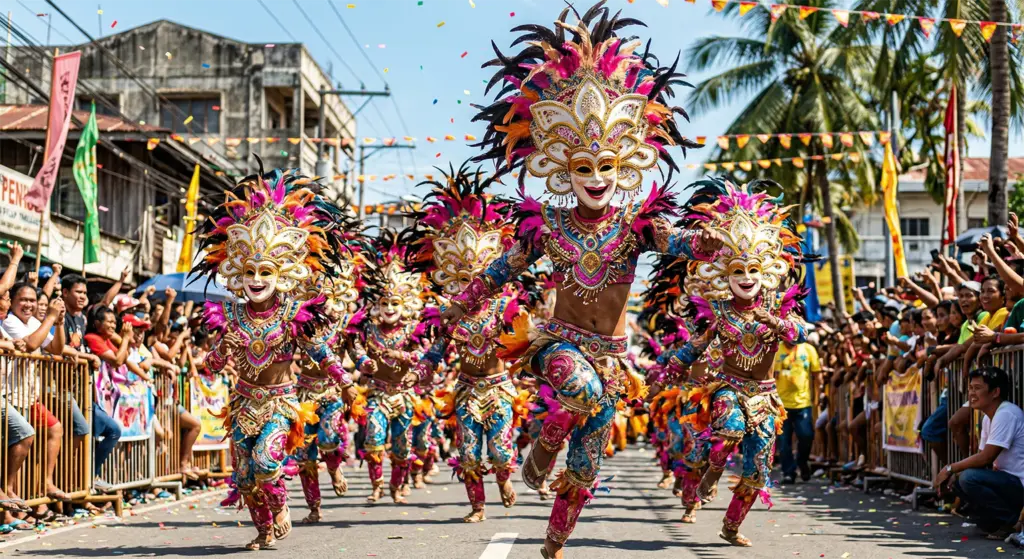
I watched the MassKara Festival street dancers for the first time and understood. I learned something about Negros Island that the history books had been circling around. The dancers were not performing happiness. They were insisting on it. The masks, hundreds of them, painted gold and white with fixed smiles, were not decoration. They were an argument. The people who had been through what Negrenses went through in the early 1980s have something to teach us. After the global sugar market collapsed, a humanitarian crisis followed, making international news. The people here found something to smile about. They were still able to fill the streets of Bacolod with color, music, and genuine-quality choreography. The smiles were not fake. They were earned.
Culture is always the product of history. On Negros Island, that history is unusually specific. Look back at an indigenous people and a Spanish colonial apparatus. Add to that a sugar economy that remade the entire social structure of the western province. Then add an American chapter that introduces English, democratic institutions, and Silliman University. Each of those layers left something in the culture that did not disappear when the next layer arrived. The festivals, the food, the language situation, the architecture, and the literary tradition. These all make Dumaguete different from every other city in the Visayas. And they are all traceable to specific historical moments. Knowing those moments makes the culture more legible.
My Personal Experience
I have family and a home in Mabinay. As a result, I have experienced the culture of the eastern province first-hand. It is something I have been part of from within a family rather than as a visitor passing through. That is a different kind of knowing. What follows is my attempt to write about Negrense culture. I will try to express that intimacy and the historian’s instinct for why things are the way they are.
Two Languages, Two Provinces — And Why It Matters
The most immediate cultural fact about Negros Island is something most travel articles skip: the two provinces speak different languages. In Negros Occidental, the dominant language is Hiligaynon, also called Ilonggo, the language of Panay Island and Western Visayas. The haciendero families who drove the sugar economy of Negros Occidental came largely from Panay. This occurred when the cane fields opened in the mid-19th century, and they brought their language with them. Hiligaynon is the language of Bacolod, of the hacienda towns, of the sugar country. It is melodic, relatively soft, and distinct enough from the other major Visayan languages that speakers of one cannot easily understand the other.
In Negros Oriental, the dominant language is Cebuano, also called Bisaya. This connects the eastern province culturally and linguistically to Cebu Island, Bohol, and the Eastern Visayas. Dumaguete speaks Cebuano. Mabinay speaks Cebuano. The two provinces share an island and a mountain spine, but their languages are significantly different. A Bacolod resident and a Dumaguete resident speaking to each other in their respective regional languages will not understand one another. Filipino serves as the bridge, as it does across the Philippines. Couple that with English, which is widely spoken in both provinces and strongly present in Dumaguete’s university community. Then, you have a means to communicate more effectively.
The Impact
The language divide maps onto the cultural divide in ways that go deeper than simple geography. The Hiligaynon culture of Negros Occidental carries the weight of the sugar economy and the included social stratification. This includes the hacienda architecture and the festivals that originated, in part, as expressions of collective identity. This was necessary in a society that knew severe inequality. The Cebuano culture of Negros Oriental has its own social history. It was shaped by a more diverse economy. Then, factor in a stronger educational tradition and the specific character of Dumaguete as a university town. These are not just language differences. These are different ways of being Filipino.
The Festival Calendar — What Negros Celebrates and Why
Negros Island has more major festivals than most Philippine islands of its size. Understanding what they are celebrating, not just what they look like, is the key. Taking this approach, you will get something real out of attending them.
MassKara Festival — Bacolod, October
The MassKara Festival was created in 1980. The timing is not incidental. That year, two catastrophes hit Negros Occidental simultaneously. First, the global sugar price collapsed, gutting the economy on which the entire province depended. Second, a passenger vessel, the MV Don Juan, sank in waters near the island with catastrophic loss of life. The leaders of Bacolod City made a deliberate choice: rather than cancel the harvest festival, they would transform it. They turned it into something that asserted, against the facts of the moment, that the city would not be defined by its losses. The mask, plural smiling faces, hence “Mass Kara” (meaning ‘many faces’), was the central image.
What followed has grown into one of the most spectacular street festivals in the Philippines. The October celebration fills Bacolod’s streets with contingents of dancers, each group representing a municipality or organization. They perform intricately choreographed routines in matching costumes behind gold-and-white masks. The masks themselves are a craft tradition, made from papier-mâché and decorated by artisans. They work on them for months. Some of the more elaborate festival entries feature masks with moving parts and embedded LED lighting, making the night parades extraordinary. The competitive elements are judged on choreography, costumes, and overall presentation, ensuring that quality continues to improve.
The festival is held during the third week of October, coinciding with the traditional sugar harvest season. Bacolod fills up. Hotel rooms are booked months in advance. If attending MassKara is a priority, plan accordingly. The street dancing competition and the grand parade are the main events. The night parades with the illuminated masks are what people remember longest.
Buglasan Festival — Dumaguete, October
Negros Oriental holds its own major celebration in the same month. The Buglasan Festival, held in Dumaguete during the third week of October, takes its name from Buglas, the ancient name for Negros Island. Buglas, which means “cut off” in the old Visayan languages, is a reference to the island’s geographic isolation from the Panay mainland. The festival is also known as the Festival of Festivals. It is recognized this way because it gathers contingents from all the municipalities of Negros Oriental. The intent is to showcase their local celebrations, traditions, and products under one umbrella.
Buglasan is less internationally known than MassKara, which makes it, in some ways, a better experience. The crowds are more manageable, and the atmosphere is more communal. The range of what is on display, street dancing, traditional crafts, local food, cultural performances, and indigenous community participation, is genuinely broad. This is the best way for travelers who want to experience Negros Oriental’s cultural diversity in a few days. Buglasan brings it all together in one place and is therefore the most efficient and enjoyable way to do so.
Pintaflores Festival — San Carlos City, November
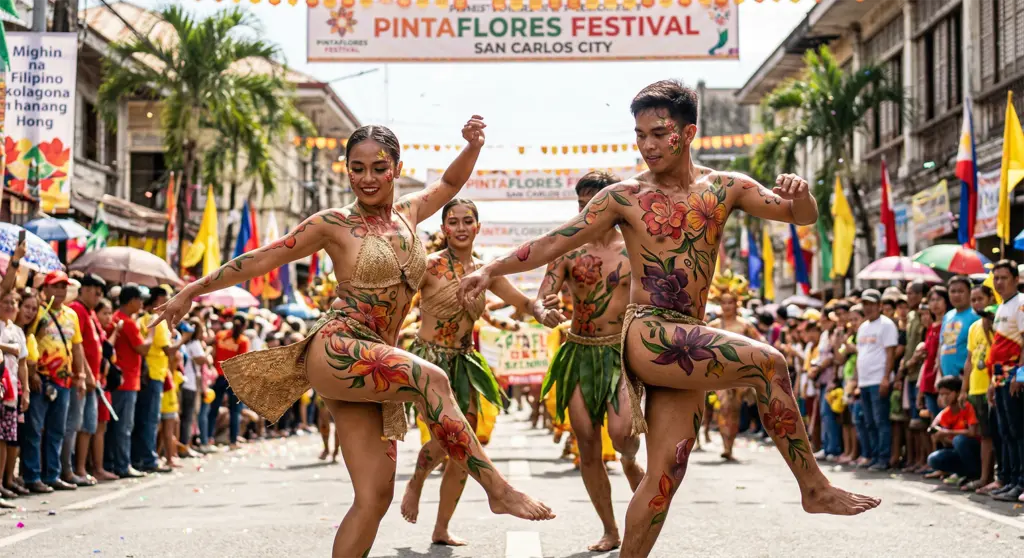
San Carlos City, in the northern part of Negros Occidental, holds the Pintaflores Festival every November. It’s a celebration unlike anything else in the Visayas. Participants paint their bodies with elaborate floral designs. This is inspired by both the city’s flower-growing tradition and the pre-colonial practice of ritual tattooing. The local legend of Princess Nabingka, a figure whose story centers on flowers, beauty, and sacrifice, provides the narrative. This is the thread connecting the floral body art to the island’s indigenous past.
The dancers perform in the streets wearing little clothing and elaborate full-body paintings that take hours to apply. The visual effect is genuinely striking and unlike anything a visitor might expect from a provincial Philippine festival. Pintaflores is smaller than MassKara and less visited, and that intimacy is part of what makes it worth attending. San Carlos City is accessible from Bacolod and can be combined with visits to the northern Negros Occidental coast.
Panaad sa Negros Festival — Bacolod, April
The Panaad sa Negros Festival is held at Panaad Park and Stadium in Bacolod. It is a provincial trade fair and a cultural showcase, held every April. All the cities and municipalities of Negros Occidental participate. Each sets up a pavilion to showcase their local products, food specialties, and cultural traditions. The event runs for about a week and draws large crowds from across the province. It is less visually spectacular than MassKara but more practically informative. It is the best place to sample the full range of Negrense food products, from muscovado sugar confections to native wines to fresh seafood, in a single location. For a traveler interested in what the province actually produces rather than what it celebrates, Panaad is the better event.
The Food of Negros Island — What the Sugar Economy Left Behind
The food of Negros Island is one of the most distinctive regional cuisines in the Philippines. It is shaped by the same historical forces that produced the festivals. These forces include indigenous ingredients, Spanish techniques, Chinese trade influence, and the overwhelming presence of the sugar economy. The western province, the sugar province, has a culinary identity built around sweetness and richness. It capitalizes on the creative application of muscovado sugar to everything from savory marinades to elaborate desserts. Negros Oriental’s food is leaner, more influenced by the sea and the upland farming traditions. It is built around Cebuano flavor preferences that favor the sour and the briny alongside the sweet.
Chicken Inasal
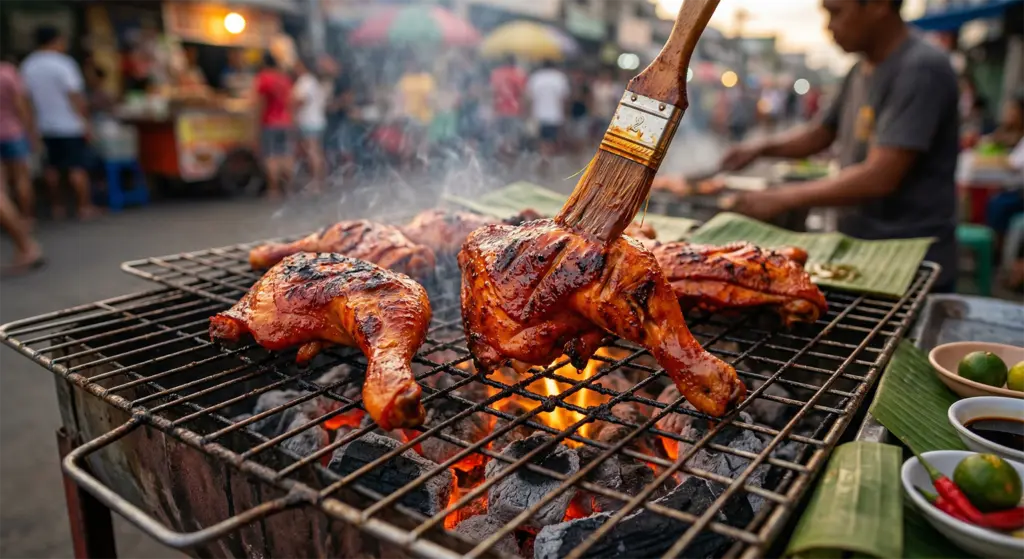
Chicken Inasal is Bacolod’s most famous contribution to Philippine cuisine and the dish most likely to be the first thing anyone mentions when you say you are going to Negros Occidental. The preparation is straightforward and specific: chicken marinated in calamansi juice, coconut vinegar, black pepper, and annatto seeds, then grilled over charcoal and basted during cooking with a mixture of annatto-colored butter that gives the skin a deep red-orange color and a flavor that no commercial version has ever replicated. The chicken is served with garlic rice and a dipping sauce of vinegar, soy, and calamansi, and the appropriate way to eat it is with your hands. The nationwide chain Mang Inasal takes its concept from Bacolod. The original, in the city that invented it, is something different.
Kansi
Kansi is Negros Occidental’s version of a slow-cooked beef soup, think bulalo (bone marrow soup) crossed with sinigang (sour soup), but made specifically sour with batwan fruit, a souring agent native to the Visayas that gives the broth a tartness distinct from tamarind. The beef shank is cooked until the marrow loosens and the meat falls from the bone. A proper Kansi is a meal that takes the better part of a day to prepare and about twenty minutes to eat. It is the kind of food that defines a province’s culinary identity, and Bacolod does it well.
KBL — Kadios, Baboy, Langka
KBL, or Kadios, Baboy, and Langka, is a stew that captures the Ilonggo approach to flavor in three ingredients: kadios (pigeon peas), pork, and unripe jackfruit, sourced again with batwan. The combination of textures, the dense peas, the rich pork, the firm jackfruit, and the specific sour-savory flavor profile is distinctly Negros Occidental, and it is the dish that longtime residents tend to miss most when they leave the island. Less well known internationally than Inasal, but more representative of everyday Negrense cooking.
Piyaya and the Muscovado Tradition
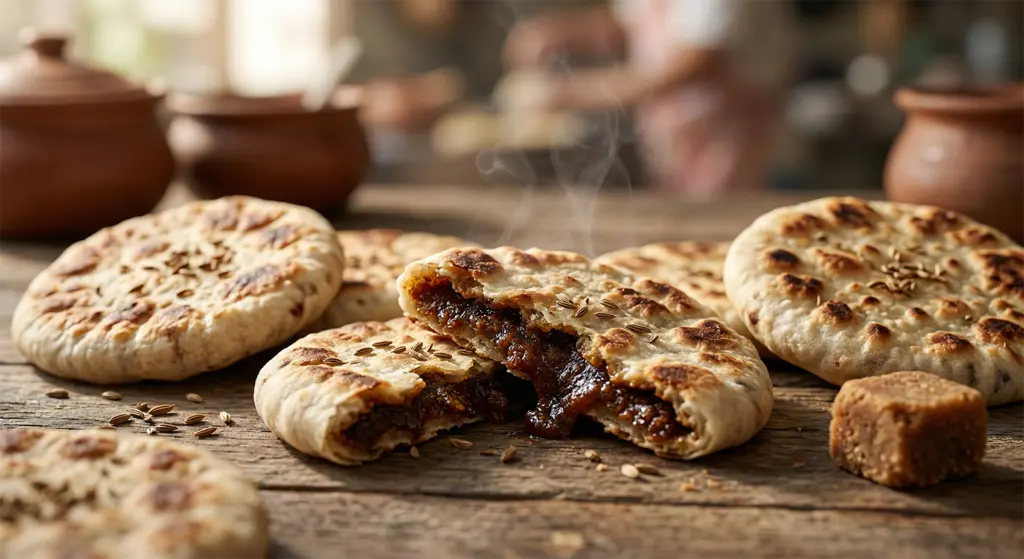
Piyaya, sometimes spelled piaya, is the edible symbol of Negros Occidental’s relationship with sugar. A flat, round pastry filled with dark muscovado sugar syrup infused with anise, grilled until the outside is slightly crispy and the filling has caramelized into a dense, almost savory sweetness, it sounds simple because it is simple, and it is very good. Muscovado sugar, raw, unrefined, with a robust molasses character that refined white sugar has deliberately had extracted from it, is made in Negros Occidental and is one of the province’s genuine agricultural products. Buying it in the source province is the right move. The piyaya made with authentic Negros muscovado does not taste like the versions available in Manila, and the muscovado itself belongs in your luggage if you can get it home.
Batchoy, a noodle soup with pork organs, crispy cracklings, and beef loin in a rich pork broth, actually originates from La Paz in Iloilo City across the Visayan Sea, but it is deeply embedded in the food culture of both Negros provinces and appears on virtually every menu across the island. Kinilaw, raw fish or shellfish marinated in vinegar and calamansi until the acid “cooks” the protein, with ginger, onion, and chili, is the coastal snack that both provinces claim with equal enthusiasm. In Negros Oriental, the kinilaw uses whatever the fishing boats brought in that morning, and the freshness level makes all the difference.
Arts, Crafts, and the Artisans Who Make Them
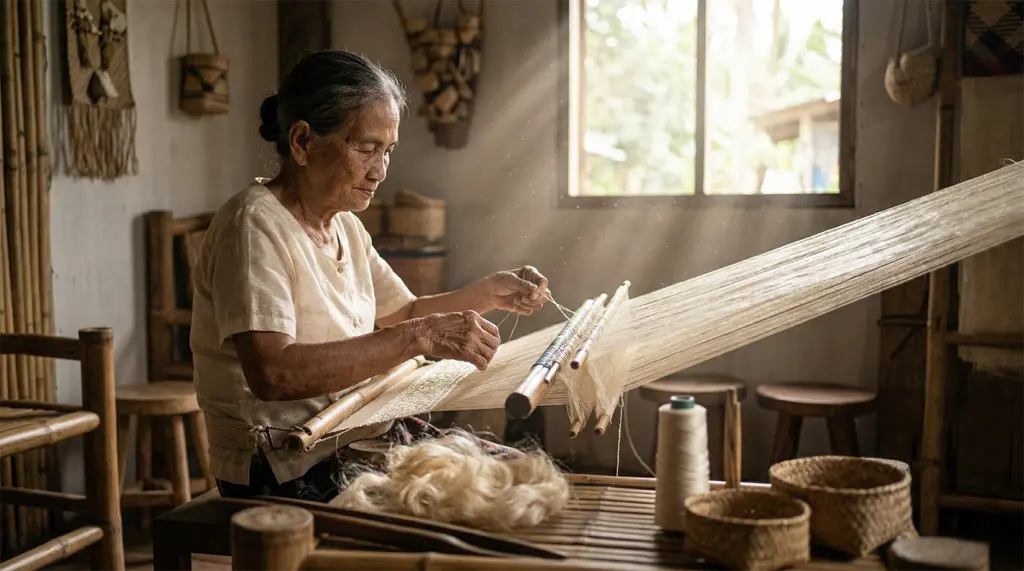
The craft tradition of Negros Island is both functional and specifically local. The materials are native: pineapple fiber (piña), abaca, bamboo, rattan, local clay, and shells from the surrounding sea. The products range from the formal, the barong Tagalog, made from piña or jusi (pineapple silk), a national dress fabric that Negros artisans have produced for generations, to the everyday, functional.
Textiles
The weaving tradition in Negros Island centers on abaca and piña fiber. Piña cloth, woven from the fibers of pineapple leaves, labor-intensive to produce and translucent with a natural sheen, is the prestige fabric of Philippine formal wear. A hand-woven piña barong Tagalog, the formal shirt worn by Filipino men at state occasions and weddings, can take weeks to produce. The weavers who make it are skilled in a craft that is genuinely difficult to automate and requires knowledge passed down across generations. Abaca, the hemp fiber extracted from the stalks of a plant in the banana family, is woven into a rougher, more durable fabric used for bags, mats, and accessories that are both practical and distinctly Filipino in appearance.
Pottery
Pottery communities in Bago City and Sagay, in Negros Occidental, have maintained a tradition of functional earthenware that connects to pre-colonial ceramics traditions while adapting to contemporary forms and markets. The clay pots, jars, and decorative pieces produced in these communities have the character of things made by hand and made to be used, not the tourist-optimized smoothness of mass-produced crafts. The natural earth colors and the weight of the clay in your hands are their own argument for authenticity.
The Negros Museum — Bacolod
The Negros Museum in Bacolod City is the best single institution for understanding the island’s cultural arc. The collection covers pre-colonial artifacts through the Spanish colonial period, the social history of the sugar economy, the Cantonal Republic, the American period, and contemporary Negrense art. The historical artifacts and the contemporary paintings share space in a way that makes the connections between past and present visible rather than implied. It is a well-curated institution that punches above the weight of a provincial museum, and it is the right starting point for anyone who wants context before exploring the island.
Architecture and the Houses That Sugar Built
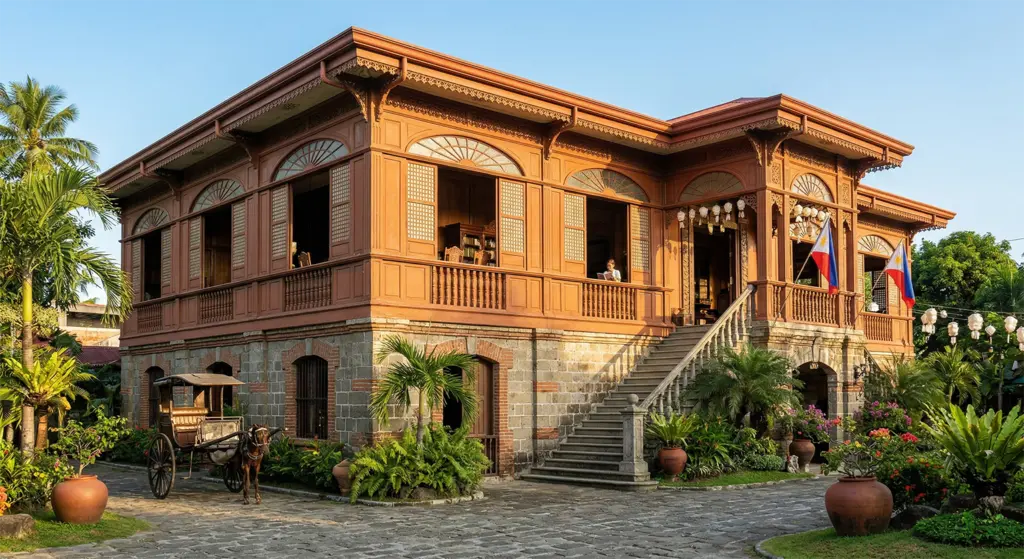
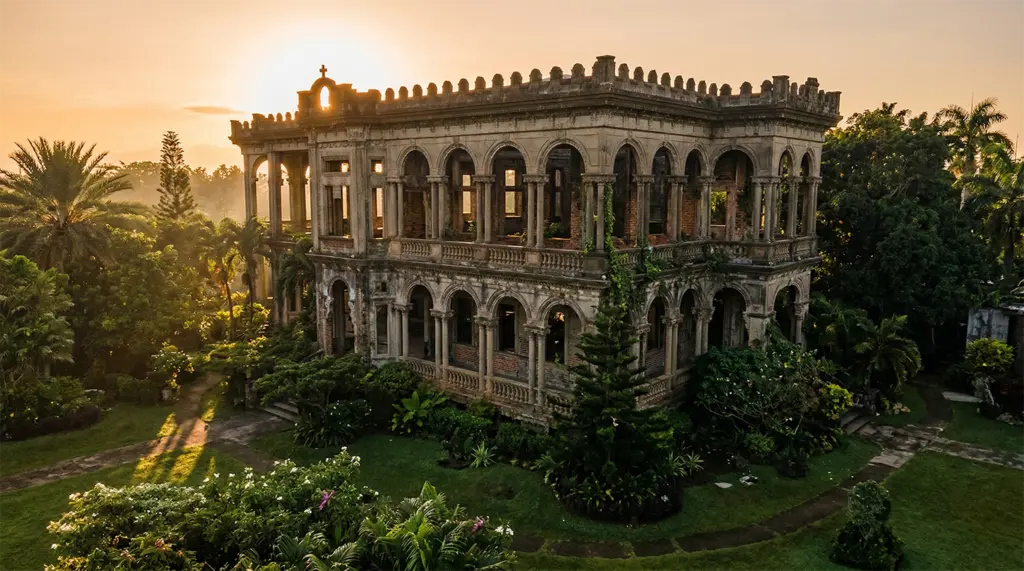
Negros Occidental has a concentration of colonial-era ancestral homes, bahay na bato, literally “stone houses,” that reflects the wealth generated by the sugar economy in the late 19th and early 20th centuries. These houses follow a distinct Filipino-Spanish hybrid architecture: stone or brick on the ground floor (for flood protection and storage), hardwood on the upper floor (for living), with wide capiz-shell windows that allow light and air circulation in the tropical heat. The scale of some of the haciendero homes, multiple rooms, high ceilings, formal staircases, and imported European furniture, documents how much money moved through the sugar economy in its peak decades.
Several of these homes have been preserved and are open to visitors, particularly in Silay City, which has the highest concentration of heritage houses in Negros Occidental and has been designated as a heritage city by the National Historical Commission. Silay is less than 30 minutes from Bacolod and is worth a half day for anyone interested in Philippine colonial architecture and social history. The houses themselves tell the story of who profited from the sugar economy and what they did with the money.
Dumaguete and the Literary Tradition of Negros Oriental
Negros Oriental’s cultural identity is not built around sugar or festivals in the way that Negros Occidental’s is. It is built around education and literature, specifically around Silliman University and the literary community that has grown up in Dumaguete over more than a century of the university’s existence.
Silliman University, founded in 1901 by American Presbyterian missionaries, was the first American university in Asia. It established a culture of English-language education in Dumaguete that is still palpable today: the city has more bookshops per capita than almost any comparable city in the Philippines, a literary journal in print for decades, and the Silliman National Writers Workshop, one of the most prestigious creative writing programs in the country, held annually, and producing writers who have shaped Philippine literature in English and Cebuano. The writers Nick Joaquin, F. Sionil José, and many others have been associated with the Dumaguete literary community at various points.
The result is a city with a particular intellectual character. Dumaguete has the Rizal Boulevard waterfront, the Sans Rival café, the university campus in the city center, and a general atmosphere that suggests a place where people read, argue, and take ideas seriously. It is the most distinctive mid-sized city in the Visayas, and its cultural character cannot be separated from the educational institution that has been at its center for 120 years.
The Negros Island Series — What Follows This Article
Negros Island is one of those destinations that resists a single article. The island is large enough, varied enough, and historically layered enough that a traveler who reads only one piece about it before arriving will miss the larger picture, and the larger picture is worth having before the flight lands.
This article is part of a five-piece series covering Negros Island in full. The history article traces everything from the pre-colonial Ati and Bukidnon communities through the Spanish sugar economy, the 1898 Cantonal Republic of Negros, the American chapter, and the sugar crisis of the 1980s that produced the MassKara Festival, a context that makes the hacienda architecture, the festival culture, and the social character of Bacolod and Dumaguete considerably more readable on the ground. The natural wonders article covers Mt. Kanlaon and the broader volcanic landscape, the Mabinay cave systems, the waterfalls of Negros Oriental, the Twin Lakes of Balinsasayao, and the endemic species of the North Negros Natural Park.
The culture article (this article) examines the language divide between the two provinces, the full story of MassKara and Buglasan, the food traditions of both coasts, the ancestral home architecture of Silay City, and the literary culture that Silliman University has sustained in Dumaguete for more than a century. The ocean and marine life article delves into Apo Island’s community conservation story, the muck-diving coast at Dauin, and the cetacean corridors of the Taon Strait. The overview article is the practical planning piece: the two-province decision, how to get there and between them, when to visit, and which province to base yourself in, depending on what you are looking for.
The Takeaway
Read together, the five articles cover the island the way it deserves to be covered. Read individually, each one stands on its own. Either approach works, but the traveler who arrives knowing the history, ecology, culture, and marine environment will find that Negros Island gives back more than it asks.
Frequently Asked Questions About the Culture of Negros Island
Q1: When is the MassKara Festival, and how do I attend?
The MassKara Festival is held annually in Bacolod City, Negros Occidental, during the third week of October, with the main street dancing competition and grand parade on the weekend nearest October 19. Hotels in Bacolod fill up months in advance for festival week; book early. The festival is free to attend as a street event; grandstand seating for the competition requires tickets that can be purchased through the Bacolod City government tourism office. The night parades with the illuminated masks are the most visually spectacular component and are worth staying out for. The festival is family-friendly throughout, and the street atmosphere in central Bacolod during festival week is among the best crowd experiences in the Philippines.
Q2: What is the difference between Hiligaynon and Cebuano, and which do people speak in Negros?
Negros Island has a linguistic divide that mirrors its provincial divide. In Negros Occidental, the dominant language is Hiligaynon (also called Ilonggo), the language of Panay Island and Western Visayas. In Negros Oriental, the dominant language is Cebuano (also called Bisaya or Binisaya), which is the language of Cebu, Bohol, and the Eastern Visayas. The two languages are mutually unintelligible; a Bacolod resident and a Dumaguete resident cannot easily understand each other in their regional languages. Filipino and English serve as the common languages across both provinces, and English is particularly well-spoken in Dumaguete due to Silliman University’s influence.
Q3: What should I eat in Negros Occidental?
In Negros Occidental, Chicken Inasal is the non-negotiable first meal, marinated in calamansi, coconut vinegar, and annatto, grilled over charcoal, eaten with your hands. Kansi (slow-cooked beef bone soup soured with batwan fruit) is the dish serious eaters seek out. KBL (kadios, baboy, langka) is the everyday stew that locals eat, and tourists rarely order. For sweets, piyaya (muscovado-filled flatbread) is the right souvenir and snack. Buy Negros muscovado sugar if you can take it home. Attend the Panaad sa Negros Festival in April if your timing allows; it is the most efficient way to sample the full range of provincial food in one location.
Q4: What is the Silliman National Writers Workshop?
The Silliman National Writers Workshop is an annual creative writing fellowship held at Silliman University in Dumaguete, Negros Oriental. Founded in 1962, it is one of the oldest and most prestigious writing programs in the Philippines, offering fellowships to emerging writers working in Filipino, Cebuano, English, and other Philippine languages. Many of the most significant contemporary Filipino writers have participated as fellows or panelists. The workshop is held in late May or June and is open to the public for some sessions. It is the annual event that most clearly expresses Dumaguete’s identity as a literary city, and the literary culture it has sustained for more than sixty years is the most distinctive thing about Negros Oriental’s cultural landscape.
Q5: What are the ancestral houses of Silay City, and are they worth visiting?
Silay City, about 20 kilometers north of Bacolod in Negros Occidental, has the highest concentration of preserved colonial-era ancestral homes in the province, with approximately two dozen bahay na bato (stone houses) dating to the late 19th and early 20th centuries, when sugar money was at its peak. The National Historical Commission has designated Silay a heritage city. Several homes are open to the public, including the Balay Negrense Museum (a fully restored haciendero home with period furnishings and family photos that document the sugar elite’s world at the turn of the century). Silay is easily combined with a visit to Bacolod and is worth a half-day stop for anyone interested in Philippine colonial architecture and the social history of the sugar economy.
SUGGESTIONS FOR LODGING AND TRAVEL
Lodging is widely available throughout the Philippines. However, you may want to get some assistance booking tours to some of the Philippines’ attractions. I’ve provided a few local agencies that we’ve found to be very good for setting up tours. For transparency: We may earn a commission when you click on certain links in this article, but this doesn’t influence our editorial standards. We only recommend services that we genuinely believe will enhance your travel experiences. This will not cost you anything, and I can continue to support this site through these links.
- For Hotel Accommodations in the Manila area, I highly recommend The Manila Hotel. It is centrally located and within walking distance of Rizal Park and Intramuros. Many other attractions are easily accessible from there as well. I have provided a search box below for you to find hotels (click on “Stays” at the top) or flights (click on “Flights” at the top). This tool will provide me with an affiliate commission (at no cost to you).
Local Travel & Lodging Assistance
- Guide to the Philippines: This site specializes in tours throughout the Philippines. They seem to have some flexibility in scheduling, and pricing is very competitive.
- Kapwa Travel is a travel company focused on the Philippines. It specializes in customizing trips to meet customers’ needs.
- Tourismo Filipino is a well-established company that has operated for over 40 years. It focuses on tailoring tours to meet customers’ needs.
- Tropical Experience Travel Services – Tours of the Philippines: This company offers a range of tour packages, allowing you to tailor your trip to your preferences.
Specific Lodging Suggestions
- Big BamBoo Beach Resort Sipalay – This is a moderately priced resort in Sipalay, Negros Oriental, with great beach access.
- Hotel Dumaguete – A very nice hotel with good reviews and reasonably priced.
- Rovira Suites in Dumaguete – A very nice hotel with very good reviews and a very reasonable price.
- Citadines Bacolod City – A highly rated and popular hotel in the Bacolod area. A little pricier than some, but worth the cost.
- Stonehill Suites – Another highly rated hotel in the Bacolod area. This one is a little more reasonably priced.
- Circle Inn – Hotel & Suites – This hotel falls into the budget-friendly category. They, too, are well-rated and provide good, comfortable lodging.
Lastly, we recommend booking international travel flights through established organizations rather than a local travel agent in the Philippines. I recommend Expedia.com (see the box below), the site I use to book my international travel. I have provided a search box below for you to use to search for flights (click on “Flights” at the top) or Hotels (click on “Stays” at the top). This tool will provide me with an affiliate commission (at no cost to you).